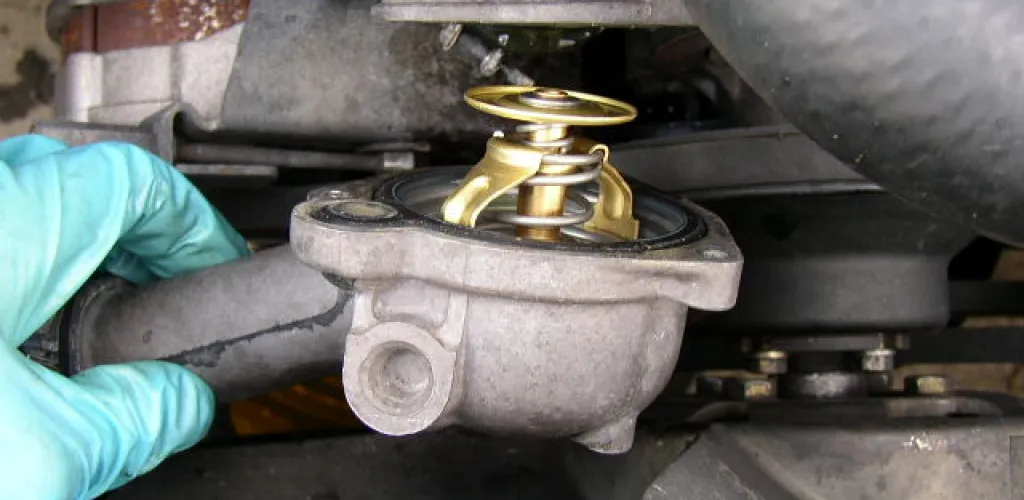

- Lokalizacja termostatu zależy od ułożenia silnika (poprzeczne/podłużne).
- Przed szukaniem termostatu silnik musi być zimny.
- Płyn chłodniczy może poparzyć skórę, uważaj.
- W autach FWD lokalizacja termostatu jest trudniejsza z powodu kompaktowej osi przedniej.
Traditionally, finding the thermostat in a car or truck was a relatively easy task. It was always there, just above the intake manifold. Now, the location of the thermostat will depend a lot on whether the engine is mounted transversely or longitudinally. A basic knowledge of how an automotive cooling system works will help find it more easily.
Before looking for the thermostat, ensure that the engine is cold. Antifreeze can burn the skin. Most people think about this before working on their cooling system. But what doesn’t immediately come to mind is that many vehicles have electric fans.
Sometimes these fans can turn on even when the engine is off. The last thing you want is to lose a finger while looking for the thermostat. If you feel the need to search with a warm engine, go ahead and unplug the battery cable, so the fan won’t touch any of your fingers.
The best way to discover where the thermostat is located
Once the water passes through the engine, it circulates through the radiator. Then, the antifreeze comes through a large hose back to the engine. It is at this point that the thermostat intervenes.
This hose can be seen with the naked eye quite easily. In some cases, especially on front-wheel-drive cars, it is more difficult to find because everything is more compacted on the front axle, with this axle also being the engine in this case.
It is also noteworthy that there is probably a video on YouTube clearly showing where the thermostat is for your exact car. You probably won’t find it by typing “where is the thermostat on a 2004 Dacia Logan.” But if you type “Dacia Logan thermostat replacement,” you’ll more than likely find what you need.
Symptoms of a faulty thermostat?
There are two main symptoms of a faulty thermostat. If the following scenarios do not quite match what is happening with your vehicle, you may need to look deeper at the water pump or a faulty radiator.
1. The car overheats
Although vehicle overheating can be caused by a thermostat that does not open, it can also be caused by a few other things, it would be wise to check first if it is the thermostat’s fault or not. Here are some other things that could cause engine overheating.
Air bubbles in the cooling system - have you recently changed the antifreeze? The presence of air in the cooling system will clearly increase the risk of overheating.
Defective or inadequate water pump - a good way to know that the pump is faulty is to squeeze the main radiator hose with the engine running (be careful) and see if there is pressure. If you can easily compress the hose, then it is sufficient proof that the water pump is not creating pressure.
There is no antifreeze in the system - lack of antifreeze can lead to overheating and worse, engine blockage. The radiator will have to work with a smaller amount of antifreeze, which will heat up much more quickly and will struggle to keep the fluid cooled at all times.
2. The car does not reach optimal temperatures
Unlike automotive overheating, which can be caused by several issues, when the engine does not reach the optimal operating temperature, you can be almost certain that there is a problem with the thermostat. Often, people do not notice it until the first day of very low temperatures. They want to turn on the heater in the car but the water is at 50-60 degrees.
When the vehicle overheats, the thermostat does not open (if the overheating problem is caused by the thermostat). When it opens, it allows cooler water to enter the engine and cool the engine block and absorb the heat generated by the combustion process.
Źródło: dieselgiant.com, actiongatortire.com.