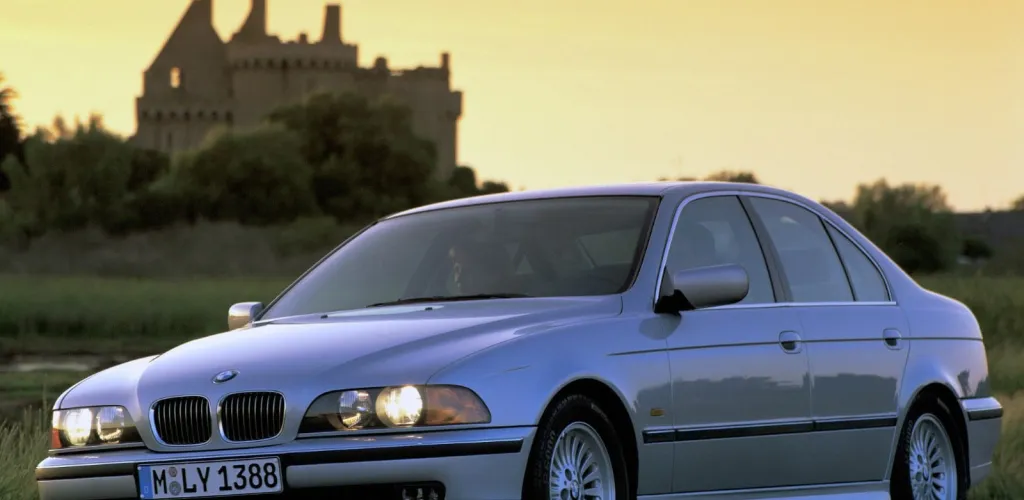
- E39 (1995–2004) is the 4th-gen 5 Series, sedan first, Touring in 1996, no AWD.
- It introduced aluminum suspension, a four-cylinder diesel, and an M5 with a V8.
- Common issues include cooling system parts, diesel fuel system, ZF transmission, suspension, and sensors.
- Gasoline: M52/M62 with VANOS, M54 later; Diesel: M51/M57, plus M47 520d.
The BMW E39 represents the fourth generation of the prestigious 5 Series, produced between 1995 and 2004, and is regarded by many enthusiasts as one of the most successful iterations of the Bavarian model. Initially launched as a sedan, the range expanded in 1996 with the wagon version, marketed as Touring.
This generation introduced several key milestones for the 5 Series: it was the first to use aluminum for all major front and rear suspension components, the first to offer a four-cylinder diesel engine, and the first to host an M5 powered by a V8. Unlike its predecessor the E34 and its successor the E60, the E39 was not offered with all‑wheel drive.
What owners say about choosing the BMW E39
To better understand why enthusiasts choose this model, we gathered real testimonies from owners.
Manolache Cosmin explains his choice for the 520d: “In the first place, the E39 seems to me the most beautiful model produced by BMW (the E60 would be the most beautiful in my opinion) and secondly it has many options; it is still a sedan.”
Totorean Alin adds: “The BMW 5 Series, i.e., the BMW E39, impressed me from the moment it appeared in 1996; I dreamed of one. I consider it a reliable car and, in my view, it’s the perfect blend between a sporty car and an elegant one.”
For the 525i version, Nitoiu Valentin notes: “It combines sporting credentials with a weekend/family car. A BMW enthusiast. In the past I owned a BMW E36 325i, E34 535i.”
Common BMW E39 problems - what to watch for
Although the E39 is recognized as a reliable platform, there are some typical weak points for this generation. The most frequent issues reported in owner reviews include:
Cooling system
- Water pump — a vulnerable component that requires regular attention
- Thermostat and radiators can develop failures over time
Diesel fuel system
- Turbocharger — especially on high‑mileage versions
- Injectors — issues specific to the diesel engine
- High‑pressure pump on diesel engines
Transmission
- ZF transmission — especially problems with gear selection
- Clutch on manual models
Other common issues
- Suspension components (control arms, tie rods)
- Cooling fan
- Pressure and temperature sensors
- Aging headlights due to mileage
Complete range of engines available
The E39 benefited from an extended range of engines throughout its lifecycle, evolving to meet market demands.
Gasoline engines
At launch, the lineup included BMW M52 inline‑six engines and BMW M62 V8. In 1998, these received VANOS (M52) and double VANOS (M62) to optimize low‑end torque. The 2000 facelift brought the M54 engine to replace the M52, while the M62 remained for the V8 versions.
Diesel engines
Initially, the diesel range was led by the turbo M51 six‑cylinder. In 1998, the successor M57 was introduced in the 530d, while the M51 continued powering the 525td and 525tds until 2000. A notable development arrived in 1999 with the 4‑cylinder turbo‑diesel M47 for the 520d.
Main engines and characteristics
Gasoline:
- 520i (M54B22, 6 cylinders): 168 hp, 210 Nm
- 528i (M52TUB28, 6 cylinders): 190 hp, 280 Nm
- 540i (M62TUB44, V8): 282 hp, 440 Nm
- M5 (S62B50, V8): 394 hp, 500 Nm
Diesel:
- 520d (M47D20, 4 cylinders): 134 hp, 280 Nm
- 525d (M57D25, 6 cylinders): 161 hp, 350 Nm
- 530d (M57D30, 6 cylinders): 190 hp, 410 Nm
The M54B30 engine used in the 530i was listed among the best engines in 2002 and 2003, underscoring BMW’s engineering excellence.
Driving experience and real-world fuel consumption
The BMW E39 was often hailed as the best car in the world at launch, a title reflected in current values. Its near‑perfect 50/50 weight distribution and superior engineering made the E39 a pleasure to drive.
Owner feedback on driving
Cardos Raul (Touring) shares: “In the city it feels a bit heavy at first since it’s a touring, but once you get used to it, it’s easy to drive. On long trips it drives excellently, settles well on the road, and is comfortable.”
Picleanu Alin emphasizes: “In the city you don’t feel its size; even in crowded areas it handles well. On long trips you feel comfort, safety, and it never lets you down.”
Neagu Mihai details: “In the city it’s quite easy to drive, it helps with overtakes; on long trips it drives very well, has torque, sticks to the road, you sit low at the wheel, you feel the car as a whole, you always know where the wheels are and I was impressed by how stable it is.”
Real fuel consumption
For the 520d (136 hp):
- Totorean Alin: “City driving in winter around 9.5 L/100 km, summer around 8 L/100 km; on the highway it can be 6.4 L/100 km; mixed about 7.3 L/100 km.”
- Cardos Raul: “Depends how you drive it; 6 L/100 km on the highway, 7–8–9 L/100 km in the city. But I also got 5.3 L/100 km on the highway and an average of 6.5 in the city.”
- Manolache Cosmin: “In the city 10–11 L/100 km, on the highway the lowest I’ve seen is 6.5 L/100 km (5 people + luggage).”
For the 535i (235 hp) automatic:
- Alexe Daniel: “15 L/100 km in the city, 12–13 L/100 km on the highway.”
For the 525i (192 hp):
- Nitoiu Valentin: “16–18 L/100 km in Bucharest, 10 L/100 km outside the city.”
E39 reliability — real owner testimonials
The E39 maintains its reputation as a reliable car even after two decades, a common sight on Romanian roads.
Owner experiences with reliability
Totorean Alin (425,000 km): “In my opinion, it is very reliable if it’s well maintained and not mistreated. If you perform the maintenance and repairs on time there are no major problems; at 425,000 km it doesn’t draw a drop of oil between changes, which says a lot about reliability.”
Cardos Raul details the costs over 8 months: “I’ve replaced basically what tends to wear: filters, oils, vacuum hose and fuel return hose, the clutch (bearing, disc, pressure plate), brake pads, turbo pressure sensor, control arms, bushings, tie rods.”
Ilie Emilian highlights: “Considering the number of owners and its age, it’s reliable. A major problem would be the gearbox, originally ZF, with shifting problems — but that is a common issue.”
Manolache Cosmin reports briefly: “Only one problem so far: factory Xenon and the headlamp level sensor failed. Other than that I haven’t had issues.”
Prices on the used market
The used market for the BMW E39 remains active, with price variation depending on condition, mileage, and engine:
- BMW 530d (2000, 500,000 km): approximately €3,450
- BMW 520d (2002, 230,000 km): approximately €3,150
Prices reflect the continued appreciation for this generation, especially for well‑maintained examples.
Buying tips
Advice from experienced owners
Totorean Alin suggests: “Look for one that has been cared for, not one where the owner says they haven’t spent a penny. Considering its age, check the exterior for rust. After that, the fuel injection pump is a known issue; cold/hot starts, the turbo, and the overall condition are important.”
Adam Andrei simply recommends: “Just buy the car and you will be more than satisfied with it. It’s a car for life. You must pay attention to the steering and the front electric cooling fan.”
Cardos Raul warns: “Don’t buy one with a 2.0L engine; you’ll regret it. Being an older car, be mindful of rust, then the engine condition. Other parts can be replaced if worn.”
Key checks to perform:
- Complete maintenance history
- Bodywork condition and presence of rust
- Functioning diesel injection system
- Condition of suspension and steering components
- Functioning cooling system
- Test the gearbox across all gears
- Check the electrical system and sensors
The E39 remains an excellent choice for enthusiasts seeking a perfect balance of performance, comfort, and reliability, provided there is proper maintenance and careful selection at purchase.