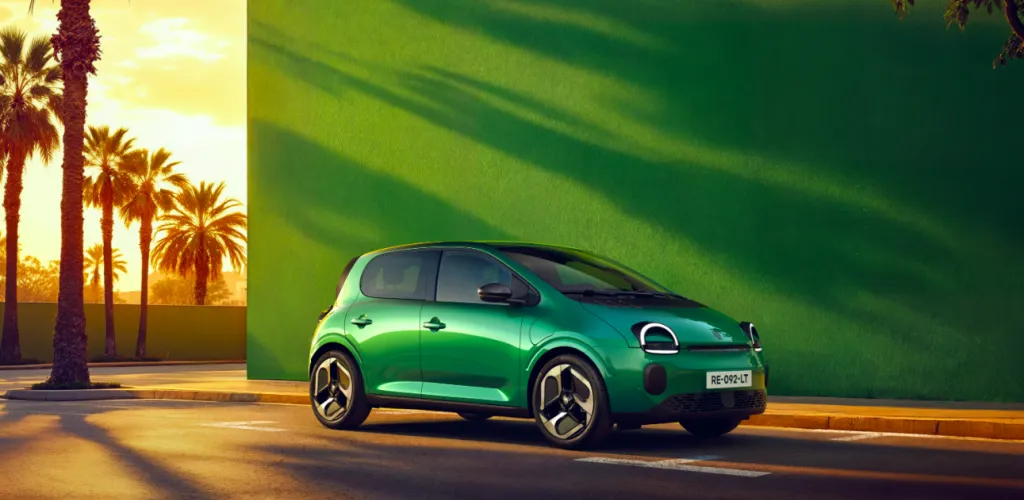

- Renault revives Twingo as a 100% electric, affordable A-segment city car
- Five-door design with two sliding rear seats and foldable front passenger
- OpenR Link with Google delivers multimedia and driving aids
- LFP battery up to 263 km WLTP; 60 kW motor; price below €20k
At its launch in 1992, Renault Twingo revolutionized the A segment by bringing a bold vision to the city car: cheerful, colorful, modular, and full of freedom. It invited customers to “invent the life that suits them.” This was a time when the market was extremely dynamic, with numerous new models launched every year. Today, this segment represents less than 5% of the European market.
Contrary to perceptions, the decline of the A segment is not due to a lack of demand. European drivers remain attached to affordable and compact cars, ideal for urban environments or as a second car. The real challenge is on the supply side: most manufacturers have withdrawn, facing the difficulty of combining competitiveness, compliance with regulations, and increasingly high customer expectations.
With a rich history and solid expertise in developing small cars, Renault turns the challenge into a major growth opportunity. The new generation Twingo emerges as a real “game changer,” marking a profound change both within the company and on the market.
This transformation is the result of the rigorous and passionate mobilization of Renault teams, an accelerated development process, and competitive production in Europe. In the market, Twingo redefines the standards of the A segment: a 100% electric urban vehicle, modern, rich in customer value, and available at an affordable price.
The Twingo spirit lives on, respecting the DNA of the first generation and taking it to a new level. The iconic, easily recognizable design is combined with exemplary habitability and modularity: five doors, two independent and sliding rear seats, and a foldable front passenger seat back—all standard on every version. All this allows for optimized space for all needs and unprecedented versatility in this category, at a surprisingly affordable price.
Renault continues the innovative spirit of Twingo and launches the Twingo E-Tech electric, a model that sets a new standard for the A segment. Silent, with zero emissions at use, and equipped with advanced technologies, the new Twingo brings into the segment solutions inspired by higher segments: driving assistance systems and the multimedia platform OpenR Link with integrated Google—a first in this category.
The objective is clear: to facilitate the use and adoption of electric mobility. Twingo E-Tech electric features a suitably sized LFP battery, offering up to 263 km WLTP range, and an agile 60 kW motor, perfect for urban and suburban life. The “One Pedal” function makes driving in traffic more relaxed, reducing daily fatigue. Competitive pricing remains a priority: Twingo E-Tech electric will be available at a launch price below €20,000, maintaining its attractiveness even in the best-equipped versions.
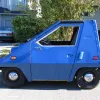
More practical and simpler than ever, Twingo E-Tech electric sets a new standard for the A segment, remaining faithful to the innovative spirit of Renault and the original Twingo model. The new model fully meets European customers’ expectations and brings an added touch of optimism to urban life.
Manufactured at the Renault plant in Novo Mesto, Slovenia, Twingo E-Tech electric will be available at the beginning of 2026 in Europe.
To succeed in offering an electric car under 20,000 euros, without giving up production in Europe, our decarbonization targets, and customer value, we have returned to the Twingo spirit—the one that placed everyday life, ingenuity, and joy at the heart of design. The new 100% electric generation remains faithful to what matters most to Renault: understanding the real needs of European drivers, their expectations for accessibility, emotion, and responsibility. Personally, what I like about Twingo E-Tech electric is that it manages to be both a tribute to its origins and a leap into the future. Fabrice Cambolive, CEO Renault Brand.
Since 1992, Twingo has become one of the most iconic city cars in the automotive world. With over 4.1 million units sold in 25 countries, Twingo has marked entire generations with its innovative monovolume design, generous habitability, intelligent modularity, and vibrant character.
Today, Twingo E-Tech electric carries this story forward, offering a modern and relevant reinterpretation. The new model retains the essence of the first generation, adapting it to current demands: electromobility, responsibility, and driving pleasure. With this launch, Renault reaffirms its position as a leader in the electric city car segment, combining innovation, accessibility, and environmental commitment.
The result of an innovative and unprecedented international organization, Twingo E-Tech electric embodies Renault’s desire to democratize electric mobility and make the transition to it accessible to as many people as possible.
Twingo E-Tech electric was designed to meet the following three major objectives:
Accessibility and sustainability: with a starting price under €20,000 (excluding potential subsidies), Twingo E-Tech electric becomes an affordable and more sustainable solution for European families.
Accelerated development: reducing development time to just two years—a record in Renault’s history, achieved within an innovative pilot project, the results of which will be leveraged in future company projects.
Competitive production in Europe: assembled at the Renault plant in Novo Mesto (Slovenia), Twingo E-Tech electric benefits from an optimized industrial organization and a local supply chain.
Making electric mobility more accessible and sustainable
The European electric vehicle market is evolving rapidly, and consumers are demanding increasingly affordable models. Renault has taken this strong demand into account. Starting in 2023, teams have been working to develop a vehicle with an entry price under €20,000 (excluding government subsidies).
Responding to this demand meant much more than a simple price adjustment. To design an affordable and competitive electric city car, Renault had to thoroughly rethink its design and industrialization methods. This organizational transformation, supported by radical technical choices and Ampere’s expertise, made it possible to achieve the goal of offering a vehicle under 20,000 euros.
To achieve the accessibility objective, Twingo E-Tech electric adopts an LFP (Lithium-Iron-Phosphate) battery—a first for Renault Group. This technology capitalizes on abundant natural resources, such as iron and phosphate, while reducing dependence on critical metals like cobalt and nickel. This choice contributes to Renault’s decarbonization strategy, providing more sustainable and responsible electric vehicles without compromising on safety or performance. Additionally, the LFP battery utilizes a “cell-to-pack” architecture, allowing the integration of more cells in a given space and reducing the overall cost of the battery.
Combining LFP chemistry with this innovative architecture leads to a roughly 20% reduction in battery costs.
A purchase advantage complemented by a reduced cost of use: Twingo E-Tech electric’s consumption will be at the best level thanks to optimizing engine efficiency and aerodynamics, which allowed for limiting the size and weight of the battery. The result? Performances that can directly compete with thermal vehicles in the same category.
Furthermore, from the first sketch, designers and engineers aimed to create a vehicle with optimized efficiency for urban use and a reduced footprint. Objective: reducing the carbon footprint of the new model by 60% compared to a thermal city car of the same size. This performance is based on a global approach, which includes production and the entire vehicle life cycle.
Reducing the development duration of a vehicle to two years
Twingo E-Tech electric paves the way for the “Leap 100” program (“100” for one hundred weeks), intended to transform the entire vehicle development cycle. Thus, Twingo E-Tech electric becomes the fastest-developed model in Renault’s history. Conceived and industrialized in just a hundred weeks—twice as fast as previous electric models—while maintaining the group’s latest quality standards, Twingo E-Tech electric illustrates Renault’s ability to respond to the accelerated transformation of the market.
To achieve this objective, Renault implemented a unique organization, which combines European expertise with innovation from China, relying on three pillars: Ampere, ACDC, and the Novo Mesto assembly plant. This method opens the way for a new generation of vehicles conceived more quickly, more simply, and more efficiently.
Ampere, Renault Group’s subsidiary specializing in smart electric vehicles, coordinated the project through its three key stages in France, China, and Slovenia.
The design of Twingo E-Tech electric was launched in France, at the Technocentre, drawing from the group’s technological advantages, using the AmpR Small platform, specifically designed for electric vehicles in the A and B segments, with a state-of-the-art electronic architecture. Ampere implemented a simplified governance focused on efficiency and speed in decision-making in this framework. This approach allowed for faster validation of stages, reduction of interactions between departments, and full integration into Renault’s electric strategy.
The second stage was carried out with ACDC, Renault Group’s research and development center in Shanghai. This entity accelerated the project by leveraging the local ecosystem and new industrial partners. Close interaction between teams favored a fluid transfer of best practices. Approximately one hundred people contributed to the various phases of the project, with support from key suppliers, like Launch Design for the upper and visible part of the vehicle, CATL for batteries, and Shanghai e-drive for motorization. Ampere provided the platform and developed all electronic systems, the software and multimedia part, as well as the driving assistance systems. Joint efforts reduced the usual design deadlines and allowed cost optimization without compromising quality.
Finally, the production of the Twingo E-Tech electric model is carried out at a European plant of the Renault Group, guaranteeing a high level of quality and reliability. Thanks to this new approach, Renault has transitioned from a traditional linear development process to a collaborative and transversal method, bringing together all key functions in a single team. This approach allowed for duration reductions at every stage. Renault thus gained approximately a year in the design process of a comparable vehicle, while also reducing necessary investments by 50%.
By applying this method in the case of the Twingo E-Tech electric model, Ampere anticipated the objectives of the “Leap 100” program and demonstrated that it is not a one-off optimization but a new, sustainable, and replicable way of working. In detail, preliminary activities, which include planning, will be reduced by 16%; development, encompassing design and technological conception, will be reduced by 41%; and industrialization, which includes the implementation of production tools and logistics, will be shortened by 26%.
ACDC, “the technology center in China,” accelerator for Renault Group
Opened in 2024 in Shanghai, ACDC is a research and development center created to integrate into the Chinese ecosystem, recognized for its fast-paced development, cost competitiveness, and technological expertise. ACDC brings together engineering functions to accelerate development times, procurement to improve competitiveness, and technological monitoring to identify future technologies.
The team numbers approximately 150 collaborators in Shanghai, supplemented by a few resident engineers from the Technocentre. The Twingo project mobilized around 100 ACDC engineers responsible for system integration and project management.
Maintaining competitive production in Europe
The production of the Twingo E-Tech electric model takes place in Novo Mesto, Slovenia, a historic Renault Group plant covering 66 hectares and committed to a pursuit of industrial excellence. Over time, more than 5 million vehicles have been manufactured here, mainly iconic models from the A and B segments (Renault 4, Renault 5, Clio, Twingo 2 and 3). In 2016, the plant launched its first electric model, Smart ForFour EV, for Daimler, and since 2020 it has exclusively produced Twingo 3 Electric for the entire European market.
Integration of the Twingo E-Tech electric model on production lines was anticipated through exchanges between ACDC and Novo Mesto. Renault Group has made significant investments with the ambition to transform this plant into a model of sustainability and industrial intelligence in service of European customers. Key directions of this transformation include:
Modernizing equipment across the entire production line, with the installation of completely new lines for bumper injection and painting, seat assembly, and front cross member assembly.
Enhancing employee skills through intensive training and retraining programs in digital fields and technologies related to electric vehicles.
Ecological and digital transition of the plant, with solutions like Plant Connect (industrial metaverse) and a photovoltaic plant, thus affirming the Group’s commitment to more responsible and connected production.
This project fits Renault’s strategy of combining industrial performance, technological innovation, and ecological responsibility. At the end of the production chain, 75% of Twingo E-Tech electric customers are located less than 1,000 kilometers from the plant, limiting logistics costs and carbon footprint.
Simplification: an assumed strategy
Experience with recent models has shown that an overly complex offering slows production without tangible benefits for the customer. Twingo E-Tech electric adopts a different logic, designed primarily for efficiency. Thus, at launch, only four body colors are available, compared to almost ten previously. Equipment has been rationalized, and technical systems optimized.
A specific example of this approach: while other models had 11 variants of the climate system, Twingo E-Tech electric applies a simplified solution from the design phase. This strategy reduces industrial complexity while maintaining commercial attractiveness.