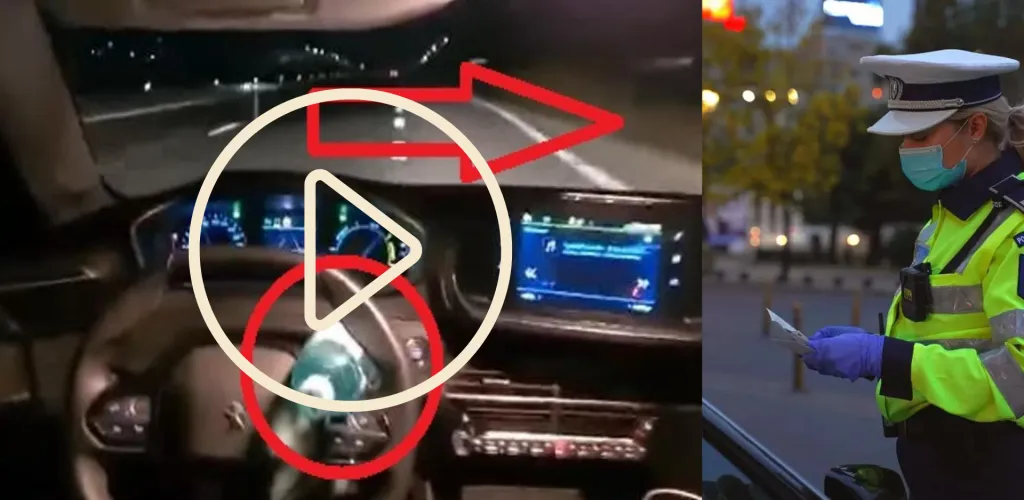
- Romanian police say fines can’t be issued from non-approved devices due to manipulation concerns.
- Courts rarely accept video evidence, limiting enforcement of traffic violations.
- In many countries, citizens can send footage to police and get fines.
- Authenticity checks and metadata analysis are essential obstacles to implementation.
Social networks are filled daily with traffic footage posted by drivers, many of which show serious violations of traffic rules. Although the Police issued a statement informing that posting such footage is not legal, no sanctions have yet been recorded for those who publish them.
The question raised is more complex: can the police self-initiate action and fines based on a video posted online? This issue becomes even more relevant as many police officers and courts do not consider video recordings made by drivers in traffic.
Flagrant cases requiring intervention
Recently, an online recording surfaced showing a driver holding a child of only a few years old in his arms while driving on Valea Oltului. This irresponsible behavior endangers not only the driver’s own family but also other road users. Such situations raise a legitimate question: shouldn’t such actions be sanctioned, regardless of how they come to the attention of authorities?
Current position of the Romanian Police
Under current law, police representatives argue they cannot issue fines based on recordings made with non-homologated devices. The argument is that images could be digitally altered, though in reality most drivers simply want those who commit serious violations to be sanctioned.
This conservative stance ignores the fact that not all Romanians are IT specialists who modify images to harm others. Most footage is authentic and captures real situations that endanger road safety.
Courts and acceptance of video evidence
At present, only a very small number of Romanian courts have begun to accept video recordings as evidence in court cases. This acceptance is usually limited to situations where the recording is used by the party challenging the case for their own purposes.
This restrictive approach makes it very difficult to sanction those who commit traffic offenses, even when there are clear video proofs.
International practices in using footage
Advanced European countries
In most other European countries, as well as in the United States, citizens have the legal right to send the police footage of those who commit traffic violations. The process works efficiently:
- Citizens send the video materials to authorities
- Drivers are identified based on the license plate
- Fines are issued in accordance with the law
Benefits of a functional system
Implementing such a system in Romania would have multiple advantages:
- Increased road safety by deterring dangerous behaviors
- Holding drivers accountable who know they can be filmed and sanctioned
- Making the Police more efficient by involving citizens in traffic monitoring
- Reducing accidents caused by aggressive or negligent driving
Obstacles in implementing the system
Technical aspects
The main concern of authorities relates to the authenticity of the images. Nevertheless, there are technical solutions for validating the recordings:
- Checking the metadata of video files
- Technical analysis to detect alterations
- Using a structured reporting system
Legal aspects
The current legal framework does not provide the necessary basis for generalized acceptance of video evidence from citizens. Legislative changes would be required to:
- Define the conditions for accepting footage
- Establish verification procedures
- Regulate the rights and duties of citizens
Conclusion
Although Romania is still far from European standards regarding accepting citizens’ footage as evidence for sanctioning road violations, implementing such a system would be technically relatively straightforward and would contribute significantly to improving road safety.
In the current context, where dangerous driving behaviors are increasingly frequent and severe, the reluctance to use all available means to identify and sanction violations seems unjustified. An adapted legal framework and a modern approach by authorities could transform citizens’ footage from a mere expression of frustration into an effective tool for improving road discipline.