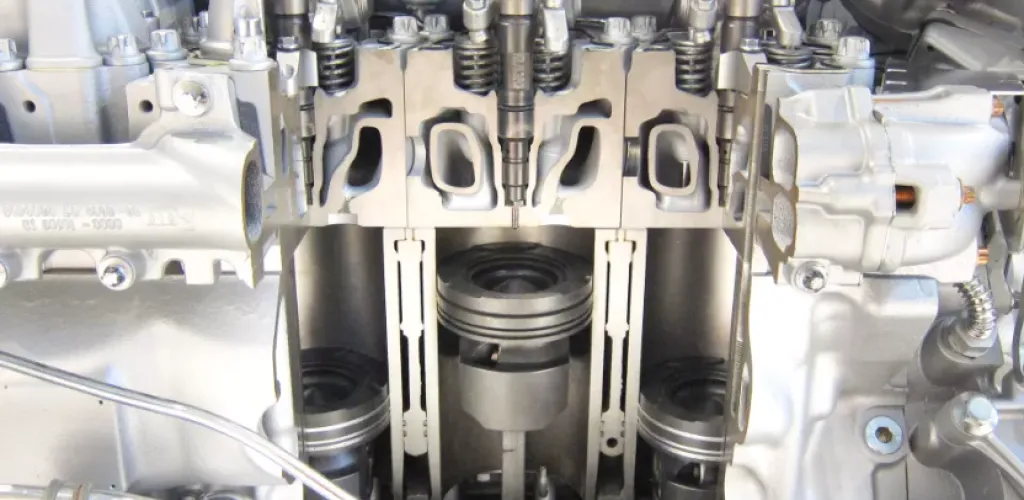
- Engine displacement is the total volume the pistons sweep per cycle.
- It equals π/4 × bore² × stroke × cylinders.
- Larger displacement generally yields more power and torque but lowers fuel efficiency.
- In Romania, car tax bands depend on displacement: under 1600cc, 1600-2000cc, over 2000cc.
Engine displacement, also known as engine capacity, refers to the total volume of air and fuel the engine can process in a complete operating cycle. This fundamental technical parameter directly influences power, torque, and fuel economy, making it a key factor when choosing the right car.
Understanding engine displacement is essential for any driver who wants to make an informed choice, whether the priority is fuel efficiency, sporty performance, or a balance between the two.
What engine displacement actually means
Engine displacement represents the total volume swept by all the pistons as they move from bottom dead center to top dead center. This value is calculated by multiplying the displacement of a single cylinder by the total number of cylinders.
The pistons move in a reciprocating motion, up and down inside the cylinder, while the crankshaft turns. The volume inside a cylinder changes as the piston moves through the combustion cycle.
Meanwhile, other cylinders change their volumes as their pistons move through other phases of the combustion cycle.
Although each cylinder's volume changes constantly, the total engine displacement remains constant.
How engine displacement is calculated
Engine displacement = π/4 × bore² × stroke × number of cylinders
- Bore is the interior diameter of the cylinder (measured in millimeters)
- Stroke represents the distance the piston travels from bottom dead center to top dead center
- π/4 is the mathematical constant required to calculate the cylinder volume
Displacement is typically expressed in:
- Liters (L) - standard unit
- Cubic centimeters (cm³ or cc) - commonly used for motorcycles
- Cubic inches (CI) - used in the American imperial system
Practical calculation examples
For a 2.0-liter engine with 4 cylinders:
- Each cylinder is about 500 cm³
- Bore could be 86 mm, and stroke 86 mm
- Result: π/4 × 86² × 86 × 4 = approximately 2000 cm³ = 2.0 L
Why engine displacement matters
Impact on power and torque
Engine displacement directly influences the vehicle's performance. A larger displacement engine can inhale and compress more air-fuel mixture per cycle, generating:
- Higher power - more horsepower available
- Greater torque - more rotational force at low RPM
- Better throttle response - power reserve for overtakes
Influence on fuel economy
Generally, larger displacement engines consume more fuel because:
- They process bigger volumes of fuel per cycle
- They have more cylinders requiring lubrication and cooling
- They incur higher friction losses
However, modern technologies such as turbocharging and direct injection allow small engines to deliver high power with lower fuel consumption.
Tax and maintenance considerations
In Romania, as in many other European countries, car tax is calculated based on engine displacement:
- Under 1,600 cm³ - reduced tax
- 1,600-2,000 cm³ - moderate tax
- Over 2,000 cm³ - progressively higher tax
Also, larger engines typically entail higher maintenance costs due to:
- Larger quantities of oil and fluids
- Bigger components
- Increased complexity of auxiliary systems
Range of capacities available on the market
Small engines (sub 1.5L)
- Applications: city cars, fuel economy
- Advantages: low consumption, low tax, inexpensive maintenance
- Disadvantages: limited power, modest performance
Medium engines (1.5L - 2.5L)
- Applications: family cars, balance between economy and performance
- Advantages: versatility, balanced power-to-economy ratio
- Disadvantages: mid-range compromises
Large engines (over 2.5L)
- Applications: premium cars, SUVs, performance models
- Advantages: high power, generous torque, refinement
- Disadvantages: higher consumption, higher tax, costly maintenance

Modern technologies that influence the choice
Turbocharging (downsizing)
Small turbocharged engines can deliver the power of larger engines with the economy of small ones:
- The 1.4 L turbo engine can rival a 2.0 L naturally aspirated
- Reduces CO₂ emissions
- Maintains performance
Hybridization
Hybrid systems combine small internal combustion engines with electric motors:
- Compensate for the limitations of small engines
- Improve efficiency in urban traffic
- Significantly reduce fuel consumption
How to choose the right displacement
For urban use
- 1.0L - 1.4L for most needs
- Priority on fuel economy and maneuverability
- Sufficient for congested traffic
For mixed use
- 1.4L - 2.0L offers optimal balance
- Good for city and long highway drives
- Power reserve for overtaking
For performance or heavy workloads
- Over 2.0L for maximum power
- Necessary for towing or hauling
- Ideal for a sporty driving experience
Decision factors
Before you choose, evaluate:
- Available budget (purchase + running costs)
- Type of driving dominant
- Space and load needs
- Personal priorities (economy vs. performance)
If you want to increase your car's power, there are optimization options, but displacement remains a fundamental limiting factor.
In conclusion, engine displacement is much more than a technical specification - it defines the character and capabilities of your vehicle. The right choice starts with a clear understanding of your needs and the trade-offs you're willing to make.
Photo source: topspeed.com, carsguide.com.au