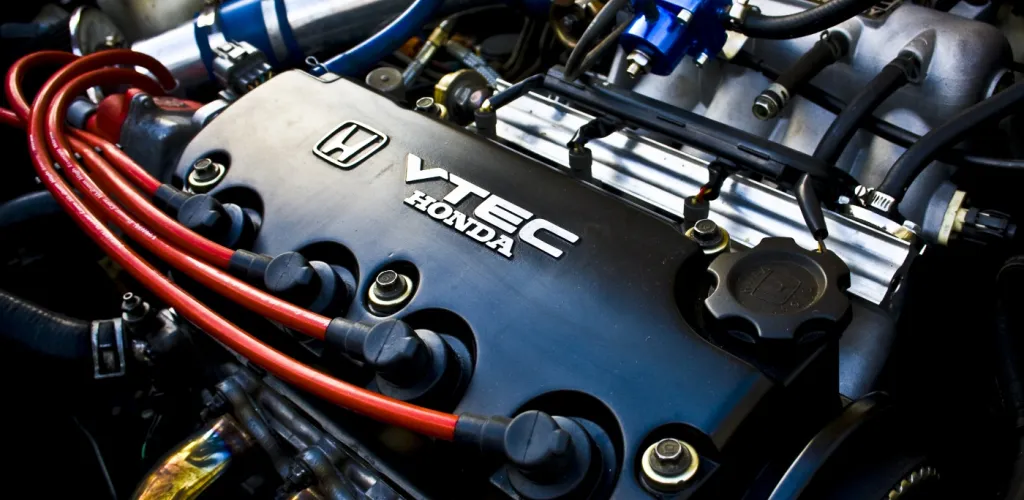
- VTEC lets engines optimize performance at both low and high RPM.
- Conventional engines use fixed cam lobes; VTEC switches via dual cams and lifters.
- Low RPM uses small cams for efficiency; high RPM uses large cams for power.
Honda’s VTEC system is one of the most ingenious innovations in the automotive industry, developed by Honda engineers in the late 1980s. This groundbreaking technology allows the engine to optimize its performance at both low and high RPM, delivering efficiency and increased power at the same time.
At its core, the VTEC principle solves one of the biggest challenges in modern engine design: how to achieve optimum performance for everyday economical driving as well as in situations that demand maximum power.
Principles of Engine Valve Operation
To understand the importance of the VTEC system, let’s first analyze how the valves of a conventional engine work.
- Intake valves - allow the air-fuel mixture to enter the cylinder
- Exhaust valves - allow exhaust gases to exit the cylinder
These valves are controlled by the camshaft, which via the lobes actuates lifters to open and close the valves at the proper moment in the engine cycle.
Critical valve parameters
The optimal valve operation depends on three main factors:
- Opening timing – when the valves open relative to the piston position
- Duration of opening – how long the valves stay open
- Maximum lift – how far the valves open
These parameters are determined by the profile of the lobes on the camshaft and are fixed in a conventional engine.
The Challenge of Optimizing for Variable RPM
The shape and size of the lobes on the camshaft are crucial for engine performance, but they also pose a fundamental engineering problem.
Low RPM operation (1,000–2,000 rpm)
- The valves have time to open and close fully
- The air-fuel mixture has time to enter the cylinder efficiently
- Gas flow velocity is low, so large openings are not necessary
- The engine runs smoothly and economically
- Priority is efficiency and reduced emissions
High RPM operation (5,000–8,000 rpm)
- The valves open and close up to about 4,000 times per minute
- The intake and exhaust timing becomes extremely short
- It is necessary for the valves to open earlier and longer
- Gas flow must be maximized to fill the cylinder
- Priority is maximum power and peak torque

The Engineer’s Dilemma
The fundamental problem: An optimized camshaft for low RPM will limit power at high RPM, while one optimized for high RPM will cause idle issues — an uneven idle, higher fuel consumption, increased emissions, and potential cold-start problems.
The Solution: VTEC dual-cam technology
The VTEC system solves this problem with an ingenious configuration that combines the advantages of both cam types.
Main system components
1. Dual-cam configuration
On the same camshaft exist cams of different sizes:
- Small side cams for low RPM (low lift, short duration)
- Large central cam for high RPM (high lift, long duration)
2. Variable lifter system
At low RPM:
- Each valve is actuated independently by the small side cams
- Lifters operate separately
- Valve opening is controlled and moderate
At high RPM:
- A hydraulic mechanism “connects” the three lifters
- The assembly becomes solid and moves as a single piece
- The large central cam takes control of all valves
3. Electronic control system
The car’s ECU continuously monitors:
- Engine speed (crank position sensor)
- Throttle position (TPS sensor)
- Engine temperature (coolant temperature sensor)
- Engine load (manifold pressure sensor)
- Cam position (phasing sensor)
Hydraulic switching mechanism
How the hydraulic system functions
Switching between the two modes is accomplished by a sophisticated hydraulic system:
Main components:
- Electronically controlled solenoid valve
- Oil passages in the camshaft
- Hydraulic pistons in the VTEC lifters
- Return springs
Activation process:
- The ECU determines that VTEC conditions are met
- The solenoid valve is activated
- Oil pressure moves the pistons in the lifters
- Lock pins extend and connect the lifters
- The large central cam takes control
Activation conditions for VTEC
The system engages when all conditions are met:
- RPM exceeds the set threshold (typically 3,000–5,500 rpm)
- Oil temperature is optimal (above 60°C)
- Coolant temperature is normal
- Throttle is sufficiently pressed
- No system errors
Types and variants of VTEC systems
Classic VTEC (first generation)
Characteristics:
- Only lifts and durations vary
- On/off activation at a specified RPM
- Distinct switching sound
- Used on B16A, B18C, F20C engines
VTEC-E (Economic)
Efficiency-focused optimizations:
- Operates only on intake valves
- At low RPM, one intake valve remains nearly closed
- Creates turbulence in the cylinder for better combustion
- Up to ~15% lower fuel consumption
i-VTEC (intelligent)
Improvements:
- Combines VTEC with VTC (Variable Timing Control)
- Varies both lift and timing
- Continuous control, not just on/off
- Smoother transitions between modes
VTEC Turbo (current generation)
For turbocharged engines:
- Optimized for turbo operation
- Variable exhaust systems to manage boost pressure
- Integration with direct injection systems
- Used on L15B7, K20C engines in the Type R series
Benefits of the VTEC system
Performance benefits
Increased power:
- 15–25% power rise at high RPM
- Maintains torque over a broad RPM range
- Improved throttle response after VTEC activation
Flexibility:
- Engine usable in all conditions
- Extended power band
- Sporty character on demand
Efficiency benefits
Fuel economy:
- 10–20% lower city fuel consumption
- Lower CO2 emissions in normal driving
- Optimized for homologation cycles
Smooth operation:
- Stable idle and quiet at idle
- Reduced vibrations at low RPM
- Increased daily comfort
Durability benefits
Wear reduction:
- Components optimized for each regime
- Lower valve stresses at low RPM
- Improved lubrication via the hydraulic system
Competing systems and the technology’s evolution
Similar systems from other manufacturers
Toyota VVT-i/Valvematic:
- Continuous variation of cam timing
- Electric lift control
- Hybrid integration
BMW VANOS/Valvetronic:
- Fully electronic valve control
- Elimination of the throttle plate
- Increased efficiency through precise loading control
Volkswagen/Audi:
- Systems integrated in [TSI and TFSI] engines
- Combination with direct injection and forced induction
- Downsizing optimization
Nissan VVL:
- Similar VTEC-like system for the Skyline GT-R
- Integration with e-POWER technology
Toward the future
Current trends:
- Hybrid system integration
- Full electronic valve control
- Optimization for alternative fuels
- Real-driving emissions reductions
Identifying and diagnosing the VTEC system
How to recognize a VTEC engine
Visual signs:
- VTEC badge on the valve cover or body
- Engine block inscription
- Lifters’ arrangement visible when disassembled
Auditory signs:
- Characteristic sound when switching to VTEC (roughly a switch)
- Change in engine tone as RPM threshold is crossed
- Aggressive sound after activation
Behavioral signs:
- Sudden and noticeable power increase at a certain RPM
- Power surge after activation
- Change in engine character
Common issues and diagnostics
Symptoms of VTEC failure:
- No VTEC engagement (engine feels flat at high RPM)
- Delayed or premature engagement
- Metallic noise from the head area
- Increased oil consumption
- Unstable idle
Common causes:
- Degraded or low oil level
- Stuck VTEC solenoid
- Worn lifters or cam lobes
- Sensor problems (RPM, oil pressure)
- Faulty engine computer
Common error codes:
- P1259 – VTEC solenoid valve circuit
- P1253 – VTEC system malfunction
- P1009 – VTEC synchronization error
Maintaining the VTEC system
Oil change – critical for VTEC
Why the oil is crucial:
- The hydraulic system depends entirely on oil pressure
- Deteriorated oil can block the system
- Metallic particles wear fine components
- High temperatures affect viscosity
Specific recommendations:
- Change at a maximum of 10,000 km (more frequent in severe conditions)
- Use only Honda-recommended oil (0W-20 or 5W-30)
- Check oil level monthly
- Replace the oil filter at every change
Preventive maintenance
Every 20,000 km:
- Clean the VTEC system with specialized additives
- Check oil pressure
- Test system operation with a scanner
Every 40,000 km:
- Check lifter and cam wear
- Test the VTEC solenoid
- Analyze oil quality
Every 80,000 km:
- Complete timing/distribution system overhaul
- Check valve clearances
- Replace worn components
Tips to extend system life
Driving style:
- Warm up the engine before using VTEC
- Avoid frequent switching when cold
- Shift at moderate RPM
- Gradual cooling after sporty driving
Fuel and additives:
- Use high-quality gasoline (95+ octane)
- Additives to clean the intake system
- Avoid high-ethanol fuel blends
Honda models with the VTEC system
Classic models (1989–2000)
Civic Type R (EK9):
- B16B engine with 185 hp
- VTEC at 5600 rpm
- One of the most celebrated applications
Integra Type R (DC2):
- B18C engine with 200 hp
- VTEC at 4400 rpm
- Ideal balance between torque and power
NSX:
- C30A/C32B engines with 270–290 hp
- VTEC on both banks
- First VTEC application on a V6 engine
Modern models (2001–present)
Current Civic Type R (FK8):
- K20C1 engine with 320 hp
- VTEC Turbo with direct injection
- Nürburgring record for front-wheel drive
Jazz/Fit:
- L15A engine with i-VTEC
- Optimized for efficiency
- Wide adoption of the technology
VTEC’s impact on the auto industry
Technological influence
The VTEC system demonstrated that:
- It is possible to optimize for multiple operating regimes
- The technology can be reliable and durable
- The benefits justify the added complexity
- Electronic control can dramatically improve performance
Shifting perceptions
Before VTEC, engines were viewed as optimized for a single purpose. Honda showed that an engine could be simultaneously:
- Efficient in urban use
- Spectacular when needed
- Long-term reliable
- Clean in terms of emissions
Conclusion: the VTEC legacy
The VTEC system remains one of the most important innovations in the history of internal combustion engines. By marrying mechanical ingenuity with electronic control, Honda created a technology that redefined what a combustion engine could do.
Today, VTEC principles appear in various forms across most automakers, from simple variable cam timing to fully electromagnetic valve control. This widespread adoption confirms the value and significance of the innovation.
In the era of electrification, VTEC continues to evolve, integrating with hybrid technologies and optimizing for new efficiency and emission requirements. For automotive enthusiasts, VTEC remains synonymous with intelligent performance—the ability of a engine to deliver both sporty driving pleasure and daily practicality.