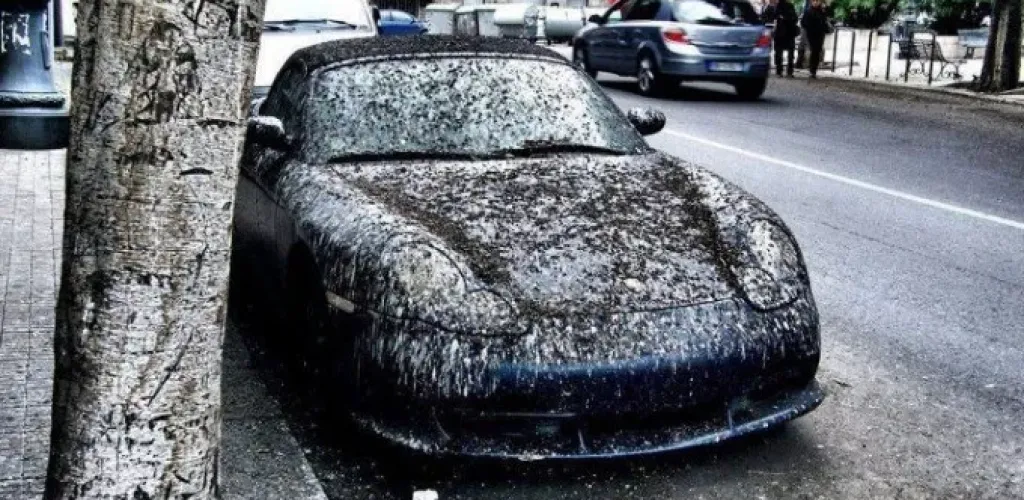
- Bird droppings are highly acidic (pH 3–4.5) and chemically degrade paint.
- Daily thermal cycling pulls uric acid deeper, causing permanent discoloration and possible corrosion.
- Rain won’t fully remove dried droppings and can accelerate corrosion.
- Soak with warm water for 10–15 minutes, wipe gently, then wash and dry.
Bird droppings on a car parked outdoors or without access to a garage can seem like a minor issue, but they can have serious consequences for the vehicle’s appearance. What looks like a simple aesthetic nuisance can quickly become an expensive problem if not treated promptly.
In this article we will explore in detail how bird droppings affect car paint, why you must act quickly, and what the most effective removal and protection methods are.
Why Bird Droppings Are So Harmful to Car Paint
Bird droppings are not only a visual nuisance — they are chemically corrosive substances. With a pH range between 3 and 4.5, they contain significant amounts of uric acid, a highly aggressive chemical that reacts directly with paint components.
The uric acid attacks hydrocarbons in the paint’s composition, triggering chemical degradation. The problem becomes even more serious when we consider the thermal cycles the body undergoes.
The Damage Mechanism: Thermal Cycling
The mechanism by which bird droppings penetrate the paint is closely linked to thermal expansion and contraction:
- During the day, as the temperature rises, the paint expands at the molecular level, and uric acid leaches into the superficial layers
- At night, with the temperature drop, the paint contracts, and the uric acid remains trapped inside the paint layer
- Cyclic, this process repeats daily, allowing the acid to penetrate deeper and deeper
The result? Permanent discoloration, matte spots that cannot be removed by a simple wash, and in extreme cases, the exposure of the base metal to corrosion.
Why Rain Isn’t a Solution
Many owners hope rain will solve the problem, but this is a misconception that can be costly. Dropped-on dried and hardened droppings won’t be completely removed by precipitation, no matter how heavy it is.
Rain can remove only the superficial layer, leaving residues to penetrate deeper into the paint. Moreover, rainwater can even accelerate the corrosion process by creating a moist environment that favors chemical reactions.
How to Correctly Remove Bird Droppings
Removing dried droppings requires care and the correct technique to avoid scratching the paint. Here is the method recommended by auto detailing specialists:
The Soaking Method
- Prepare a soft microfiber cloth and moisten it with warm water (not hot)
- Place the cloth directly over the affected area, ensuring it covers the droppings completely
- Let it act for 10-15 minutes — this step is crucial to soften the deposits fully
- Carefully remove the droppings with gentle motions, without rubbing or applying excessive pressure
- Wash the area with a quality car shampoo to remove any acid residue
- Dry well with a clean microfiber towel
Recommended Products
For effective and safe cleaning, invest in:
- High-quality microfiber towels (fine fibers and high density)
- Neutral-pH cleaning solutions, specially formulated for removing bird droppings
- Detailing sprays that help soften dried deposits quickly
- Quick detailer for finishing after cleaning
Mistakes to Avoid
Never:
- Try to remove dried droppings by direct rubbing — you will scratch the paint
- Use harsh textile cloths or abrasive sponges
- Let the problem persist — the longer you wait, the more damage
- Use cold water on a hot body — the sudden temperature difference can affect the paint
Prevention: How to Protect Your Car’s Paint
The best approach is prevention. If you know the car will be parked outdoors for long periods, consider the following:
Protective Wax
Applying a quality auto wax creates a protective barrier between the paint and external agents. Wax:
- Forms a sacrificial layer that takes the attack of uric acid
- Facilitates easier cleaning of subsequent droppings
- Provides additional protection against UV rays
- Should be reapplied every 2-3 months for maximum effectiveness
Ceramic Coatings
For superior and long-lasting protection, ceramic coatings offer:
- Durability of 1-5 years, depending on product quality
- Superior chemical resistance compared to wax
- Hydrophobic properties that make dirt slide off more easily
- Protection against minor scratches
Paint Protection Film (PPF)
For maximum protection, especially for premium or collectible vehicles, clear protective films offer:
- Physical protection against droppings, stones, and scratches
- Durability of 5-10 years
- Self-healing properties for minor scratches
- Maintains the vehicle’s resale value
Car Cover
If the car is parked for extended periods:
- Use a breathable, high-quality cover that allows moisture to evaporate
- Ensure the cover is clean before applying
- Periodically check the condition of the body under the cover
How Quickly Should You Act
Timing is crucial when it comes to removing bird droppings. Ideally, you should remove them within 24-48 hours of deposition. The longer the substance stays on the paint, the more:
- It penetrates deeper into the paint layers
- It becomes harder to remove without affecting the finish
- It increases the risk of permanent discoloration
- It intensifies the corrosion process
In hot summer months, when temperatures exceed 30°C, damage can occur in just a few hours, not days.
When to Call a Professional
If the droppings have stayed on the body for a long period and you already notice discoloration or matte spots, it is recommended to consult a car detailing specialist. They have:
- Professional polishing and restoration products
- Specialized equipment (polishing machines with controlled speed)
- Experience in evaluating and treating paint damage
- Solutions for severe cases that might require local touch-ups
Conclusion
Although they seem minor, bird droppings can cause significant and costly damage to car paint if ignored. The high acidity and daily thermal cycles make these deposits far more hazardous than they appear at first glance.
The key is to act quickly — remove the droppings as soon as possible using the correct soaking method and invest in preventive measures such as wax, ceramic coatings, or protective films. A few minutes dedicated to proper cleaning can prevent hundreds or even thousands of RON in repainting costs.
Keep an emergency cleaning kit in the car at all times — a few microfiber towels and a bottle of quick-cleaning solution can save your vehicle’s paint in the long term.