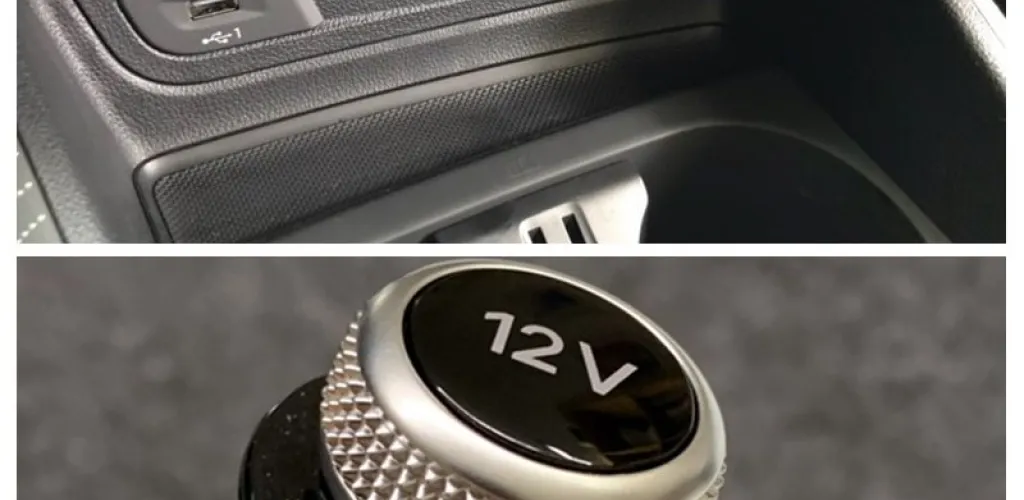
- The 12V outlet connects to the battery with ground and positive contacts.
- Fuses protect the outlet, blowing if excessive current occurs.
- Two fuse types: standard blade fuse and fusible/thermal link.
- Locations vary by car; check the manual and replace with same amperage.
Most modern cars are equipped with at least one, and often two or three interior power outlets. Over time these outlets can stop working properly and may need replacement. While the rear or trunk outlet is optional, the one near the driver can be very important, offering a range of uses—from charging a phone to powering a GPS or dash cam.
This guide explains how the 12V outlet works, common failure causes, and the step-by-step process to replace it.
How the car’s 12V outlet works
The car’s 12-volt outlet has a relatively simple operating system. It is connected directly to the vehicle’s 12-volt battery, from which it draws the energy needed to power various electronic devices. Beneath its cap, the 12-volt car outlet is, in fact, just a metal cylindrical socket with a few wires.
Those wires run to the vehicle’s 12-volt battery. One wire connects the sleeve of the outlet to the battery’s negative terminal (ground), while another connects the outlet’s center contact to the positive terminal. When you insert a correctly shaped plug or adapter into the outlet, it makes contact with both the sleeve and the center contact, completing the electrical circuit.
Evolution from cigarette lighter to universal outlet
In the past, cars did not have a dedicated power outlet; they had cigarette lighters. The system was the same, but the lighter served mainly for smokers. At the bottom, it had a heated metal element that heated up quickly with current. The same system is used today to transmit current to a charging outlet that can power our electronic devices.
Fuse protection system
Although the car’s battery powers the 12V outlet, they are not connected directly. Like any other electrical accessory in your car, there are fuses between them. The fuses protect electrical components in case of a short circuit. When more current passes through the system than the circuit can handle, one or more fuses will blow to protect the consumers.
Types of fuses in the car’s outlet system
There are two fuses you should be aware of in this case:

Standard blade fuse (metal pins) - The usual car fuse with metal pins, often a 15-amp fuse. You’ll typically find it in the fuse box under the hood or in the dashboard fuse panel. However, its location varies from car to car, so check the owner’s manual for details. If the fuse is blown, you can replace it easily; just ensure you use an identical fuse with the same amperage.
Fusible link (thermal fuse) - The other fuse for the power outlet is a fusible link, also known as a thermal fuse, and it sits at the rear of the outlet. If you see a thinner wire than the others, that is it. Like conventional fuses, it will break if too much current passes through, although it can handle variable loads better. Since the accessory outlet often experiences variable current, carmakers place fusible links there to protect the electronics we power.
Because the fusible link is basically just a wire, it can technically be replaced. However, in many cars, the wire is bonded to the outlet. Therefore, if it fails, it is usually much easier to replace the entire outlet. If you opt only to replace the fuse wire, the operation will be more involved. Additionally, replacing the outlet is not an expensive operation.
Direct current vs. alternating current
Car batteries are designed to provide direct current (DC), just as household outlets provide alternating current (AC). For some devices, such as radar detectors, portable GPS units, and Bluetooth/satellite radio transmitters, DC is fine. But others, such as a smartphone or an MP3 player, need AC.
That is why USB adapters you can plug into these outlets include built-in DC-AC converters. And if you need to power something larger, such as a laptop, you need a dedicated power inverter to convert the 12V DC into 220V AC.
Common causes of car outlet failure
Typically, the car power outlet fails because one or both fuses blow due to:
- Excessive current draw (connecting devices that pull too many amps)
- A short circuit (accidental contact between positive and negative poles)
- Wear of the contacts inside the outlet
- Damage to the fusible link
- Corrosion of electrical connections
Step-by-step guide to replacing the 12V outlet
Step 1: Check if the outlet is really defective
Before deciding to start replacing the car’s outlet, double-check that it is truly defective. There are many situations where, especially if you use a low-quality adapter, the contact may not be proper or the adapter itself could be faulty. It would be a pity to replace the outlet only to discover the adapter is at fault.
Test several different adapters in the outlet. If none work, the problem is certainly with the outlet or the fuses.
Step 2: Check the fuses
If you tested the adapter and it works properly, the next necessary step is to check the fuses. The quickest way is to consult your vehicle’s manual to correctly identify the fuse for the power outlet.
Look in the fuse box (either under the hood or in the cabin) for the fuse usually marked as “ACC” (accessories), “PWR OUTLET” or “12V.” Remove the fuse with the help of the plastic tweezers (usually found in the fuse box). If you see that the metal wire inside is broken, the fuse is blown and must be replaced with an identical one.
Step 3: Preparation for replacement
If neither of the two solutions makes the outlet work again, you will need to replace the power outlet.
Tools needed:
- Set of screwdrivers (flat and Phillips)
- Pliers
- New 12V outlet compatible with your car
- Flashlight (for visibility in tight spaces)
Step 4: Panel removal
First, remove the dashboard panel/central console that houses the power outlet. This usually involves prying off plastic clips, but you may need to remove other panels first. Work carefully to avoid breaking the plastic clips.
Tip: Take photos of the dismantling process so you know exactly how to reassemble everything.
Step 5: Disconnect and inspection
After this, disconnect the wiring from the back of the outlet and inspect it. If it is damaged, the wires are burned, or you see melted insulation, it is time for a professional mechanic, as the issue may be more serious.
Step 6: Removing the old outlet
Using screwdrivers and pliers, remove the original socket. Usually the outlet is fastened with screws or clips. Note exactly how it is mounted to install the new one correctly.
Step 7: Installing the new outlet
Install the new outlet in the same position as the old one. Make sure it is firmly attached and that it makes solid contact with its support.
Step 8: Reconnect and test
Reconnect the wiring to the new outlet. Ensure the connections are secure. Test the outlet before reassembling the panel — plug in an adapter and verify it works.
Step 9: Reassembly
If everything works correctly, put the panel back in place, ensuring all clips snap into place.
Maintenance tips for the car outlet
To extend the life of the 12V outlet:
- Do not connect devices that draw more than 10A (120W)
- Avoid leaving adapters plugged in when the engine is off
- Clean the outlet contacts periodically with an electrical contact spray
- Use quality adapters, avoiding cheap plastic ones
- Do not force the adapter into the outlet
- Periodically check the fuse status
When to go to a mechanic
If after replacing the outlet the problem persists or if:
- The fuses keep blowing repeatedly
- You notice a burning plastic smell
- The wiring shows visible damage
- You do not feel comfortable performing the repair
In these cases, it is safer to call a professional auto electrician who can diagnose and resolve more complex electrical issues.
Conclusion
Replacing the power outlet or the fuses that control it can be done quite easily. It is a simple process that any driver can undertake without great difficulty. No special automotive knowledge is required, and with a little patience and attention to detail, you will have a functioning outlet in your car again.