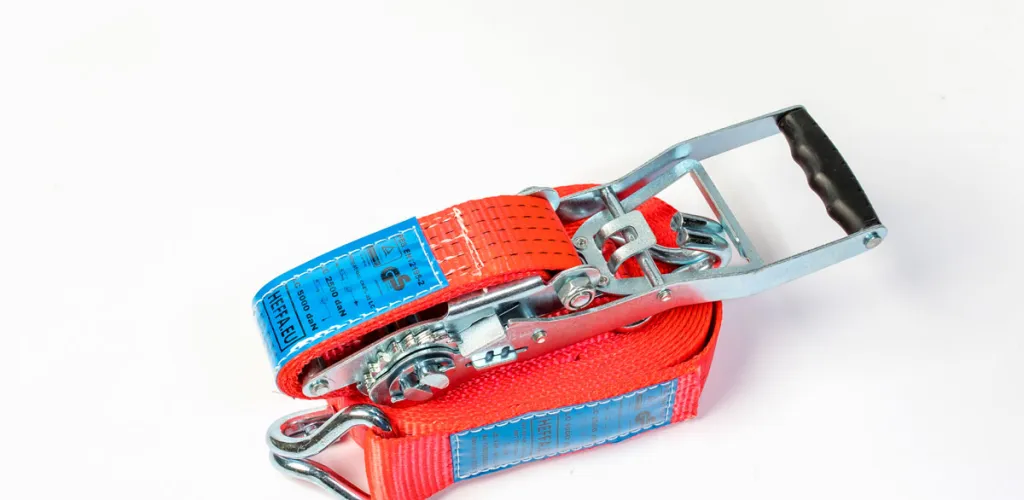
- Ratchet straps provide constant clamping force and won’t loosen in transit.
- They are easy to tighten, adjust safely, and have a long service life.
- All straps and accessories must have equal or greater ratings.
- Avoid elastic equipment; use straps with proper securing points.
Transporting bulky or heavy items with a passenger car presents a challenge that requires extra attention and proper equipment.\n\nWhether you’re moving furniture, helping a friend, or hauling luggage to the mountains, securing the load correctly is not only a safety matter but also a legal obligation. Legislation imposes substantial fines for those who transport goods without proper fixation, and a single wrong move can cause serious accidents and significant property damage.\n\n## Why ratchet straps are the best option\n\nFor load securing there are several methods available: ropes, simple belts, chains, tarps or protective nets. Each option has its own advantages and drawbacks.\n\nWe do not recommend using elastic equipment because they can stretch very easily and do not provide the stability required. Even ropes and traditional cords have some elasticity, but if tied correctly they can be effective.\nRatchet straps represent the optimal solution for the following reasons:\n\n- They provide a constant and strong clamping force\n- They do not loosen during transport\n- They are very easy to tighten with the ratchet mechanism\n- They allow precise and safe adjustments\n- They have a long service life\n\n## Technical features and safety requirements\n\nBefore using a ratchet strap, we must understand a few fundamental safety principles.\n\n### Maximum load rating\n\nThe nominal load rating of the ratchet strap must always be equal to or greater than the weight of the objects you intend to secure. In general, the strap thickness and width correlate with the load-carrying capacity:\n- 25 mm width straps: up to 500 kg\n- 35 mm width straps: up to 1000 kg\n- 50 mm width straps: up to 2000 kg\n- 75 mm width straps: over 2500 kg\n\n### Accessories and anchor points\n\nAll strap accessories — hooks, carabiners, rings — must have at least the same maximum load rating as the strap itself. The system will always fail at the weakest point, so it is essential that all components are properly rated.\n\n## Securing techniques depending on the type of load\n\n### Flat objects (furniture, panels, boards)\n\nFor transporting flat loads such as cabinets, tables or panels, you should use straps that go from one side of the object to the other. The minimal configuration includes:\n- One strap securing the object along its length\n- One strap securing the object across its width\n- Both straps must pass over and under the load\n\nFor larger objects, we recommend using two straps for each dimension — giving four securing points that practically eliminate any movement.\n\n### High-value bulky objects (motorcycles, ATVs, boats)\n\nWhen transporting valuable and delicate equipment, it is mandatory to use at least four securing straps:\n- Two straps at the front (diagonal)\n- Two straps at the rear (diagonal)\n- An X configuration for maximum stability\n\nFor wheeled vehicles, always block the wheels with wheel chocks and consider using additional protective nets. Free-rolling wheels can allow unwanted movement even with properly tightened straps.\n\n### Additional safety measures\n\nTo increase grip and prevent slipping:\n- Place rubber anti-slip mats under the objects\n- Use beds or mats with high traction\n- Ensure the contact surface is as large as possible\n- Avoid smooth or plastified surfaces\n\n## Correct procedure for using a ratchet strap\n\n### Step 1: Preparation\n1. Check the strap condition — no cuts, wear or damage\n2. Check the ratchet operation — it should lock firmly\n3. Inspect hooks and accessories — no cracks or deformations\n4. Open the ratchet by lifting the lever\n\n### Step 2: Positioning the strap\n1. Pass the free strap (without the ratchet) around or over the load\n2. Clip both ends to the vehicle anchor points\n3. Ensure the strap is not twisted\n4. Verify that the load is centered between the fixing points\n\n### Step 3: Tightening\n1. Insert the free end of the strap into the ratchet\n2. Operate the ratchet lever up and down to tighten\n3. Apply even tension — do not over-tighten\n4. The strap should be firm but not over-tightened\n5. Listen for the characteristic ratchet click as it locks\n\n### Step 4: Finishing\n1. Lock the ratchet lever in the down position\n2. Wrap the excess strap to prevent it from hanging\n3. Check that there are no contact points with sharp edges\n4. Protect delicate surfaces with soft material\n\n## Common mistakes and how to avoid them\n\n### Over-tightening straps\nAlthough it may seem counterintuitive, excessive tightening can:\n- Damage the load by deforming it\n- Cause the strap to break during transport\n- Affect the ratchet mechanism\n- Create points of tensile concentration\nA properly tightened strap allows a slight movement of the load (a few millimeters) but keeps it stable during braking and cornering.\n\n### Inadequate protection of surfaces\nHooks and straps can scratch or mark delicate surfaces. Be very careful how you fix the hooks to prevent damage. Solutions:\n- Use textile protections at contact points\n- Wrap the hooks with soft material\n- Avoid direct metal-to-paint contact\n- Check that strap edges do not rub against painted surfaces\n\n### Neglecting periodic checks\nDuring a long transport, straps can loosen due to:\n- Road vibrations\n- Load settling\n- Temperature changes\n- Material relaxation\nStop and check the securing after the first 20–30 km and then every 100 km or per hour of driving.\n\n## Legal aspects and regulations\n\nUnder Romanian road traffic regulations, load transport must meet certain requirements:\n- The load must not extend beyond the vehicle’s dimensions without proper markings\n- Transported objects must be fixed so they do not fall onto the roadway\n- For loads extending beyond the vehicle, special signaling is required\n- Fines for improper transport can reach hundreds of lei and result in penalty points.\n\n## Maintenance and storage of ratchet straps\n\n### After use\n- Clean the straps of dirt and dust\n- Dry them completely before storage\n- Check for wear and damage\n- Lubricate the ratchet mechanism if necessary\n\n### Storage\n- Keep straps cool, away from direct sunlight\n- Avoid contact with chemicals or petroleum\n- Do not leave them compressed or deformed\n- Store loosely to prevent permanent creases\n\n## Conclusion\n\nUsing ratchet straps correctly is essential for the safe transport of any bulky or heavy loads. Investing in a quality set and following proper securing techniques can save you from major problems, fines, and accidents.\n\nGolden rule: it is always better to use an extra strap than to face the consequences of using one insufficient. Never hit the road without double-checking the load securing and ensuring all straps are properly positioned and tightened.\n\nYour safety and that of other road users depends on the responsibility with which you approach cargo transport. Invest time in proper preparation — it can save your life and your belongings.