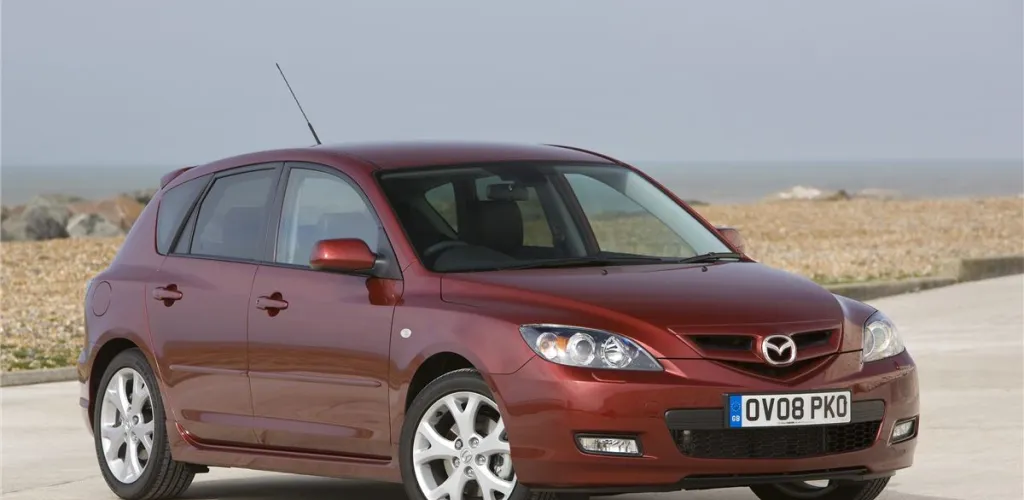
- First-gen Mazda 3 BK launched in 2003, praised for handling and interior design
- Engine lineup spans 1.4-2.3L gas and 1.6-2.2L diesels; turbo MPS at 260 hp
- Real-world fuel economy varies; urban 7–9 L/100km, extraurban 6–8 L/100km
- Rust is the main issue; other problems include suspension wear and timing concerns
The first-generation Mazda 3, known internally as BK, marked the Japanese automaker’s entry into a competitive segment, replacing the Familia/323/Protege in 2003. This compact car stood out with its distinctive design and dynamic handling, quickly becoming a popular choice in Europe and North America.
Launched initially in Japan under the Axela name in October 2003, the Mazda 3 BK was well received by automotive press for its performance, nimble handling and well‑designed interior. The performance‑oriented version was marketed as Mazdaspeed3 in North America and Mazda 3 MPS in Europe, offering 260 hp from the 2.3 turbo engine.
Engine range: from efficiency to performance
Gasoline engines:
- 1.4 L MZR - 84 hp and 122 Nm of torque
- 1.6 L MZR - 105 hp and 145 Nm of torque
- 2.0 L MZR - 150 hp and 187 Nm of torque
- 2.3 L MZR DISI Turbo - 260 hp and 280 Nm of torque (MPS version)
Diesel engines:
- 1.6 L MZ-CD - 109 hp and 240 Nm of torque
- 2.0 L MZR-CD - 143 hp and 360 Nm of torque
- 2.2 L MZR-CD - 185 hp and 400 Nm of torque
Driving experience and real-world consumption
Owner Alex Bizdoaca describes the Mazda 3’s behavior as: “In the city it is quite stiff and at times seems a bit tough for urban driving, but you get used to it. On long journeys it’s at ease. The larger engine makes the trip comfortable and the stability in corners gives you the confidence to push the tires to the limit.”
Titi Marian adds: “In the city the car handles well. The acceleration is good, and the fuel consumption is reasonable. On long trips the car drives well. One downside is that it does not have cruise control. The pedals are a bit firmer than in a Seat Ibiza. The steering is precise.”
Real-world consumption reported by owners:
Engine 2.0i (150 hp):
- Urban: 9.2 L/100 km
- Extraurban: 6-8 L/100 km
Engine 1.6i (105 hp):
- Mixed: 7.2 L/100 km
- Urban: 9-10 L/100 km
- Extraurban: 6.5 L/100 km
Engine 1.4i (84 hp):
- Urban: ~7 L/100 km
- Extraurban: 5-6 L/100 km
Common problems of Mazda 3 BK
Rust - the main problem
The most widespread issue of the first-generation Mazda 3 is rust, which mainly affects:
- Sills and wheel arches
- Rear torsion beam
- Lower body panels
Other common problems:
- Suspension: wear of rear shocks and suspension arms
- Timing system: issues particularly at high mileage
- Diesel particulate filter (DPF) in diesel versions
- Air conditioning and engine cooling radiators
- Knock sensor on certain units
Reliability from the owners’ perspective
Stefan Pricop, owner of a Mazda 3 1.4i, confirms: “No problems, it doesn’t burn oil like other cars of its age and class.”
Luchian Sofrone adds: “The car is mechanically reliable, no electrical or engine issues. The oil pan has been changed; it’s made of sheet metal and is affected by wear.”
Corujan Andreea, after 13 years of use: “It presents well; at purchase I only changed the discs and the oil; of course the rust issue is frightening, but it can be treated.”
Prices on the used market
The first-generation Mazda 3 has become affordable on the used market:
- Mazda 3 2.0 (2008, 236,000 km): ~€3,500
- Mazda 3 1.6 (2006, 220,000 km): ~€1,990
Prices vary depending on the engine, body condition, and actual mileage.
Buying tips
Recommendations from owners:
Trusca Ovidiu recommends: “Choose the 2.0 gasoline engine. Power and about 9.2 in city driving under sporty conditions. Be attentive to rust. As I said, it’s their weakness.”
Alex Bizdoaca cautions: “Do not buy Mazda 3 and in general Mazda diesel. Japanese engines are very good on gasoline!! Watch out for rust!”
What to watch for:
- Check for rust – inspect sills, wheel arches, and the rear bumper
- Avoid diesel versions – especially for urban use
- Prefer gasoline engines – more reliable in the long term
- Inspect the suspension – check shocks and control arms
- Check the maintenance history – regular oil changes are important
Conclusion
The Mazda 3 BK remains a solid choice for those seeking a compact car with superior dynamic qualities. While rust is the main problem, well-maintained examples can offer a pleasant driving experience and reasonable maintenance costs. Gasoline engines, especially the 1.6 and 2.0, prove to be the most reliable options for this generation.