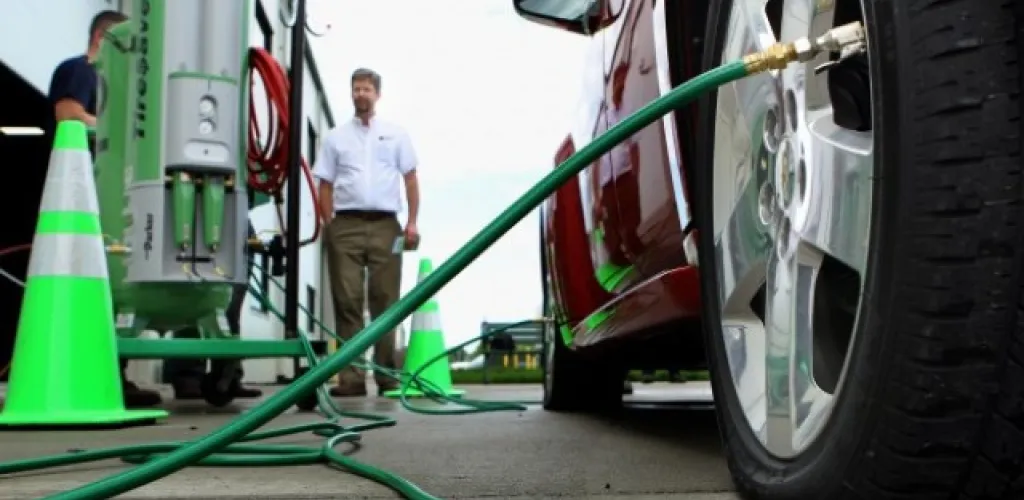
- Stable pressure: nitrogen leaks slower, reduces temperature-related pressure fluctuations.
- Fuel efficiency: constant pressure can save 3-6% energy; lowers rolling resistance.
- Longer tire life: potentially cutting tire disposal by up to 30%.
- Higher safety: maintains pressure, lowers risk of underinflation; nitrogen doesn’t ignite.
Nitrogen inflation has grown increasingly popular in recent years, representing a modern alternative to traditional compressed air. Although this technology is not yet widespread in Romania, Western countries have used it for years in motorsport, aviation, and military applications. Nitrogen offers significant benefits in maintaining constant pressure and extending tire life, but it also comes with certain drawbacks and additional costs that every driver should evaluate.
Major advantages of nitrogen in tires
[Stable tire pressure]
Nitrogen provides the major benefit of remaining in the tire longer, as it passes much more slowly through the rubber structure than regular air. Nitrogen molecules are larger than oxygen molecules, which significantly reduces the rate of pressure loss.
Thus, a nitrogen fill will have greater durability than compressed air. You will also notice lower fluctuations in pressure as temperatures change, a crucial factor for consistent performance.
This is one of the main reasons nitrogen is preferred in car racing. Tires heat up extremely quickly at high speeds, causing frequent pressure fluctuations when inflated with air. With nitrogen, this problem is resolved without frequent visits to the mechanic.
[Fuel efficiency]
If tire pressure remains constant, it stands to reason that performance and fuel efficiency will be higher as well. Studies show that maintaining proper pressure across all four tires can save 3-6% of energy over their lifetime.
Correct and constant pressure reduces rolling resistance, which directly translates to lower fuel consumption. For a driver who covers 20,000 km per year, this difference can mean substantial savings.
Lower environmental impact
An essential reason nitrogen is preferred over air is that it is easy to produce, it has no distinctive odor, it does not burn, and is largely present as a component of atmospheric air (78% of air is nitrogen).

Did you know that over 300 million tires are discarded annually worldwide? Using nitrogen to inflate tires can reduce this enormous number by up to 30%, by extending tire life.
Longer tire life
By helping maintain a constant tire pressure, nitrogen also leads to longer tire life. For a wheel that loses only 10% of its pressure, its life can be reduced by 7-15%.
Additionally, nitrogen is dry (moisture-free), so it does not interact with metallic components and does not cause rusting or progressive damage to wheels or rims. Water in compressed air can promote rusting and deterioration of steel rims.
Higher safety level
You may not know it, but over 90% of tire blowouts are rooted in low pressure. Thus, inflating the wheel with nitrogen and maintaining a constant pressure from the start reduces the risk of driving with underinflated wheels.

Moreover, nitrogen does not ignite, so a tire inflated with nitrogen will not worsen a fire in an accident scenario. Unlike air-filled tires, whose temperature can change frequently, the temperature inside nitrogen-filled tires remains stable and around 30-40 degrees during summer.
Disadvantages of nitrogen inflation
Additional costs
Inflating your tires with nitrogen, compared to traditional air, will certainly cost you more. You’ll need to decide whether the investment is worth it and whether the benefits outweigh the costs.
Typically, the initial nitrogen fill can be 3-5 times more expensive than compressed air, and subsequent top-ups can cost between 2-10 lei per wheel, depending on the service.
Limited availability
Unlike air-inflation centers (found at every gas station), nitrogen can be harder to find. Most specialized automotive service shops and some premium stations offer this facility, but the network remains limited.

It does not eliminate checks entirely
Even though nitrogen-inflated tires have greater durability and pressure stays constant for a longer period, that does not mean you won’t need to check pressure from time to time.
Monthly pressure checks remain a recommended practice, regardless of the gas used for inflation.
Conclusion: Is the investment worth it?
Overall, the decision rests with you: whether the investment and the time to find a center that offers nitrogen inflation are worth it, or you stick with traditional air.
It is a fact that over 70% of cars on the road today have tire pressures below the recommended level, which increases the risk of accidents.
Although nitrogen is not yet a very popular technique here, it has been used for years in the West, and not without reason. The list of benefits that nitrogen in tires offers over air is considerable: in addition to those mentioned, you can add increased driving comfort, a lower risk of tire blowouts, higher road safety, and many more.
For drivers who cover long distances annually, those who drive in extreme conditions, or owners of high-performance cars, the nitrogen investment can be justified. For ordinary urban use, compressed air remains a practical and economical solution, provided pressure is checked regularly.