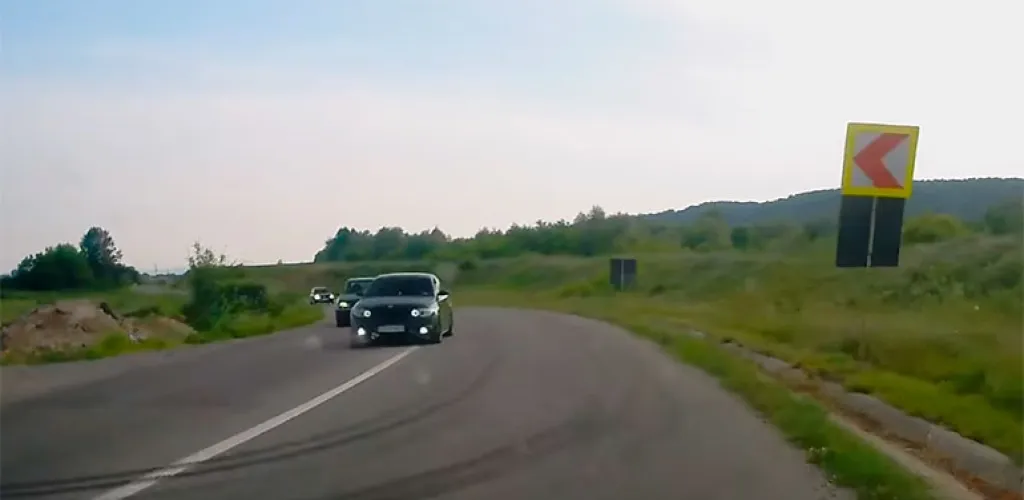
- Overtake on the left; trams or left-signaled vehicles may be overtaken on the right.
- Safe overtaking only: no one starting, enough space to re-enter, no oncoming traffic.
- Curves/grades with reduced visibility ban overtaking; solid line; exception for motorcycles/bicycles if safe.
- Tunnels with one lane per direction ban overtaking, even if illuminated.
Overtaking is one of the most risky maneuvers in traffic, responsible for a significant number of serious crashes on Romanian roads. Despite the rules being clear, many drivers choose to ignore them, putting their lives and the lives of other road users at risk. A correct understanding of the situations in which overtaking is forbidden and adherence to these regulations can make the difference between a safe journey and a tragic accident.
Under Article 45 of the Regulation implementing the Road Traffic Code, overtaking is defined as the maneuver by which a vehicle passes in front of another vehicle or alongside an obstacle located on the same direction, by changing direction and leaving the lane or the line of vehicles.
Before initiating this maneuver, the driver must meet several essential conditions:
- Ensure that the vehicle ahead or behind has not already started an overtaking maneuver
- When crossing the axis that separates directions, verify that no oncoming vehicle is approaching
- Have enough space to re-enter the initial lane after performing the maneuver
- Must re-enter the initial lane after completing the overtaking
It is important to mention that the situation in which a vehicle is moving faster on one lane than vehicles on another lane in the same direction does not constitute overtaking. In addition, the general rule states that overtaking is performed only on the left side of the vehicle being overtaken, with the exception of a tram or a vehicle whose driver signaled the intention to leave the traffic lane to the left — these are overtaken on the right.
Situations where overtaking is strictly prohibited
1. Curves and grades with reduced visibility
Curves and grade changes are extremely dangerous zones for overtaking, as reduced visibility prevents you from observing oncoming vehicles. These road sections are marked with a solid line and a prohibition sign for overtaking for all vehicles.
There is a single exception: overtaking a motorcycle or bicycle, but strictly under the condition that you do not enter the opposite traffic lane. This maneuver is actually a passing and can be performed only when there is sufficient safety space between your vehicle and the vehicle being overtaken, without having to invade the opposite lane.
Risks of overtaking on a curve include:
- Inability to estimate the distance to oncoming vehicles
- Insufficient reaction time in case of an emergency
- Difficulty in controlling the vehicle at high speeds in tight curves
- Danger of encountering an unforeseen obstacle after the bend
2. Tunnels and underground passages
Tunnels and underground passages with a single lane in each direction are zones where overtaking is strictly prohibited, regardless of whether they are illuminated. The reasons for this prohibition are multiple:
- Limited space that does not allow avoidance maneuvers
- Reduced visibility, even in lit tunnels
- Inability to abandon the maneuver in case of emergency
- Increased risk of frontal collision
However, overtaking is permitted when there is more than one lane in your direction of travel, provided you do not cross into the lane of the opposite direction. In this case, you must strictly follow road markings and stay in your lane.
3. Level crossings with railway tracks
Level crossings with railway tracks and the surrounding area are considered among the most dangerous points of the road network. Overtaking is absolutely forbidden in these locations for the following reasons:
- Need to yield to approaching trains
- Possibility that the overtaken vehicle may have to brake suddenly
- Risk of getting stuck on the tracks during the maneuver
- Reduced reaction time in case a train approaches
Correct procedure when approaching a level crossing:
- Gradually reduce speed
- Observe acoustic and visual signals
- Stop at a safe distance if necessary
- Cross the tracks only after ensuring no train is approaching
- Do not stop or stand on the tracks
4. Bike lanes and adjacent areas
Near a bike lane, overtaking is prohibited due to the high risk of hitting cyclists traveling parallel to the road. Bike lanes often have intersections with regular streets where overtaking can endanger both cyclists and pedestrians.
Safety aspects to consider:
- Cyclists may change direction without prior warning
- The required minimum lateral distance from cyclists is 1.5 meters
- Cyclists’ lower speeds can create large speed gaps
- Children riding bicycles are unpredictable in behavior
5. Intersections
Intersections are critical nodes of road traffic where multiple streams of vehicles, cyclists and pedestrians meet. Overtaking is prohibited at intersections for the following reasons:
- Traffic complexity from multiple directions
- Presence of pedestrians crossing the street
- Possibility that the vehicle in front will turn
- Risk of collision with vehicles entering the intersection
- Difficulty in properly assessing priorities
The exception to this rule: overtaking is allowed only if there are road signs clearly indicating this or when the traffic police directing the traffic signals you to perform the maneuver.
Exceptions to the overtaking prohibitions
There is one exception that applies to most of the situations mentioned above: when a stationary vehicle blocks the road in the same direction you are traveling, it may be overtaken. This maneuver is allowed under the following conditions:
- Ensure beforehand that performing the maneuver is not dangerous
- Respect road markings and signals
- Yield to oncoming vehicles
- Return to your lane as soon as possible
Also, under the same circumstances, you may overtake bicycles, respecting the minimum safe lateral distance of 1.5 meters.
How to correctly perform an overtaking maneuver
To perform an overtaking maneuver with maximum safety, follow these steps:
- Evaluation: Estimate the speed of the vehicle you wish to overtake and calculate the time required for the maneuver
- Check: Look in the rearview mirror, the side mirror, and check the blind spot
- Signaling: Activate the left turn signal well in advance
- Ensure: Check that no oncoming vehicle is approaching and that you have enough space
- Acceleration: Increase speed to minimize the time spent in the opposite lane
- Return: After you have completely overtaken the vehicle, signal to the right and return to the initial lane
Penalties for unlawful overtaking
Unlawful overtaking is sanctioned under the Road Traffic Code with a monetary fine and penalty points. In serious cases, such as overtaking in high-risk zones or causing an accident, license suspension may be imposed.
Conclusions
Overtakings are one of the leading causes of serious road accidents, after speeding. It is essential to ensure you are well prepared before entering an overtaking maneuver and never perform a forced maneuver. Patience and prudence can save lives — better to wait until you are sure you can overtake under maximum safety conditions.
Remember: no overtaking is worth risking your life. Observing traffic rules is not optional, but an obligation to yourself and to other road users.