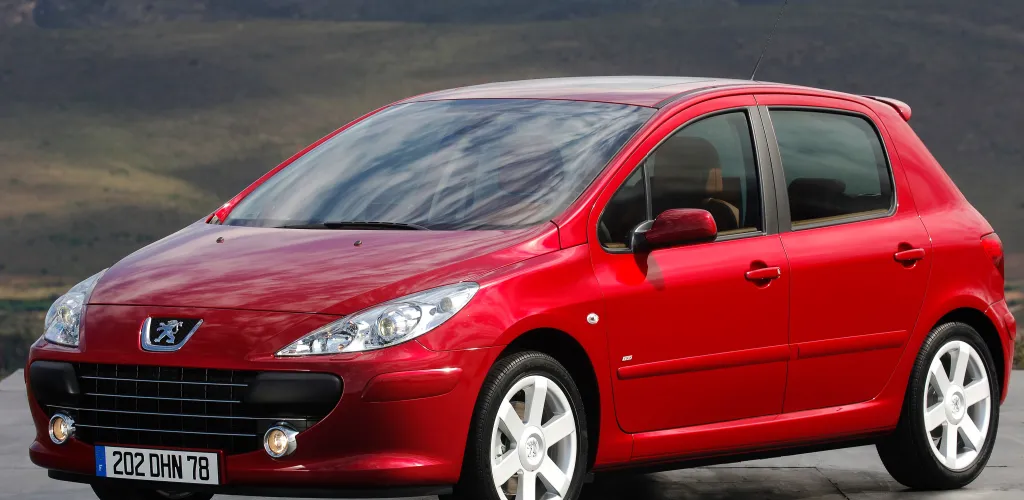
- Peugeot 307 (2001-2008) won European Car of the Year in 2002.
- Common issues include EGR valve, DPF, dual-mass flywheel, electrical and ECU faults.
- Diesel and petrol ranges offered, including S HDi 90/110 and GT 2.0 180.
- Variants include 307 Break and 307 SW; China sedan version produced 2004-2014.
The Peugeot 307 remains a popular choice in the compact family car segment, produced from 2001 to 2008 as the successor to the 306. This French car won the title of European Car of the Year in 2002 and enjoyed notable commercial success across Europe and beyond.
The model continued to be offered in China and certain South American markets until 2014, even after the introduction of its successor, the Peugeot 308, in September 2007. To better understand this car, we gathered owner opinions and first-hand experiences from Peugeot 307 owners in Romania.
History and variants of the Peugeot 307
Production hatchback versions were introduced on European markets on 26 April 2001. The Peugeot 307 uses an improved 306 platform, which is also used by the Citroën Xsara and the Citroën ZX from 1991. However, the car is larger than the 306 in all dimensions.
The 307 range was expanded in June 2002 with the introduction of two new models: 307 Break and 307 SW. Externally, the two variants are almost identical, but the SW version benefits from a panoramic glass roof. A four-door sedan version was launched in China in June 2004, produced by Dongfeng Peugeot-Citroën Automobile until 2014.
Owner opinions - why they chose the Peugeot 307
We collected responses from Romanian owners of the Peugeot 307 to understand the reasons behind their choice.
Engine 1.6 HDi (110 hp)
Pana Mihnea explains: “Since I was young I liked this model and I knew both its reliability and the comfort of a Peugeot.”
Morar Rareș mentions: “For looks, comfort, the simplicity with which it is built, and when I look at the front of the car it gives me the impression of a car with a lot of horsepower.”
Engine 1.6 16V (109 hp)
Florin Alexandru says: “I liked it at the time, it seemed good for a beginner and fit my budget.”
Babtan Ruben appreciates: “Comfort (offers more than the competition), design, engine (HDI recognized as among the best diesel engines).”
Common problems on the Peugeot 307
Based on owner feedback and technical analysis, the following issues are frequently reported:
- EGR valve - one of the most common problems on diesel engines
- Diesel Particulate Filter (DPF) - requires periodic regeneration by driving long distances
- Dual-mass flywheel - can show problems at high mileage
- Electrical system - various sensor and lighting cluster issues
- ECU (Engine Control Unit) - electronic faults can occur
Available engines and performance
The Peugeot 307 offers a diverse range of engines for all preferences:
Diesel engines
- S HDi 90 (3-door) — 0-100 km/h in 12.5 s
- S HDi 110 (3-door) — 0-100 km/h in 11.2 s
- GT HDi 136 (5-door) — 0-100 km/h in 9.8 s
- Urban HDi 90 (5-door) — 0-100 km/h in 12.5 s
Petrol engines
- S 1.4 16v (3-door) — 0-100 km/h in 12.8 s
- S 1.6 16v (5-door) — 0-100 km/h in 10.7 s
- Sport 2.0 16v (5-door) — 0-100 km/h in 8.9 s
- GT 2.0 180 (5-door) — 0-100 km/h in 8.2 s
- X-Line 1.4 16v (5-door) — 0-100 km/h in 12.8 s
Driving experience and fuel consumption
Owners describe the Peugeot 307 as a pleasant car to drive, with good maneuverability in the city and on long roads.
Traffic behavior
Pana Mihnea: “Easy to drive, quite small, parking spaces are easy to find. It is very comfortable; you can drive hundreds of kilometers without problems.”
Morar Rareș: “Easy, except that being a station wagon you have to look twice for parking spots. On long trips it is very comfortable.”
Babtan Ruben: “Easy. Although parking can be tight at times. On long trips it is very comfortable.”
Fuel consumption
Engine 1.6 HDi (110 hp)
- Pana Mihnea: “5-5.1 L/100 km on highways and 6.2-6.3 L/100 km in the city.”
- Morar Rareș: “Normal driving 5-6 L/100 km on highways and in the city 7-9 L/100 km, depending on your driving style.”
Engine 1.6 16V (109 hp)
- Andries Daniel: “Mixed consumption around 8 L/100 km, outside 6.5 L/100 km.”
- Florin Alexandru: “Outside the city, on long trips you get about 3-4 L/100 km, very little, and in the city 6-7 L/100 km.”

Reliability of the Peugeot 307 - real experiences
Reliability is crucial when choosing a used car. Owners share their experiences with the issues they encountered.
Experiences with the 1.6 16V (109 hp)
Andries Daniel: “As problems: I changed anti-roll bar links and rear shocks, and otherwise usual wear… and the battery suddenly gave out, but I was at home.”
Babtan Ruben: “Major issues: replaced an injector, flywheel, radiator. Minor issues: sensors, bulbs, spark plugs, relay, skid plate. Given the mileage, not many repairs.”
Florin Alexandru: “The biggest problem was the clutch; it wasn’t that I did something to it, but it needed replacement. Other parts last fairly long, especially if you buy quality, I didn’t have problems aside from the clutch and the turbo.”
Experiences with the 1.6 HDi (110 hp)
Pana Mihnea: “The only problem was the crankshaft pulley, but it was resolved very easily, without high costs; otherwise the car performed very well, I didn’t encounter other problems.”
Morar Rareș: “The only major issue is regenerating the particulate filter (you need to go on a long trip and heat it up).”
Prices on the second-hand market
Based on the Romanian auto market analysis, prices for the Peugeot 307 range from €1,500 to €3,000, depending on year of manufacture, mileage, and overall condition.
Concrete price examples
- Peugeot 307 SW, 2.0 diesel, 2006 - 183,000 km: €1,650
- Peugeot 307, 1.6 petrol, 2006 - 150,000 km: €2,990
Buying tips from owners
Experienced owners offer valuable advice for potential buyers:
Babtan Ruben: “It is a good choice; pay attention to the DPF and the light cluster.”
Florin Alexandru: “I recommend buying it, especially for beginners; it does the job, but watch the revs. Like any diesel, you must be careful with the turbo; it tends to fail.”
Pana Mihnea: “Buy it with confidence; you won’t regret it, although rumors say otherwise.”
Morar Rareș: “Consider whether you will drive outside the city at least once every two weeks; otherwise the particulate filter can clog.”
Conclusion
The Peugeot 307 remains a solid choice for those seeking a reliable and comfortable family car. While it does show some common issues tied to its age and technology (2001-2008), most owners are satisfied with their purchase. The key to success lies in proper maintenance and selecting a well-kept example at purchase.
Photo credit: autoevolution.com