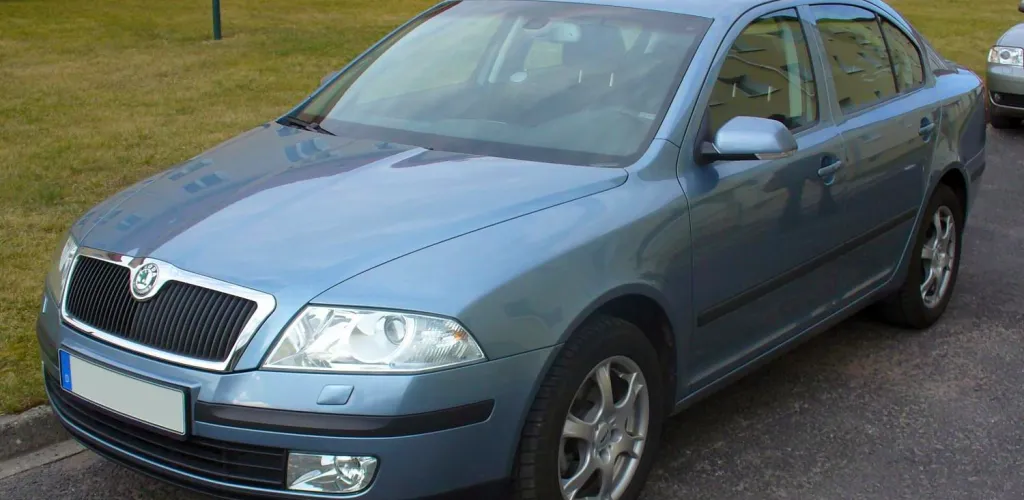
- Octavia II (2005–2013) rides on VW Group’s PQ35 platform, shared with Golf and A3
- It boosted interior space, ride height, boot capacity, and rigidity
- Nearly 5 million sold; about 40% of Skoda’s global output, showing impact
- Common issues: automatic 6-speed transmissions, EGR clogging, DPF, and turbo problems
Skoda Octavia has long been the cornerstone of the Czech manufacturer’s lineup, a family car that earned its reputation for reliability and practicality. The second generation, produced from 2005 to 2013, marked a significant moment in the model’s evolution, delivering meaningful improvements in design, space, and technology.
With nearly 40% of Skoda’s global production represented by the Octavia and over five million units sold worldwide, this model demonstrated that it can compete successfully in the compact-medium segment. Built on the Volkswagen Group A5 (PQ35) platform, the Octavia II shares technical underpinnings with respected models such as the Audi A3 Mk2, VW Golf Mk5, and SEAT Leon Mk2.
Evolution of design and technical platform
The second generation Octavia was introduced in March 2004, led by design teams under Thomas Ingenlath and Peter Wouda. The new PQ35 platform allowed increased interior space, improved ground clearance, and optimized handling.
Changes to the bodywork included:
- Generous legroom for front and rear passengers
- Increased ride height for a more comfortable driving position
- Large boot, a hallmark of the Octavia
- Improved body rigidity
Real owner opinions
We collected feedback directly from Octavia II owners to understand the true strengths and weaknesses of this model.
Why did they choose Octavia II?
For the RS 2.0 TFSI (200 HP):
Iulian Grecu: “I opted for petrol, because I currently drive mostly in the city, and the chosen engine was perhaps also a bit for adrenaline.”
For the 1.9 TDI (105 HP):
Alin Simion: “Because I knew they are reliable, given the 1.9 TDI engine from other VW Group models, and I needed a sturdy and reliable car.”
Ionica Marian: “Power, space, comfort, safety, design. These are just a few of the qualities of these superb and extremely efficient cars I own.”
Lefter Rareș: “Low maintenance, parts are easy to find and cheap, enough power, it doesn’t let you down in overtakes, perfect for both a beginner and an experienced driver.”
Common problems on Skoda Octavia II (2005-2013)
Based on owner feedback and service experience, the main issues observed include:
Automatic transmission
Automatic gearboxes, especially 6-speed units, can show issues at higher mileage. Symptoms include:
- Gears slipping or not engaging
- Noise when shifting gears
- The need to replace transmission oil at regular intervals
EGR system (Exhaust Gas Recirculation)
EGR valves can become clogged, particularly on diesel engines:
- Rough idling
- Increased fuel consumption
- Higher emissions
- Periodic cleaning or replacement required
Diesel particulate filter (DPF)
Common in modern diesel engines:
- Clogging with heavy city use
- Forced regeneration needs
- High replacement costs
Turbocharger
In TSI and TDI engines issues may appear:
- Oil leaks
- Blade wear
- Vacuum system problems
- Power loss and higher fuel consumption
Comprehensive engine range
The Octavia II offers an impressive selection of engines for all needs:
Gasoline engines
- 1.2 TSI (104 HP, 175 Nm) – efficient for city driving
- 1.4 MPI (74 HP, 126 Nm) – reliable entry level
- 1.6 8V/MPI (101-104 HP, 148-153 Nm) – good power/consumption balance
- 2.0 MPI (118 HP, 180 Nm) – for those who prefer natural aspiration
- 2.0 TSI RS (197 HP, 280 Nm) – top sport version
Diesel engines
- 1.6 TDI (104 HP, 250 Nm) – modern with DPF
- 1.9 TDI (104 HP, 250 Nm) – the legendary, DPF-free engine
- 2.0 TDI RS (168 HP, 350 Nm) – sporty diesel with excellent performance
Driving experience
Owners praise the Octavia II’s road behavior across conditions:
In urban driving and parking
Laurențiu Constantin: “As long as the car is long, it is easy to drive. Parking is fairly easy, a drawback being the ride height, which can limit parking in tight spots.”
Buruiană Dorin: “The only obstacle is parking in crowded cities, but it isn’t overly problematic. In terms of driving, it handles very well and you don’t feel the traffic.”
On long roads and highway
Buruiană Dorin: “On long trips it is exceptional. A car you can rely on for overtaking or driving through winding roads. On the highway you don’t notice time passing at speeds around 130–140 km/h.”
Ionița Adrian: “It has a very pleasant stance on open roads; you don’t feel when you reach 130–140 km/h.”
Reliability – real experiences
Powertrain 2.0 TFSI (gasoline)
Iulian Grecu: “As my chosen engine, the 2.0 gasoline isn’t exactly the most fuel-efficient, it depends on driving style and how you press the accelerator.”
Tudorache Bogdan: “Suspension is rigid; it’s reliable as long as you don’t mix in other things besides fuel.”
Powertrain 1.9 TDI (diesel)
Ionița Adrian: “So far I haven’t had issues; the few I’ve had were small and quickly resolved; it never left me stranded. It’s very reliable in my view.”
Alin Simion: “Minor issues overall related to daily use. Very minor problems. Revisions, timing belts, and clutches in general, as well as brakes and consumables.”
Less pleasant experiences
Ferenc Dumitrașcu: “The biggest problem was that the engine cracked on the way home from abroad. It was a manufacturing defect, a piston bolt without proper safety, which moved and came out of place. The connecting rod tore the engine in three places. A used engine, 5800 RON, 2010 manufacture, BXЕ, runs well even today.”
Second-hand market prices
Based on current market research, Octavia II prices vary by:
Price examples (2024)
- Octavia 1.6 TDI (105 HP, 2012, 189,000 km): 5,350 EUR
- Octavia 1.9 TDI (2006, 248,000 km): 3,890 EUR
- Octavia 2.0 TSI RS (2008-2010, 150,000–200,000 km): 6,000–9,000 EUR
- Octavia 1.4 TSI (2009-2012, 120,000–180,000 km): 4,500–6,500 EUR
Factors influencing price
- Full service history
- Number of previous owners
- Body and interior condition
- Engine and trim level
- Actual mileage
Buying tips
Experienced owners’ recommendations:
Essential checks
Iulian Grecu: “Don’t expect ultra-low consumption; be mindful of costs and change oils on time. I’d opt for a thorough check at a dealership to learn the car’s history.”
Laurențiu Constantin: “My advice is to pay attention to the number of kilometers, previous repairs, and how the owner and the car look during viewing. It’s important to listen for any unusual noises, how the engine starts and stops.”
Why it’s worth the investment
Alin Simion: “It’s worth it. A reliable car that can be used as a daily driver or for long trips, as a family car with space or as a work vehicle. Pay attention to the engine, how it’s maintained, timely revisions, and high-quality oil.”
Mihai Nițu: “I recommend it with full confidence, such a good car, especially with low mileage. It’s the best option in the €3,500–€6,000 range. Believe me, I know what I’m talking about; I’ve owned eight cars and driven many more.”
Purchase checklist
-
Engine check:
- Idle and acceleration sound
- Oil color and consistency
- History of oil changes
- Condition of the cooling system
-
Transmission:
- Operation of the automatic transmission (if applicable)
- Clutch condition on manual transmissions
- Vibrations or abnormal noises
-
Auxiliary systems:
- Air conditioning operation
- Electrical system (lights, starters, sensors)
- Suspension wear and noises
-
Documents:
- Complete service history
- Proof of ownership
- Valid technical inspection (ITP)
- Invoices for major repairs
Octavia II remains an excellent choice for those seeking a reliable family car with reasonable maintenance costs and versatile use. With attention to known improvement points and a thorough pre-purchase check, it can offer many years of satisfying use.
Sursa foto: wikimedia.org