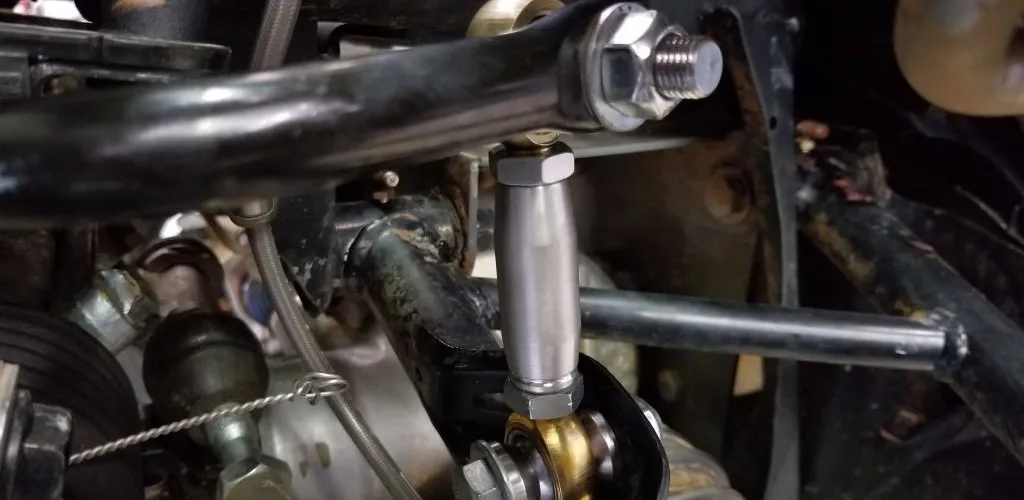

- Connects the shock absorber to the stabilizer bar at both ends.
- It limits body roll in turns and transfers load across the suspension.
- Benefits include improved stability, safety, and driving comfort with less sway.
- Signs of replacement: check mounting points for looseness or wear.
The sway bar link is a crucial component of the suspension that plays a decisive role in a car’s stability and safety in corners. To fully understand the role of this part, it’s important to first clarify the concept of roll and see how the entire stabilization system works.
Roll represents the vehicle’s motion around its longitudinal axis — basically, the car tilts to the left or right when entering corners or when weight shifts sideways. This phenomenon is natural, but it must be controlled to maintain grip and stability.
What is the sway bar link and where is it located
The sway bar link is a metal component that physically connects the car’s shock absorber to the stabilizer bar. This part is found at both ends of the stabilizer bar, on both the left and right sides of the vehicle.
Structurally, the link is a straight or slightly curved rod, equipped at both ends with spherical bearings or rubber bushings that allow controlled movement. The material used is usually heat-treated steel to withstand the mechanical stresses.
How the sway bar link works
The sway bar link works by distributing forces between the two halves of the suspension:
In normal turns
During ordinary turns, the sway bars allow a certain natural tilt of the body but limit it with an ingenious mechanism. When the car enters a right-hand turn, for example, weight shifts to the left, compressing the suspension on the left side.

In sharp turns
In extreme situations, without a sway bar link, the car would lean dramatically, potentially to the point where the wheels on the opposite side of the turn lift off the ground. The link prevents this by:
- Limiting the compression travel: When the suspension on one side compresses too much, the link reaches maximum extension
- Transferring the force: The force is transmitted through the stabilizer bar to the other side of the suspension
- Balancing the system: The shock absorber on the opposite side is forced to work more intensely
Benefits of a functional sway bar link
Improved stability
- Keeps the car’s center of gravity as low as possible
- Keeps the car’s ride height roughly parallel to the ground
- Reduces the sensation of “sway” in successive turns
Active safety
- Prevents wheel lift in tight turns
- Maintains optimal tire grip
- Improves vehicle handling
Driving comfort
- Reduces lateral weight transfer felt by passengers
- Minimizes abrupt body motions
- Provides a sense of stability and confidence at the wheel
Signs that the sway bar link needs replacement
Visual inspection
You can perform a first check yourself using the following steps:
- Visual inspection: With the car stopped, turn the steering wheel to the maximum in one direction and visually inspect the sway bar links
- Check mounting points: Ensure the link does not move at the attachment points to the shock absorber or stabilizer bar
- Examine the bushings: Look for cracks, deformations, or damage to the rubber bushings
Symptoms while driving
- Instability in turns: The car leans excessively and feels unstable
- Suspicious noises: Popping or metallic sounds in corners or over bumps
- Unpredictable behavior: The sensation that the car “dances” or sways excessively
- Uneven tire wear: May indicate compatibility issues with the suspension
Professional inspection
If you notice any of these symptoms, it is recommended to consult a specialized mechanic for:
- Checking the entire suspension system on a hoist
- Testing for play in the joints
- Assessing the condition of the bushings and mounting points
- Recommendations for replacement or repair
Maintenance and lifespan
Sway bar links are parts that wear over time, being subjected to:
- Constant mechanical stresses in turns and when crossing obstacles
- Corrosion caused by salt, moisture, and mud
- Wear of rubber bushings that lose elasticity
In general, sway bar links have a lifespan of 80,000-120,000 km, depending on driving style and usage conditions. Aggressive driving, poor roads and lack of maintenance can significantly reduce this lifespan.
For optimal operation, it is recommended to periodically check the sway bar links as part of routine suspension inspections, especially if you notice changes in the vehicle’s behavior in turns.