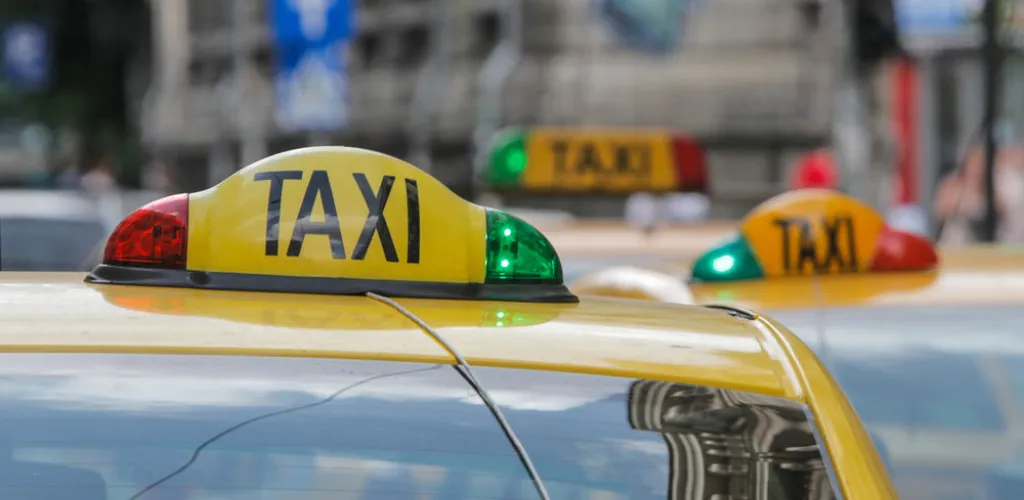
- The taxi name comes from Francesco Tasso and the Thurn und Taxis system.
- Early taxis used yellow horse-drawn carriages as public transport.
- Romania introduced motorized taxis in 1953–1954, replacing horse-drawn vehicles.
- John Hertz’s color study set yellow as the most visible taxi color.
Taxi cabs are an integral part of modern urban life, present in every major city worldwide. These vehicles give us instant mobility when we need to move quickly from one point to another, without a personal car. However, few people know the fascinating history of this transport mode that has evolved over centuries.
The story of taxis begins long before the automotive era and extends across several centuries, shaping the development of urban transport and defining the street landscape in the world’s great metropolises.
Definition and origin of the taxi term
The first taxi in history
According to Jude Stewart, author of “ROY G. BIV”, the first taxi on the globe appeared in Italy. The story begins with Francesco Tasso (1459-1517), one of the founders of the European postal service. At the time there were no cars, but horse-drawn carriages painted yellow were used to avoid political offense. The Austrian Emperor decorated Tasso with the title “Torre e Tasso” or “Thurn und Taxis”. Thus the name taxi appeared, which has endured to this day.
These medieval carriages essentially represented the first organized system of paid public transport, laying the groundwork for the modern concept of taxi.
Development of taxi services in Romania
In our country, motorized taxi services were established in 1953-1954. This period marked the transition from traditional horse-drawn transport to modern motorized vehicles.
The Romanian taxi system developed gradually, adapting to the economic and social realities of the country, evolving from a strictly regulated service during the communist era to a more flexible system in the post-1989 era.
The reason why taxis are generally yellow
New York’s yellow revolution
The first yellow vehicle to operate as a taxi was in New York in 1912. Customers who called the taxi service paid 50 cents per mile, and the business was immensely profitable, recording substantial earnings.
John Hertz and the scientific study of color
Over time, the Yellow Cab company of Chicago, founded by John Hertz, deployed a larger number of yellow cars in taxi service. John Hertz (1879-1961) commissioned a scientific study to analyze the most suitable taxi color. The study aimed to determine the color that could be observed most easily from a distance, under varying lighting and weather conditions. The results showed that yellow offers optimal visibility, being the easiest color to identify in urban traffic. That was the moment when yellow was definitively chosen. The vehicles owned by John Hertz were painted yellow from that moment, and the company gained exclusivity over this color for a period.
Expansion and market liberalization
Later, in 1925, John Hertz decided to sell the company’s stock. At that time, Yellow Cab had an impressive fleet of 2,700 taxis in major cities such as New York, Philadelphia, Kansas City, and Chicago. Shortly after the sale, U.S. judges allowed other taxi firms to paint their cars yellow as well, thereby liberalizing the market and ending the monopoly on this distinctive color.
The British exception: London’s black cabs
In many countries, taxis are yellow—USA, Germany, India, Indonesia, Russia, Sweden, Hungary, Taiwan, Thailand, Uruguay. This uniform color has become almost universal due to its proven efficiency in quickly identifying vehicles.
The London tradition
One notable exception is the United Kingdom, namely London, where taxis are black, a tradition also kept in France (Paris). The first London taxi fleet consisted of Austin FX3 cars, models produced after 1948. They came from the factory painted black, and decision-makers did not want to modify the vehicles’ appearance, considering black to offer a more elegant and professional image.
Technical features of London cabs
London taxis, known as the “black cabs”, were specifically designed to meet the requirements of Britain’s urban transport:
- Reduced turning radius: Allowing easy maneuvering on London’s narrow streets
- Generous passenger space: Including the possibility of transporting people with disabilities
- Exceptional durability: Built to withstand intensive urban use
- Excellent visibility: For both the driver and for customers to identify the vehicle
These technical features made the Austin FX3 models and their successors iconic for London’s urban landscape, just as yellow taxis define New York.
Cultural and economic impact
Taxis have surpassed their simple transport function and become cultural symbols of major cities. The yellow New York taxi, the London black cab, and the famous Parisian taxis have become defining elements of the urban identity of these metropolises.
Economically, the taxi industry has created millions of jobs worldwide and significantly contributed to urban mobility, offering a flexible alternative to mass public transport. Today, in the era of digitalization and mobile apps, the traditional concept of taxi continues to evolve, but the fundamental principles established by Francesco Tasso in the 15th century and refined by pioneers like John Hertz remain the foundation of this essential service for modern urban life.