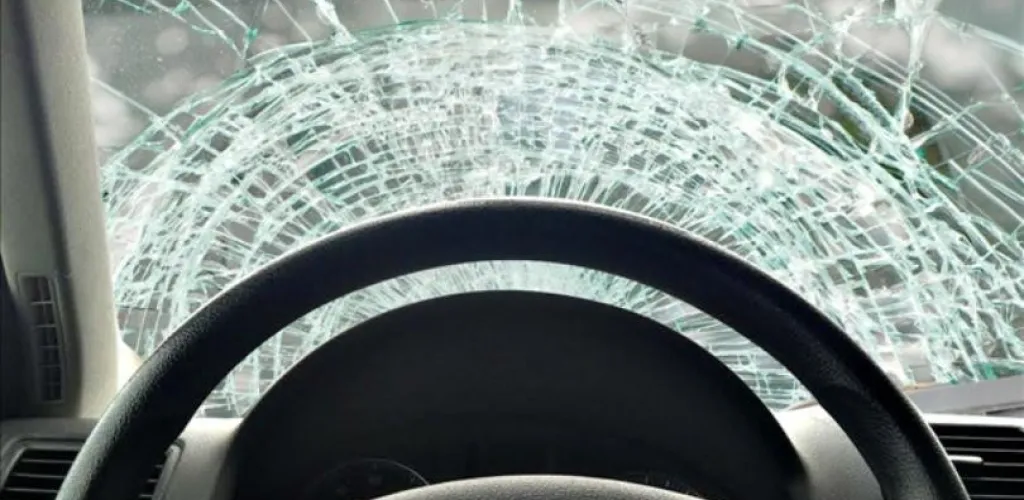
- Tempered side and rear windows break into small 3-5 mm pieces for safety.
- Laminated front windshield uses PVB to prevent shard spread.
- Tempering process creates surface compression and internal tension for strength.
- Causes of breakage include stones, vandalism, accidents, misalignment, and hail.
Car windows are carefully engineered to protect vehicle occupants, and the way they break is not accidental. When a side window or the rear window is damaged, it fragments into thousands of tiny, fine pieces—a phenomenon that may seem unusual but hides a sophisticated safety technology.
This special feature results from the type of glass used and the specific manufacturing process, providing maximum protection in emergency situations.
Difference between types of auto glass
The car’s glazing system is not uniform—each type of glass has a construction tailored to its function:
Front windshield is made of laminated glass, composed of two layers of glass joined by a special plastic film (PVB - Polyvinyl Butyral). This construction prevents shard spread in case of impact, maintaining driver visibility.
Side windows and the rear window are made from tempered glass, which consists of a single layer of glass that has been thermally treated. This difference in construction explains the distinct behaviors on impact.
The thermal tempering process – the safety secret
Tempered glass is the result of a complex technical process called thermal tempering, which transforms ordinary glass into a high-performance safety material:
Steps of the tempering process:
- Controlled heating - The glass is heated uniformly to temperatures of approximately 650-700°C
- Rapid cooling - The outer surface is quickly cooled with jets of cold air
- Tension creation - The outer layer contracts rapidly, while the interior remains hot longer
- Final balance - A balance of stresses is formed: compression on the exterior, tension on the interior
This process creates an internal structure of stresses that gives the glass its characteristic strength and its specific breaking behavior.
Why does it shatter into small pieces?
The fragmentation behavior of tempered glass is not a defect, but a safety feature:
Shattering mechanism:
- Disturbance of balance - Any crack or impact disrupts the internal stress system
- Release of energy - The accumulated stresses are released instantly across the surface
- Uniform fragmentation - The glass breaks into pieces of similar size, about 3-5 mm
Advantages of this type of breakage:
- Increased safety - Small, rounded pieces reduce the risk of severe cuts
- Maintained visibility - Small fragments do not completely obscure visibility
- Easier evacuation - In an emergency, the window can be removed more easily
- Reduced injuries - Contact with fine shards is much less dangerous
Common causes of glass breakage
Auto windows are constantly exposed to various stresses that can lead to damage:
External factors:
- Road projectiles - Gravel, small stones thrown by other vehicles
- Vandalism - Intentional damage
- Accidents - Collisions or strong impacts
- Hail - Ice chunks can crack windows
Mechanical factors:
- Misalignment - A deformed window frame can create pressure points
- Objects wedged - Foreign elements in the lifting mechanism
- Wear of the guiding system - Damaged components create nonuniform stresses
- Extreme temperature differences - Uneven expansion and contraction
Safety procedure after glass breakage
When tempered glass breaks, it is essential to follow the correct steps for your safety and that of passengers:
Immediate steps:
- Stop the vehicle safely - Find a safe place to pull over
- Evaluate the situation - Check for injuries
- Do not touch fragments with bare hands - Use gloves or a cloth
- Ventilate the cabin - Open other windows to remove suspended particles
Professional cleaning:
- Specialized equipment - Professional vacuums with fine filters
- Complete removal - All fragments, including very small ones
- Upholstery cleaning - Check seats, mats and all surfaces
- Check other windows - Inspect for possible cracks
When immediate replacement is necessary
Replacing a tempered glass pane is required immediately for several reasons:
- Repair is not possible - Tempered glass cannot be repaired partially
- Safety compromised - The stress pattern is completely destroyed
- Exposure to elements - Lack of protection against weather and intrusion
- Legal requirements - Driving with missing glass can be penalized
Preventing glass breakage
While not all causes can be avoided, preventive measures can reduce risk:
Precautionary measures:
- Keep distance from other vehicles - Avoid projectiles
- Regular checks - Periodically inspect windows for small cracks
- Maintain frames - Ensure the mechanisms operate correctly
- Protected parking - Avoid vandalism-prone or hail-prone areas
Understanding how car windows work helps you appreciate the safety technology built into your vehicle and respond appropriately in emergency situations. Tempered glass represents an ingenious compromise between strength and safety, protecting you by the very way it fails.