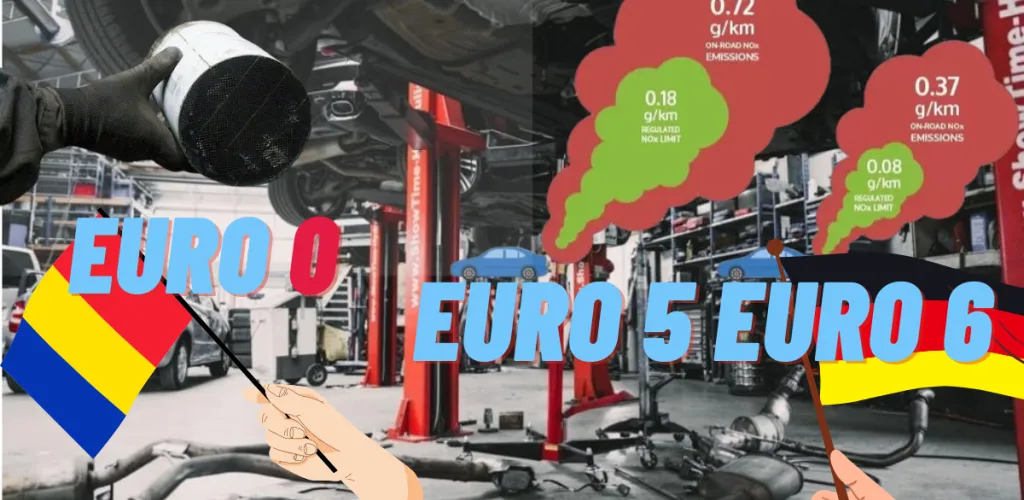
- Germany offers official Euro 5-to-Euro 6 conversions with AdBlue and DPF upgrades
- Romania typically removes exhaust aftertreatment, increasing pollution and inspection failures
- Euro 6 reduces NOx significantly and maintains PM at 0.005 g/km
- German conversions are TÜV-certified, road-legal, with warranties
Diesel vehicles in Romania have seen exhaust aftertreatment systems removed become commonplace, especially on high-mileage examples. This trend has shaped how owners approach aging diesels and the local perception of emissions and maintenance.
In contrast, Germany has chosen a completely different path: official conversions that bring older vehicles up to Euro 6 standards, often incorporating AdBlue and modern sensors, carried out by specialized companies.
Reality in Romania: removal of exhaust aftertreatment systems
In our country, an “unwritten law” has emerged that almost every BMW with over 300,000 kilometers should not have a DPF installed. This practice has spread to most brands and has become a real tradition among diesel owners.
Owners choose to remove the DPF without considering:
- The significant increase in pollution
- Unpleasant odors from the exhaust
- Gas infiltration into the cabin
- The illumination of warning lights on the dashboard
- The inability to pass the legally required inspection (ITP)
Although from the outside the car retains the appearance of a premium vehicle, technically and environmentally it becomes a veritable “garbage” that many would not invest any money in.
The German approach: official conversions to higher standards
In Germany, the automotive industry has developed a completely different approach. Instead of removing exhaust aftertreatment systems, specialized companies offer conversion services that transform older vehicles to comply with stricter emission standards.
Differences between emission standards
Euro 5 standards (mandatory since January 2011):

- CO: 0.50 g/km
- HC + NOx: 0.23 g/km
- NOx: 0.18 g/km
- PM: 0.005 g/km
- PN [#/km]: 6.0x10^11/km
Euro 6 standards (current standard):
- CO: 0.50 g/km
- HC + NOx: 0.17 g/km
- NOx: 0.08 g/km (55% significant reduction)
- PM: 0.005 g/km
- PN [#/km]: 6.0x10^11/km
For comparison, a vehicle with DPF off (Euro 0/1):
- CO: 2.72 g/km
- HC + NOx: 0.97 g/km
- PM: 0.14 g/km
The difference is dramatic - a vehicle without exhaust aftertreatment system pollutes with respect to fine particles (PM) 28 times more.
The conversion process in Germany
Available upgrades
- Vehicles Euro 2 or Euro 3 to Euro 5
- Vehicles Euro 5 to Euro 6
Components of the conversion
Software modifications:

- Reprogramming of the engine control unit (ECU)
- Optimization of injection parameters
- Adjustment of regeneration strategies
Hardware modifications:
- Installation of a new, high-performance DPF
- Installation of the AdBlue system (for Euro 6)
- Upgrade of NOx sensors
- Modernization of the catalytic converter
TÜV certification
All modifications are performed in accordance with TÜV (Technischer Überwachungsverein) standards, which means:
- Strict compliance with technical regulations
- Rigorous emissions testing
- Official certification for road use
- Warranty for system operation
The AdBlue system and its importance
For conversions to Euro 6, vehicles receive the AdBlue system, which:
- Reduces NOx emissions by up to 90%
- Uses a urea solution to neutralize nitrogen oxides
- Is mandatory to meet Euro 6 standards
- Requires periodic refilling (every 15,000–25,000 km)
Reasons for conversion in Germany
Economic factors
- Preserving a valuable investment
- Avoiding the cost of a new vehicle
- Maintaining diesel engine efficiency
Technical factors
- Preserving engine performance
- Proven mechanical reliability
- Adapting to urban restrictions
Environmental factors
- Compliance with low-emission zones
- Contributing to improved air quality
- Alignment with environmental policies
Difference in mentality
While Romania seeks solutions to bypass exhaust aftertreatment systems, Germany invests in technologies to enhance them. This difference in approach reflects:
- Different levels of environmental awareness
- Stricter technical inspections
- Greater importance given to environmental regulations
- A long-term perspective on automotive investments
Germans demonstrate that it is possible to preserve the performance and efficiency of a diesel engine while meeting environmental standards through advanced technology, not by removing protection systems.