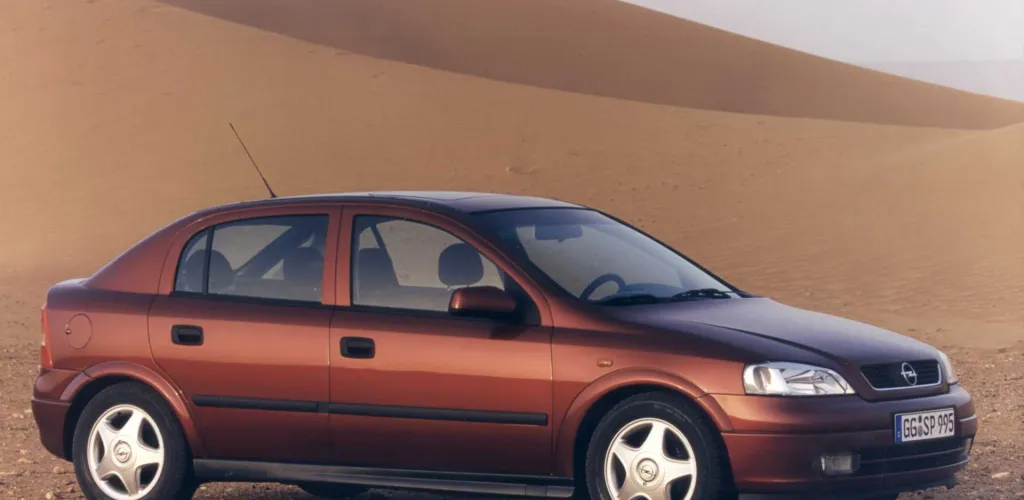
- Opel Astra G launched 1998, 11-year production on a new Lotus-tuned platform.
- Available as hatch, sedan, Caravan, coupe/cabrio; regional names include Vauxhall/Buick/Holden.
- Astra Classic II produced in Gliwice; sold in CE Europe and Turkey; Romania valued.
- Range of petrol and diesel engines from 1.2L to 2.4L; turbo 2.0L available.
Opel Astra G, launched in 1998, represents the third generation of the famous European compact family produced by the German manufacturer. This model marked an important era for Opel, being available in multiple body configurations and with a diverse range of engines. Over its 11 years of production, the Astra G proved to be a popular choice for families across Europe, offering a reasonable balance between maintenance costs and performance.
Developed on a new platform and with a chassis tuned by Lotus, the Astra G laid the groundwork for other Opel models, including the Zafira. In Romania, this model remains popular on the used market, valued for its reliability and affordable maintenance costs.
Overview and available variants
Astra G was available in several body configurations to meet diverse needs:
- Hatchback with 3 and 5 doors - the most popular version for urban use
- Sedan with 4 doors - for those who prefer a classic trunk
- Caravan with 5 doors - estate variant for extra cargo space
- Coupe and Cabrio - Bertone-produced special variants (approximately 90,000 units)
Market names varied by region: Vauxhall Astra in the United Kingdom, Buick Excelle XT in China and Holden Astra in Australia and New Zealand (until 2009, when it was discontinued due to unfavorable exchange rates).
Continuation of production as Astra Classic
After the launch of the Astra H in 2004, the sedan and Caravan production continued at the Gliwice plant in Poland, under the name Astra Classic and later Astra Classic II. These models were sold in Central and Eastern Europe, as well as in Turkey, until the end of 2009.
Available engines
Astra G benefited from a broad range of engines to cover different market segments:
Petrol engines
- 1.2L X12XE and Z12XE - economical engines for urban use
- 1.4L X14XE and Z14XE - balance between performance and consumption
- 1.6L (X16SZR, Z16SE, X16XEL DOHC, Z16XE DOHC) - the most popular choice
- 1.8L (X18XE1, Z18XE) - for those seeking more power
- 2.0L (X20XEV/X20XER, Z20LET turbo) - sporty variants
- 2.2L Z22SE - the largest petrol option in the range
- 2.4L - available in select markets
Diesel engines
- 1.7L TD 8V - the first diesel in the range
- 1.7L DTi 16V and CDTi - direct-injection versions
- 2.0L Di 16V and DTi 16V - for those who want more power
- 2.2L DTi 16V - the most powerful diesel version
Driving experience and fuel economy
Owners provide a realistic view of how these cars perform in real traffic.
Handling
Liviu Rămoștina (1.7 CDTI 80 hp) explains: “In the city it doesn’t feel special; there isn’t a big difference compared to, say, a Logan. I often go on long trips with friends and they have a good impression of the car, finding it comfortable and spacious.”
Chiscop Angel (1.6i 16V 105 hp) details: “It is fairly balanced but handles better on extra-urban roads. It benefits from the short throw of the shifter and the gear ratios are good for staying in the same gear longer. On long trips I can say it is very quiet and quite powerful once you get to know it.”
Radu Gabriel adds an important note: “On long trips it lacks a 6th gear, which affects both fuel economy and the cabin noise.”
Real-world fuel economy
1.7 CDTi (80 hp)
- Liviu Rămoștina: “I covered 1000 km with 52 liters” (about 5.2 L/100 km)
- Neculcea Marian: “From Brașov to Reșița I had about 4.3 L, in the city around 5.2 L”
1.6i 16V (105 hp)
- Adrian Aur: “Petrol shows around 8–8.5 L in the city, winter 9–10 L; on highways I’ve seen 5.2 L”
- Daniel Mădălin (GPL installation): “14 L/100 km on GPL and 12 L/100 km on petrol in the city. On highways 10 L/100 km on GPL and 7–8 L/100 km on petrol”
2.0i 16V Turbo (170 hp)
- Munteanu George: “Outside city consumption around 8–9 L and in the city around 12 L. In sporty driving you can reach 15 L. If someone is looking to buy such a car, they should consider a different engine for fuel economy.”
Common problems and reliability
Based on owner experiences, a few recurring trouble areas have been identified:
Main technical issues
- Camshaft position sensor - frequent failure affecting engine operation
- Timing system - requires periodic maintenance and replacement at intervals
- Water pump - component that can fail and cause engine overheating
- Air conditioning system - issues with the compressor and auxiliary components
- DPF (on modern diesel versions) - may require regeneration or replacement
- Oil consumption - some engines develop this problem with age
Real reliability experiences
1.7 CDTi
- Liviu Rămoștina (8 years of ownership): “I changed the starter contact and the starter motor; nothing else, no visits to the workshop beyond regular servicing. The car proved to be exactly what I expected.”
- Neculcea Marian reports: “It’s reliable. I had major issues with two injectors which I repaired, and it runs okay now. I also replaced a pulley on the alternator and a coil on the A/C compressor.”
1.6i 16V
- Georgescu Andrei: “Compared to the diesel models from the same generation, it is reliable. I had a minor issue with the exhaust manifold and a major issue with the ignition coil.”
- Chiscop Angel warns: “If bought in good condition, it can be very reliable. However, negligence and lack of professionalism from some mechanics have led to taking the engine apart twice this year. Classic issues: high oil consumption up to the piston rings.”
Prices on the used market
Based on the Romanian market analysis, Astra G prices vary considerably depending on year of manufacture, engine, and overall condition:
- Opel Astra G 1.6 (2000, 183,000 km): around €1,500
- Opel Astra G Caravan 1.7 CDTi (2004, 270,000 km): around €2,200
Factors influencing price include:
- Year of manufacture and mileage
- Bodywork and interior condition
- Maintenance history
- Body style (Caravans tend to be pricier)
- Engine type (CDTi diesels are more sought after)
Purchase recommendations
Essential checks before buying
Liviu Rămoștina recommends: “Check the starter and injectors. When I replaced the starter, I understood this is a common issue.”
Daniel Mădălin emphasizes the importance of: “The main thing a potential buyer should pay attention to is how the car has been maintained overall. Look carefully from the exterior condition, to tire wear, the engine bay, and the interior.”
Radu Gabriel insists: “Be mindful of the full history and the car’s condition. Inspect it thoroughly with a professional in the field or a seasoned mechanic, not a ‘friend’. Corrosion and good maintenance are the key aspects to consider.”
Who the Astra G is suitable for
This model is recommended for:
- Families seeking a reliable and economical car
- Beginner drivers who want an easy-to-maintain vehicle
- Budget-conscious buyers looking for a European car
- High-mileage users (diesel variants)
Not recommended for:
- Those who prioritize modern technology
- Drivers seeking exceptional sporty performance
- Users who prefer very low fuel consumption
Conclusion
The Opel Astra G remains a solid choice in the used-car market, offering a reasonable balance between purchase price and running costs. While not known for cutting-edge technology, its proven reliability and the availability of spare parts make it a practical option for many Romanian drivers. The key to success is selecting a well-maintained example and sticking to a preventive service schedule.