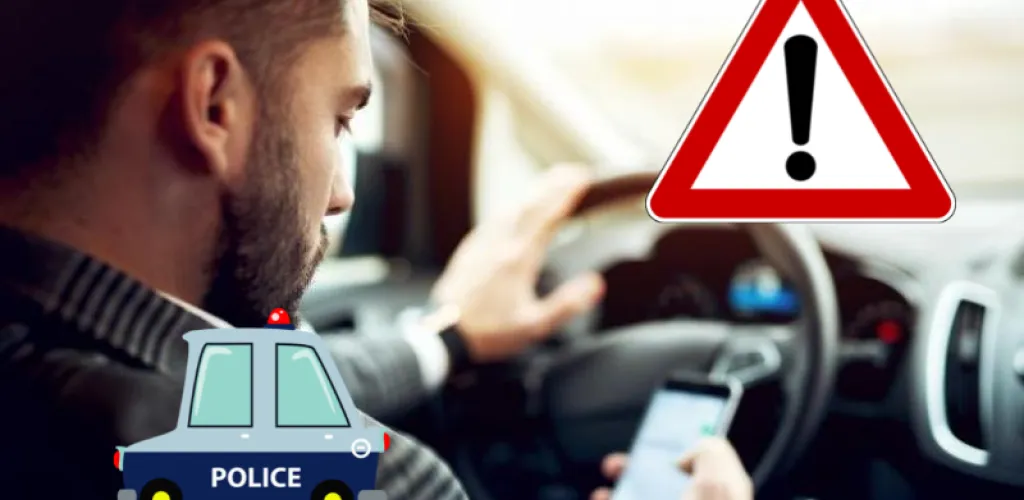
- Holding a phone on the steering wheel is easy to spot and leads to penalties.
- Downward gaze with phone on lap or right seat signals officers and endangers driving.
- Observed signs include head-down, hands off wheel, slow speed, hesitations, and lane drift.
Using a mobile phone behind the wheel remains one of the most dangerous and common traffic violations on Romanian roads. Despite being illegal and a major cause of serious road accidents, a very large number of drivers continue to practice this risky habit. Statistics show that attention drops dramatically when we use a phone while driving, reaction times increase significantly, and the risk of an accident multiplies.
This article is not intended to teach you how to avoid penalties, but to raise awareness of how easily you can be identified and punished. If your own safety and that of other road users isn’t a compelling enough reason, perhaps the fear of legal and financial consequences will curb the temptation to use a phone while driving.
Why it’s dangerous to use your phone while driving
There is always a reason that seems good enough to use the phone behind the wheel - a message from a friend, a call from work, or an apparent emergency. The reality is that no reason justifies the risk you take. In just a few seconds of taking your eyes off the road, your car can cover tens of meters without control, enough to cause a serious accident.
If the situation is truly urgent, pull over in a safe place - in a parking lot, on an emergency lane, or in a designated area. Only after you have come to a complete stop should you use your phone safely. Road safety must always be the number one priority, and a call or message can wait a few minutes.
The methods by which police identify drivers using the phone
1. Phones held on the steering wheel
This is probably the most obvious and common method through which drivers are caught. Many think that if they hold the phone on the steering wheel, eyes remain looking at the road and the risk is minimized. This perception is completely erroneous.
When you hold the phone on the wheel to type messages or browse social networks, your attention is significantly reduced. The human brain cannot process both the visual information in traffic and the content on the screen efficiently. For a police officer in traffic or positioned at the roadside, this practice is exceptionally easy to spot. They can clearly see the device, hand position, and the driver’s gaze direction.
The sanction for this offense includes a substantial fine and penalty points added to the driver’s record, which can lead to license suspension.
2. Gaze directed downward
Another common technique drivers try to hide phone use is to keep it on the lap or on the right seat. This practice is even more dangerous than the first because it forces the driver to direct their gaze completely downward, away from the road.
Signs that alert police include:
- The driver’s head repeatedly bent downward
- Occupied hands not on the steering wheel
- Abnormally slow speed for the traffic flow
- Hesitation at green light
- Inability to maintain a straight trajectory in the lane
- Sudden braking or delayed reactions
These behaviors are clear signs to police officers that the driver is distracted by a phone. Their experience in observing traffic enables them to quickly identify these suspicious patterns.
3. Screen glow at night
Night driving provides an unexpected advantage for police in detecting phone use. The glow of mobile phone screens is highly visible in the dark and creates a distinct light source inside the car.
Although the screen may light up automatically when a notification arrives, it turns off quickly if you do not interact with the device. If officers notice a constant glow or one that lights up repeatedly near the driver, and this glow does not come from the car’s interior lighting or other legitimate sources, it is a clear indicator that the phone is in active use.
Conveniently, this method also works during the day in low light conditions or when sunlight creates enough contrast to make the screen glow visible.
4. Surveillance cameras and radar
Modern road surveillance systems have become increasingly sophisticated. Initially used mainly to detect speeding, these systems are now equipped with high-resolution cameras capable of capturing details inside vehicles.
Fixed cameras mounted on streets and highways can capture clear images of drivers using a phone. In some countries, including Romania, there are pilot projects using AI (artificial intelligence) technology to automatically detect drivers using a phone.
If you’re caught by these systems, the consequences can come later:
- Notices by mail with clear photos of the violation
- Summons to police stations for explanations
- Higher fines due to indisputable photographic evidence
- Automatic penalty points applied
The advantage (or rather disadvantage for those who break the law) is that these systems operate 24/7 and cannot be “convinced” to ignore a violation.
5. Police on motorcycles
This might be the most effective method of mobile surveillance. Motorcycle police officers have a significant advantage over colleagues in patrol cars: mobility and traffic flexibility.
A motorcycle can:
- Move between rows of cars in heavy traffic
- Position itself right next to the driver’s window
- Directly observe inside the vehicle from multiple angles
- Approach suspect vehicles quickly and discreetly
When a motorcycle officer is parallel to your car, just a few centimeters away, it is virtually impossible to deny that you are using the phone. They can see exactly what you are doing, which apps you have open, and can even take photographs as evidence.
This method is extremely effective in busy urban traffic, where drivers tend to be more relaxed and feel “invisible” in the crowd.
Legal and safe alternatives
The simplest and most effective way to avoid a fine, penalty points, and the risk of an accident is not to use the phone at all while driving. However, we understand there are situations where communication is important. Here are legal alternatives:
Built‑in hands‑free systems or Bluetooth:
- Allow voice calls without holding the phone
- Voice commands keep hands on the wheel and eyes on the road
- Legally accepted in most situations
Voice-to-text features:
- Dictates messages without typing
- Dramatically reduce distraction
- Available on most modern smartphones
Phone mounts:
- Mounted on the dash or windshield
- Allow GPS viewing without holding the phone
- Note: interaction with the screen remains illegal
Pull over:
- The safest option for real emergencies
- Find a parking spot or an emergency lane
- Resolve the issue safely, then continue your journey
Legal consequences in Romania
In Romania, under the Traffic Code, using a phone at the wheel is sanctioned with:
- A fine between 580 and 725 RON
- 2 penalty points
- Possible suspension of the license in case of repetition
- Criminal liability in the event of an accident
These sanctions can be significantly increased if phone use contributes to a road traffic accident with injuries or major material damage.
Conclusion
Modern technology offers us countless ways to communicate, but that doesn’t mean we have to be available at all times, including while driving. A few minutes of waiting can save lives—yours, your passengers, and other road users.
The police have increasingly sophisticated methods for detecting drivers using a phone, from direct observation to AI-enabled automated systems. The risk of being caught is very real and ever-growing.
Rather than seeking ways to avoid detection, invest in safety: use legal alternatives, pull over when necessary, or wait until you reach your destination. No call or message is worth a life or the consequences of a serious accident.
photo source: dailydriven.ro