- UK tests AI cameras in roadside vans to detect phone use and violations
- Real-time AI alerts officers when violations are detected
- System distinguishes phone use from other actions and doesn’t tire
- If scalable, could be adopted globally to improve road safety
Rapid technological development brings innovations into every field, and road traffic is no exception. The latest news comes from the United Kingdom, where traffic authorities are testing AI-based technology to monitor drivers. This innovation promises to fundamentally change how violations behind the wheel are detected and sanctioned.
The technology in question can detect from a distance whether drivers are using mobile phones while driving, representing a major qualitative step compared to traditional surveillance methods. This automated system practically eliminates the possibility of evading detection, unlike classic human oversight which can be limited by traffic conditions or distance.
How the AI detection system works
The moment when cutting-edge technology clearly surpasses human capabilities has arrived. The system used by British authorities employs a monitoring van strategically positioned at the roadside. This specially equipped vehicle houses sophisticated gear capable of detecting in real time drivers who do not comply with mandatory legal provisions.
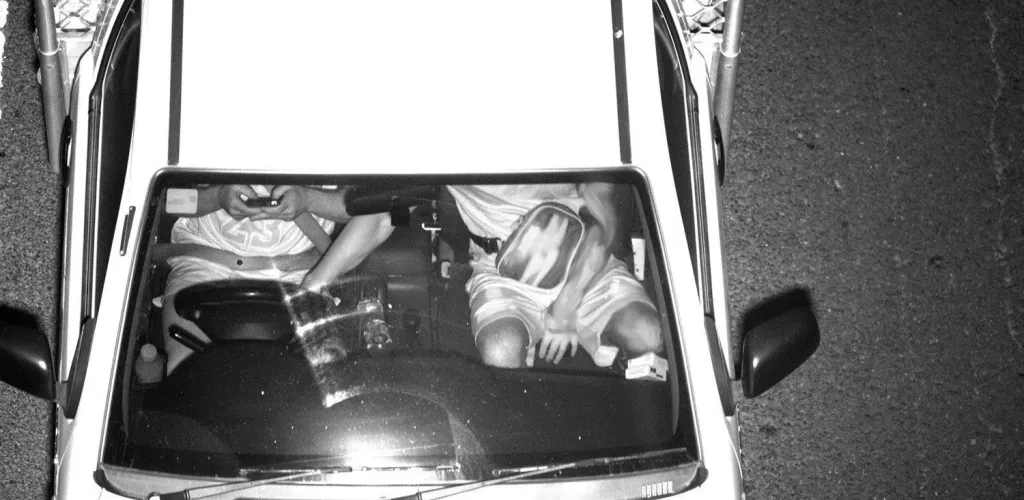
The surveillance van is equipped with a complex array of state-of-the-art video cameras that can photograph in detail the cars passing nearby. These images are instantly processed using AI-based software that rapidly analyzes each frame and identifies potential violations.
Officers receive automatic alerts whenever the system detects drivers with phones in hand, missing seat belts, or other violations. In practice, the system identifies any illegal action taking place inside a vehicle involved in traffic, offering unprecedented levels of surveillance.
Recognition and analysis process
The visual recognition technology used relies on advanced machine learning algorithms trained to identify specific patterns. The system can distinguish between a driver adjusting mirrors and one holding a phone in hand; it can detect whether the seat belt is worn correctly or merely posed to fool human monitoring.
The system’s accuracy is remarkable, with the correct detection rate far exceeding that of a human observer. Moreover, unlike a police officer, AI does not tire, does not lose focus, and can process information about hundreds of vehicles simultaneously.

Impact on road safety
It is clear that this technology could deliver a true breakthrough if deployed at scale. Drivers will be particularly surprised to be stopped in traffic and sanctioned for issues that authorities could not ordinarily observe from a distance.
If the tests in the United Kingdom yield the expected results, the technology will be used at scale and adopted by many other countries. The main goal of this initiative is to protect lives on the road, given that using gadgets while driving significantly reduces concentration.
Not wearing a seat belt or using a mobile phone while driving are two of the riskiest situations. Many accidents have devastating consequences due to non-compliance with these simple yet vital obligations. Statistics show that distraction from the phone increases the risk of an accident by up to 23 times.
Romania - alarming statistics
Loss of attention and concentration at the wheel represents a real problem, especially in our country. An analysis of 2020 places us first in the European Union for road deaths per capita—85 deaths per million inhabitants. This worrying indicator highlights the need for drastic measures to improve road safety.
The figures are even more alarming when compared with the EU average of about 42 deaths per million inhabitants. The substantial gap shows that our road safety system requires major improvements, both in infrastructure and in mindset and law enforcement.
Romanian legislation on phone use at the wheel
From October 2019 to January 2020, drivers were sanctioned if authorities caught them using a mobile phone while in traffic. For this behavior, a fine of up to 1,160 RON and 4 penalty points applied.
From January 2020, the Chamber of Deputies decided to amend these provisions. Drivers are no longer sanctioned when the device held in hand is equipped with a hands-free system. In simple terms, if the driver is caught in traffic with the mobile phone in hand, but the device has a hands-free function, this act no longer constitutes a contravention.
Current legal framework and penalties
The initial text entering into force in October 2019 stated that the driver is forbidden to hold in hand or use with hands in any way a mobile phone or any mobile device equipped with the function to record or display text, photo or video.
The article has undergone subsequent amendments, namely: “Drivers are forbidden to use mobile phones while moving on public roads, except for devices of the hands-free type.”
The same rules apply to bicycles, scooters, motorcycles or mopeds. Such behavior is punished with 2-3 penalty points and a fine of 290-435 RON.
Suspension of driving license
Moreover, drivers should know that they can end up without a driving license if they choose to talk on a phone without a hands-free system, especially when the offense is compounded by violating another mandatory traffic rule such as not wearing a seat belt.
In terms of combined offenses, penalties rise to 9-20 penalty points and a contravention fine from 1,305 RON to 2,900 RON. There is also a risk of license suspension for 30 days, which can have a significant impact on professional and personal life.
Current fines according to the Romanian Police
According to Romanian Police sources: “While driving on public roads in a moving vehicle, the driver is forbidden to hold in hand or use with hands in any way a mobile phone or any mobile device equipped with the function to record or display text, photo, or video.”
In such situations, authorities sanction drivers with a contravention fine of 580-725 RON and 4-5 penalty points.
These penalties apply for a single violation, not cumulative with other infringements.
For cumulative offenses, such as using the phone and not wearing a seat belt, the fine can reach 1,305-2,900 RON, with 9-20 penalty points and possible license suspension for 30 days.
Legal solutions for communication at the wheel
To avoid these risky situations and the corresponding penalties, drivers are advised to use modern communication devices. Legal options include:
- Android Auto and Apple CarPlay — integrated systems in the car’s dashboard that allow voice control of the phone
- Bluetooth hands-free — a wireless connection that redirects calls to the car’s speakers
- Phone speaker — enabling the speaker function allows communication without holding the phone
- Wireless headphones — a simple alternative for older cars
- Phone mounts — allow viewing GPS maps without handling the device
For cars equipped with modern technology, infotainment systems offer full integration with smartphones, enabling calls, navigation and multimedia playback without diverting attention from driving.
Perspective on implementation in Romania
Although AI technology for detecting violations is still in the testing phase in the United Kingdom, the prospect of adopting it in Romania could bring significant benefits. Given the worrying road safety statistics in our country, such a system could contribute to a dramatic reduction in accidents caused by inattention.
However, implementation would require substantial investments in infrastructure and equipment, as well as adapting the existing legal framework.
Experience from the UK will provide valuable data on the effectiveness and public acceptability of this technology, guiding Romanian authorities’ decisions.
In any case, the global trend is clear: technology will play an increasingly important role in ensuring road safety, and drivers must adapt to this new reality.