- Freon leaks are hard to detect because freon is colorless, odorless gas.
- Symptoms include reduced cooling, excess cabin humidity, and unusual compressor noises.
- The system relies on a high-pressure refrigerant cycle through compressor, condenser, expansion valve, and evaporator.
The car’s air conditioning system is a closed loop and, under normal conditions, requires little maintenance. Freon, the refrigerant at the heart of the A/C system, plays a crucial role in cooling the air before it reaches the cabin. When freon levels fall below what is required for optimal operation, the system can no longer cool the air effectively, and the root cause is almost always a leak in the circuit.
Why Freon Leaks Are Hard to Detect
Unlike other fluids used in cars — engine oil, coolant, brake fluid, or power steering fluid — freon has unique characteristics that make leak detection extremely challenging. Normally, when a system has a leak, we would see liquid puddles under the vehicle. Each fluid has distinct properties (color, smell, viscosity) that aid identification.
With freon, the situation is quite different. This refrigerant:
- Is kept at high pressures within the system to function correctly
- Quickly turns into a gas when exposed to normal atmospheric pressure
- Is colorless and odorless in gaseous form
- Evaporates immediately when it contacts high-temperature system components
These characteristics make direct visual detection of a freon leak practically impossible, unlike other auto system faults.
Symptoms Indicating a Freon Leak
Reduced HVAC performance: The most evident symptom is a gradual decline in the system’s ability to cool the air. Initially, you may notice that the cold air is warmer than usual, then the system will operate progressively weaker until it stops cooling altogether.
Excessive cabin humidity: When the leak occurs inside the vehicle, you’ll notice higher humidity in the cabin. This manifests as:
- Persistent condensation on the inside of the windshield
- Frequently foggy windows, especially on hot days
- Dampness under the front passenger carpets
- A distinct damp smell inside
Unusual noises: The air conditioning compressor can produce abnormal sounds when freon levels are insufficient, as it operates without proper lubrication.
Refrigerant Properties and How the System Works
To better understand potential problems, it helps to know how freon behaves in the air conditioning system. The refrigerant must remain in liquid form or condense into a gas at specific temperatures and pressures to ensure:
- Safe operation of the equipment
- Proper heat transfer
- Protection of system components
In an A/C system, freon continuously circulates through a compression-expansion cycle. The compressor compresses the gas, increasing its pressure and temperature. Then, at the condenser (the radiator for the air conditioning), freon releases heat and becomes a liquid. Subsequently, through the expansion valve, the pressure drops sharply, freon evaporates, and absorbs heat from the air passing through the evaporator. This cycle repeats as long as the air conditioning is running.
Professional Leak Detection Methods
Because of the difficulties described, accurately locating the leak often requires specialized equipment and techniques.
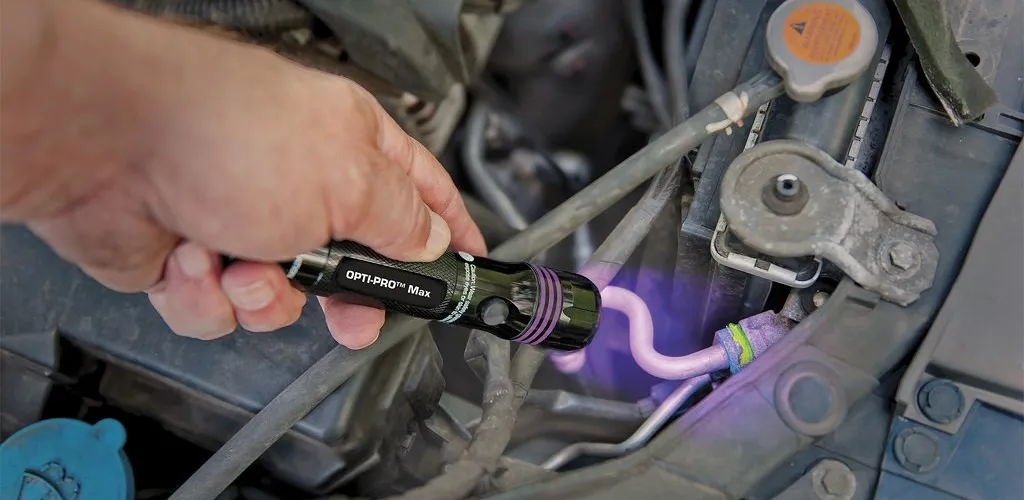
UV Dye Method
The most effective and common detection method consists of:
- Adding a special fluorescent dye to the air conditioning system
- Driving the vehicle with the A/C on for an extended period (sometimes several days)
- Parking the vehicle in a dark space overnight
- Inspecting the system with a UV lamp to identify dye traces
The dye is visible under ultraviolet light and will mark the exact leak location. This process requires careful inspection of:
- The air conditioning radiator (condenser)
- All hoses and fittings
- The compressor and its seals
- The evaporator (located behind the dashboard)
- The expansion valve
Electronic Detection
Professional auto services may also use electronic refrigerant gas detectors. These devices are highly sensitive and can identify minimal freon concentrations in the air, aiding leak localization.
Soap and Water Test
For larger leaks, technicians may apply a soap-and-water solution to fittings and joints. Where there is a leak, air bubbles will appear.
Most Common Leak Points
Hoses and fittings: The most frequent leaks occur at connections between components. Over time, rubber seals can deteriorate due to:
- Constant engine vibrations
- Temperature fluctuations
- Material aging
- Metal corrosion
Condenser (AC radiator): Positioned in front of the engine’s cooling radiator, the condenser is exposed to:
- Gravel and other road debris
- Corrosion from salt and humidity
- Vibrations and shocks
Compressor: Seal failures on the compressor shaft can occur over time, especially if the system hasn’t been used for long periods.
Evaporator: Located inside the dashboard, the evaporator can corrode due to condensate formed during operation. A leak here is the most troublesome, often requiring removal of the dashboard for access.
Solutions to Repair Leaks
Professional Repairs
When the leak is precisely located, the optimal solution is repair or replacement of the faulty component:
- Replacing worn O-rings and seals
- Repairing or replacing damaged pipes
- Replacing the condenser if it is corroded
- Replacing the compressor if its seals are defective
After repair, the system should:
- Be fully evacuated (vacuum) to remove air and moisture
- Be leak-tested
- Be recharged with the correct freon quantity according to the manufacturer’s specifications
- Be checked for performance
Sealant Agent Solutions
For minor leaks or when precise fault identification is challenging, market-available refrigerant products containing sealants can be used. They work as follows:
- Added to the system along with freon
- The sealant circulates through the entire system
- When it reaches a leak, it contacts air and forms a seal
- Freon continues to operate normally
This solution is effective for:
- Very small leaks, of the porous type
- Slightly damaged seals
- Minor cracks in components
Important: This method is not a permanent fix for large leaks and does not replace professional repairs. Some vehicle manufacturers do not recommend using these sealants, as they can affect service equipment used for maintenance.
Preventing Freon Leaks
To avoid issues with the air conditioning system:
Regular use: Start the air conditioning at least once a month, even in winter, for a few minutes. This keeps seals lubricated and helps prevent drying and cracking.
Periodic maintenance: Check the system annually and recharge freon every 2–3 years, even if you don’t notice problems.
Corrosion protection: Periodically inspect the condenser for signs of damage and keep the area in front of it free of debris.
Specialist service: Have checks performed at a trusted auto service with the equipment necessary for correct diagnostics.
Safety and Environmental Aspects
Modern refrigerants (R134a or R1234yf in newer vehicles) are less harmful to the environment than older variants (R12), but still require proper handling:
- Do not attempt to add freon without the proper equipment
- Freon recovery must be performed by professionals with certified equipment
- Comply with environmental protection legislation
- Never deliberately release freon into the atmosphere
Conclusion
Detecting freon leaks requires attention to detail and, in many cases, specialized equipment. If you notice your air conditioning system is no longer performing effectively, consult a professional auto service for a correct diagnosis. Timely repair of leaks not only ensures comfort in the vehicle but also protects system components from further deterioration caused by operating with an insufficient refrigerant charge.
sursa foto: https://carfromjapan.com/