
- Backing up is delicate; use shoulder glance and mirrors, not just one method.
- Over-the-shoulder glance works for some cars; supplement with side mirrors for safety.
- Proper mirror adjustment minimizes blind spots; see small portion of your vehicle and full road.
- Do not back up more than 50 meters; stop every 50 meters to reassess.
Introductory note Backing up is one of the most delicate maneuvers in driving, and many drivers have developed the habit of looking over their shoulder when reversing or parking. This technique, while useful, must be applied correctly and in combination with other verification methods to ensure maximum safety.
A vehicle moving in reverse is considerably harder to control than in forward motion, and reduced visibility makes this maneuver one of the main causes of minor parking lot accidents. Therefore, this operation should be performed only when absolutely necessary and with the utmost attention.
Visibility techniques for reverse driving
There are three distinct ways we can ensure optimal visibility and try to cover all blind spots when reversing.
Over-the-shoulder glance — the classic technique
This method does not work for all vehicle types. For large cars or pickups, there may be little to no visibility through the rear window, while for small two-seater cars the rear window can be too small to see properly.
For vehicles that permit this technique, the operation is relatively simple:
- Rest your right arm over the front passenger seat
- Turn your head over your right shoulder to look through the rear window
- Control the steering with your left arm
- Maintain a very low speed for optimal control
Important: Even when doing this, you should also use the side mirrors to see hidden angles. It is not enough to rely on a single verification method.
Correct use of side mirrors
In modern vehicles, the importance of mirrors has changed significantly. The rearview mirror is used less, while side mirrors have become essential. This is because current vehicles have smaller glass areas, as the car’s pillars are built more massively to improve safety.
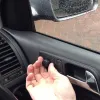
Proper mirror adjustment
Mirrors should be adjusted as follows:
- In the mirror, we should see a small portion of the side of the vehicle (roughly from the passenger door toward the rear)
- The rest should provide a full view of the road
- This positioning minimizes blind spots
Backing-up technique with mirrors
Backing up using side mirrors may seem difficult at first, but with practice it becomes second nature:
- Constantly check both mirrors, not just at startup
- Properly gauge the distances between your vehicle and other objects
- When an object appears very close in a mirror, turn the steering wheel in the opposite direction to move away
Legal and safety limitations
Traffic restrictions
According to traffic laws, it is prohibited to back up for more than 50 meters. Approximately every 50 meters, we must stop and reassess. This rule exists because:
- Vehicle control decreases over long reverse distances
- The risk of accidents increases significantly
- Visibility deteriorates over time
Additional checks needed
Even if you are positioned correctly relative to the rest of the traffic, an obstacle at ground level can cause major problems. Therefore it is essential to:
- Check the area around the vehicle before starting
- Be mindful of small children, pets, or fallen objects
- Always use at least two verification methods simultaneously
Modern driver-assistance systems
Rear-view cameras
If the car is equipped with a rear-view camera, reversing becomes much easier. These systems provide:
- Direct visibility of the area behind the vehicle
- Guidelines for the parking trajectory
- Obstacle detection at ground level
Proximity sensors
Parking sensors emit sounds or visuals to indicate distance to obstacles. However:
- Do not rely solely on sensors — they can be dirty or fail
- A dirty sensor can indicate incorrect distances
- Always combine sensor information with visual checks
Recommendations for maximum safety
To ensure a safe reversing maneuver:
- Check the area — exit the car if necessary to inspect the area
- Use multiple methods — combine the over-the-shoulder look with mirrors
- Keep speed low — the slower you go, the more control you have
- Be patient — don’t rush to finish the maneuver
- Practice regularly — practice in safe areas to improve your technique
Remember that safety comes first, and a well-executed maneuver is always preferable to a quick but dangerous one.