- Lane changes to overtake are no longer considered aggressive driving.
- Suspension penalties can extend by 30 days for certain violations.
- Suspension reduced to one-third for non-newcomers passing a rules test.
- Suspensions may overlap; substitute proofs issued for speeds over 70 km/h.
Aggressive behavior in traffic is a reality many drivers in Romania face. Although there are regulations intended to deter such situations, the reality at the wheel often remains tense. This guide provides essential information on how to react when you are harassed in traffic and what measures you can take to ensure your safety.
In the following sections, you’ll find the legislative context, recent changes to traffic rules, and practical de-escalation tips, supported by studies on driver behavior in Romania.
Harassment in traffic in Romania - Legislative context
Many drivers in our country repeatedly show a lack of obedience when it comes to respecting traffic laws. There are numerous cases where well‑intentioned drivers complain about the aggressive behavior of other road users.
Although Romanian officials have recently decided to enforce stricter penalties for aggressive driving and speeding, parts of these legal norms were amended or even repealed. Thus, new rules were introduced that increased the permissiveness of the Road Code, despite aggressive behavior in traffic remaining a serious issue.
Recent changes to traffic legislation
Among the new provisions aimed at increasing the permissiveness of the Road Code are:
-
Elimination of an act classified as aggressive behavior - the successive movement from one traffic lane to another, i.e., switching from right to left and vice versa to overtake a line of vehicles, is no longer considered aggressive behavior
-
Extension of suspension penalties - the period is extended by 30 more days for motorists who violate certain traffic rules within a term shorter than three months, instead of six months
-
Reduction of suspension duration - upon request, to one third of the duration for non‑newcomer drivers who pass a knowledge check on traffic rules
-
Changes for excessive speeds - reduction of suspension duration for drivers caught speeding more than 70 km/h over the legal limit
-
Reinstatement of overlapping periods - suspension periods may be overlapped under certain conditions
-
Issuance of a substitute proof - for the driving license in cases of exceeding the limit by more than 70 km/h
-
Relaxation of visibility requirements - removal from the legal framework of the 1000 lei fine for dirty rear windows or rear windshield. The new regulations require keeping the front windows and windshield clean
What aggressive driving means today
The new provisions state that successive lane changes, alternating from left to right to overtake a line of vehicles, no longer meet the conditions of aggressive driving at the wheel. This change comes at a time when the attitude of many Romanian drivers toward courtesy and common sense is often at odds with safety, directly affecting all road users.
How to react if you are harassed in traffic
Stay calm and avoid escalating the conflict
In Romania, there are many cases where aggressive drivers use intimidation schemes. Unfortunately, dialogue with them is not possible in most situations. The generally applicable recommendation is to avoid these types of drivers as much as possible. Continuing calmly on your route is the safest option.

Practical de-escalation techniques
-
Don’t respond to provocations - avoid any interaction with aggressive drivers, including eye contact
-
Slow down or stop - if the situation requires, slowing down or stopping the car is a viable option to avoid continuing the conflict
-
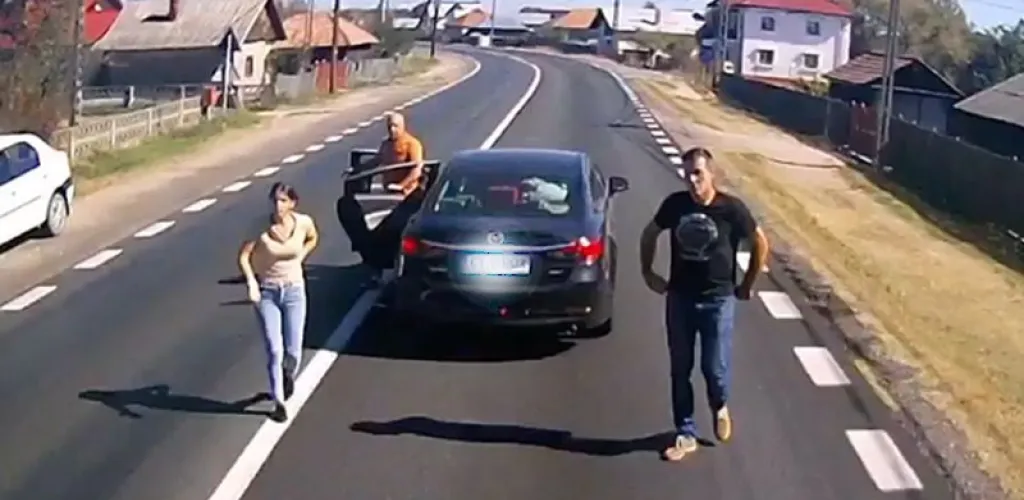
Keep your vehicle locked - if the aggressor has decided to stop, do not open the doors under any circumstances. Physical contact can result in serious harm or criminal charges
-
Document the incident - if you have a dashcam, the recording can be useful later
Call the competent authorities
One option you can call at any time in a risky situation is dialing 112. After this, authorized bodies can act to protect road safety and ensure compliance with traffic rules. It is important to provide clear information about location, description of the aggressive vehicle, and the nature of the incident.
Data and studies on aggressive behavior in Romania
Specialized research
Based on research conducted by Prof. Mihaela Rus, PhD, and senior psychologist Ionel Simionca, from the Association of Psychology and Road Safety, Romanian drivers show a predilection for harassment in traffic and aggressive behavior at the wheel.
The study shows that:
- 88% of men aged 18-25 years and 70% of men aged 25-40 believe the accident risk is minimal if they have a good car
- 65% of men aged 18-40 admit that they get annoyed when traffic is congested and have no problem overtaking the queue of cars
The study involved 127 drivers, of which 74.8% were men and 25.2% women.
Psychological profile of the aggressive driver
Aggressive driving behavior can be influenced by several factors:
- Stress accumulated from personal or professional life
- Time pressure and busy schedules
- Lack of adequate road education
- Sense of anonymity and impunity on the road
- Misperception of one’s own driving abilities
Aggressive driving - European perspective
Greece - leader in traffic aggression
Interestingly, Romania is not the only country exhibiting such aggressive road behavior. Greece ranks among the top European countries for aggressive drivers.
If you plan a car trip to Greece, it is wise to pay extra attention to Greek drivers and their driving manners, especially since Greece is a popular vacation destination for Romanian tourists.
European comparative data
According to a survey conducted in Europe:
- 91% of Greek drivers criticize drivers from other countries
- Greeks rank highest for uncivilized behavior inside their own cars
- 50% of them stated they use insults in traffic, overly use the horn, overtake on the right, or adopt aggressive manners
- A significant portion of Greek drivers admit they exit the car to start arguments or physical aggression with other drivers
Final recommendations for your safety
To ensure a safer traffic experience:
- Anticipate behaviors - be attentive to signs of aggression from other drivers
- Maintain a safe distance - leave enough space between you and the vehicle in front
- Plan your route - avoid peak hours when traffic is heavy and tensions rise
- Invest in safety equipment - a dashcam can be a valuable ally
- Ongoing education - participate in defensive driving courses
- Control your own emotions - don’t become part of the problem
Remember: your safety and that of other road users is more important than anything else. No traffic conflict is worth risking life or physical integrity.
Photo source: ziaruldeiasi.ro