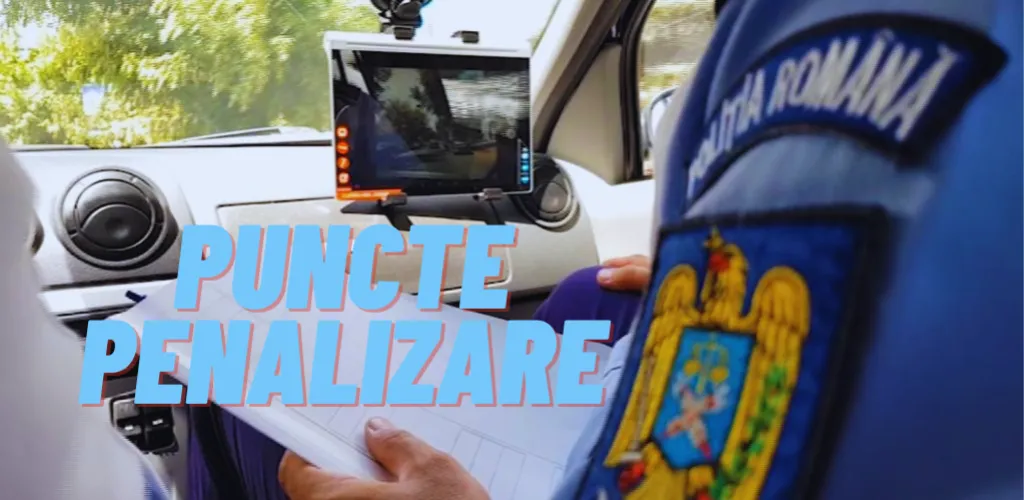
- Romania’s practical driving test assigns penalty points for every error, categories B, B1 and BE.
- Points cover vehicle checks, major preparation errors, and behavior in traffic.
- Standard checks are 3 points; major errors range 6–9.
Getting a driver’s license is a significant milestone for a young driver. To pass the practical exam, it is essential to know exactly which mistakes can lead to failure and how many penalty points you receive for each one. In Romania, the evaluation system is strict and transparent, and every incorrect maneuver or violation of traffic rules is punished with a specific number of penalty points.
This guide provides a complete list of all penalty points applied in the practical driving test for categories B, B1 and BE, organized into clear categories to help you understand the examiners’ expectations.
Preparation and technical check of the vehicle
Before starting the engine, the examiner will assess your ability to check the essential elements of the vehicle. These checks are fundamental for road safety:
Standard technical checks
- Checking with the onboard equipment the operation of the steering, braking, lubrication/cooling system, lights, indicators, and audible warning device: 3 points
- Checking the coupling device and connections of the braking/electrical system of the catadioptric lights (for BE category): 3 points
- Checking safety elements related to the vehicle load, securing, closing of doors/compartments (BE): 3 points
Major preparation errors
- Not adjusting the seat, mirrors, not fastening the seat belt, not releasing the parking brake: 6 points
- Lack of knowledge of the on-board equipment and the vehicle controls: 9 points
Behavior in traffic
Vehicle handling and position
This section evaluates your ability to control the vehicle in different driving situations:
- Mismatching of controls (engine stopping, excessive acceleration, incorrect use of gears): 6 points
- Not maintaining the direction of travel: 9 points
- Incorrect use of the road with or without markings: 6 points
- Crossing in front of other vehicles, including in tight spaces: 6 points
- Backing up, stopping and starting on a ramp, parking facing forward, backward or sideways: 5 points
- Turning the vehicle to face the opposite direction by performing forward and backward maneuvers: 5 points
- Turning on a multi-lane road in the same direction: 5 points
- Driving in an inefficient and aggressive manner that harms the environment: 5 points
Changing direction and performing turns
- Failure to ensure safety when changing direction or leaving a parking place: 9 points
- Illegal execution of turns: 6 points
- Failure to signal or incorrect signaling when changing direction: 6 points
Traffic in intersections
Intersections are critical zones where the most mistakes are made:
- Improper alignment with the desired travel direction: 6 points
- Performing prohibited maneuvers (stopping, parking, turning, reversing): 6 points
- Failure to yield when entering intersections: 9 points
- Entering/exiting highways or similar arteries, proper use of lanes and daytime lights: 5 points
- Not maintaining a sufficient following distance from those ahead or coming from the opposite direction: 9 points
Overtaking
Overtaking is one of the most dangerous maneuvers and is strictly evaluated:
- Repeated hesitation to overtake other vehicles: 6 points
- Violation of overtaking rules or performing overtakes in prohibited places or situations: 21 points
Right of way
- Failing to yield to vehicles and pedestrians with the right of way (intersections, roundabout, bus stopping area, tram stop, pedestrian crossing): 21 points
- Repeated tendency to yield to vehicles and pedestrians who do not have priority: 6 points
Compliance with traffic signals
Signs and markings
- Failing to observe the meaning of signs/markings/traffic signal colors (except red): 9 points
- Ignoring the red signal meaning of traffic lights/police signals/other similar authorities: 21 points
Speed
- Exceeding the maximum allowed speed: 9 points
- Driving at an unjustifiably low speed, not matching the pace of other road users: 6 points
Driving in adverse conditions
- Difficulty driving in rain, snow, sleet, or ice: 9 points
- Traveling at speeds not adapted to weather and road conditions: 9 points
Level crossings
- Non-compliance with legal rules at level crossings: 21 points
Situations leading to automatic disqualification
There are certain situations that lead to immediate disqualification, regardless of prior points:
- Showing up to the exam under the influence of alcohol, narcotics, drugs with similar effects or other disturbances that affect the examination of other candidates: 21 points
- Causing a road incident or the examiner’s intervention to avert an imminent danger: 21 points
Preliminary checks observed by the examiner
Before the actual start of the exam, the examiner will carefully observe the following aspects:
Mandatory checklist:
- All doors are closed
- The seat is correctly adjusted
- The side and central mirrors are correctly adjusted
- The seat belt is adjusted and fastened
- The handbrake is engaged and the gear lever is in neutral (position “0” or “N”)
Recommendations for proper preparation
Vehicle doors
Make sure all doors, including those of the passengers, are closed. You are responsible for passenger safety, and a door not properly closed can open in motion, creating a major hazard.
Seat position
Adjust the seat for maximum comfort. Press the clutch pedal fully – you should be able to do this without stretching. The correct position allows optimal vehicle control.
Steering wheel position
Adjust the seat for easy handling of the steering wheel. Do not sit too close, or the lower edge of the wheel will strike your knees, hindering maneuvering.
Seat belt
Ensure that both you and your passengers have properly fastened seat belts. The law requires all passengers to be buckled up, and for those under 12, responsibility lies with the driver.
Mirror adjustment
Adjust the mirrors to maximize rear visibility with minimal head movement. Position them to reduce the blind spots as much as possible.
Tips to avoid penalty points
To increase your chances of passing, focus on:
- Pre-checks – allocate sufficient time for correct adjustments
- Signaling – announce all direction changes and maneuvers
- Safety – always check before any maneuver
- Respect for priority – pay extra attention to pedestrians and priority vehicles
- Speed control – adapt speed to road and traffic conditions
Note that the maximum score accepted for passing is 20 penalty points. Any single mistake of 21 points or exceeding this accumulated threshold leads to automatic rejection of the candidate.