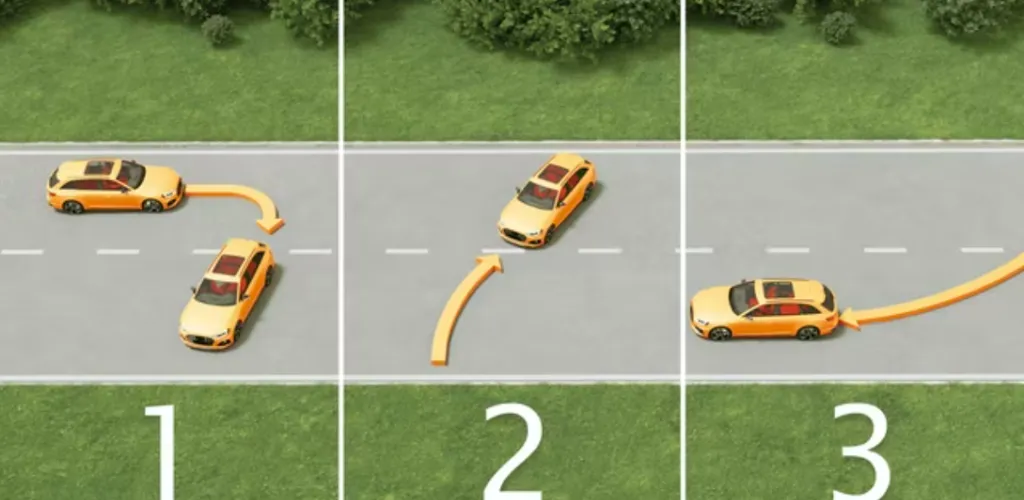
- Useful for turning around in narrow roads when space is limited.
- Consists of three steps: left forward, reverse perpendicular, right forward.
- Practice in safe areas, check mirrors, and clear traffic before starting.
- Requires only space roughly the car’s length and a small backup area.
The three-point turn is one of the driving maneuvers that can challenge even experienced drivers. Most drivers prefer to avoid this technique, opting to drive several hundred extra meters to find a more spacious place to turn. Yet mastering this technique is essential for any driver, as it can get you out of any situation, no matter how narrow the available space.
This maneuver not only helps you cope with difficult situations, but also develops your parking skills in tight spaces, improving overall precision and vehicle control.
What is a three-point turn and when do we use it
The three-point turn (also known as the three-point turn) is the ideal method when you have gone off course and need to turn around, but the road width does not allow a classic one-shot turn.
This technique is composed of three distinct stages:
- First movement: moving forward toward the left, at an angle of about 45 degrees
- Second movement: reversing until the vehicle becomes perpendicular to the road
- Third movement: starting to the right, again at an angle of about 45 degrees, to align in the opposite direction
Major advantage: to successfully perform this operation you need only a space roughly equal to the length of the car and a small area to back up.
Preparation for the maneuver
Practice in safe conditions
Before attempting the three-point turn in a real situation, it is crucial to practice in controlled conditions:
- Choose an area with low traffic and more space than needed
- Allow yourself a margin of error for the initial attempts
- Repeat the exercise while gradually reducing the available space
- Simulate real traffic conditions to build confidence
Similarities with other maneuvers
You can think of the three-point turn as similar to parallel parking or angle parking, only that in the middle of the operation the process unfolds differently. The basic principles of space control and distance estimation remain the same.
Detailed steps for correct execution
Step 1: Identifying and approaching the turning area
When you spot a zone wide enough to allow backing up:
- Move toward the outer left edge of the lane
- Position yourself at an angle of about 45 degrees to the turning spot
- Perform this positioning with great care
- Constantly check in the rearview mirrors to see if other road users permit you to perform the turn
Step 2: Checking and starting the maneuver in reverse
After you have positioned correctly:
- Check all mirrors again to ensure there are no obstacles behind or to the side
- Put the car into reverse
- Begin to steer in reverse
- Align yourself as precisely as possible in the chosen turning area
Step 3: Finishing in the opposite direction
When you reach a position perpendicular to the road axis:
- Ensure no vehicle is on the road
- Move in the direction opposite to the initial movement
- Execute the turn at as wide an angle as possible to avoid disturbing other vehicles
Mandatory safety checks
Three traffic checks are required:
- Before positioning the car at the angle
- Before turning in reverse
- Before moving again
These checks are essential for your safety and that of other road users.
Adapting to real conditions
When more than three moves are necessary
Although it is called the “three-move turn”, in reality, when the road is very narrow, it may be impossible to complete this turn as quickly as hoped. Do not hesitate to use more moves if the situation requires — the basic principles stay the same, but safety takes priority over speed of execution.
Factors influencing difficulty
- Road width: the narrower the road, the more moves will be required
- Vehicle turning radius: longer cars require additional space
- Presence of parked vehicles: reduces available maneuvering space
- Traffic in the area: affects the time available to execute the maneuver
Recommendations and important precautions
When to use this technique
The three-point turn strategy should be used only when you have absolutely no other option and you cannot turn around somewhere else. This turn temporarily blocks traffic and requires good distance estimation to avoid touching other parked vehicles.
Skills required
To execute this maneuver successfully you need:
- Precise control of the steering wheel and pedals
- The ability to accurately estimate distances
- The ability to coordinate the use of mirrors
- Calm and patience in pressure situations
- Understanding of the vehicle’s behavior at low speeds
Tips for beginners
- Start by practicing in empty parking lots or on secondary roads
- Use cones or markers to delineate the available space
- Seek help from an experienced driver for your initial attempts
- Do not rush — precision is more important than speed
- Learn to use all the vehicle’s mirrors effectively
Conclusion
The three-point turn is a valuable skill that gives you flexibility and independence in driving. While it may seem intimidating at first, with practice and patience it becomes a routine maneuver. Remember that safety is always the number one priority — it is better to perform the maneuver in five moves, but safely, than to force a three-move turn with unnecessary risks.