- A three-indicator countdown (240m, 160m, 80m) predicts crossing.
- Crossings vary: barriers, visual signals, or simple static signs.
- Saint Andrew’s Cross means rail traffic has priority; stop, look, yield, and only cross when safe.
- Accidents arise from non-compliance or misjudging trains; never rely on sight alone.
Railway level crossings are critical points in traffic where mistakes can have dramatic consequences. Although most drivers pass over rail crossings rarely, it is essential to know the exact traffic rules in these areas. Statistics show that many railway accidents occur precisely due to non-compliance with safety norms or an incorrect assessment of the situation. A collision between a locomotive and a passenger car causes major damage and, often, fatalities.
Although the crossing itself lasts only a few seconds, these moments can be decisive. Let’s look in detail at how to proceed correctly.
Railway level crossing signaling
Across Europe, all railway level crossings benefit from standardized signaling. You will encounter warning signs in white, cut by one or more diagonal red lines. The preventive warning system operates on the principle of anticipation and consists of three consecutive indicators:
- The first indicator: placed 240 meters before the crossing (with three red lines)
- The second indicator: positioned at 160 meters (with two red lines)
- The third indicator: located at 80 meters (with a single red line)
This sequence of indicators allows you to anticipate the approaching railway crossing and adjust your speed and attention accordingly. Each indicator removes a red line, acting as a countdown toward crossing.
Types of railway level crossings
Depending on traffic levels, road importance, and train frequency, you will encounter three main categories of crossings:
Crossings with barriers
These are the safest and are found on lines with heavy traffic. Barriers lower automatically when a train approaches, physically blocking vehicle access. They are also equipped with light and audible signals that announce the barrier’s descent.
Crossings with visual signaling
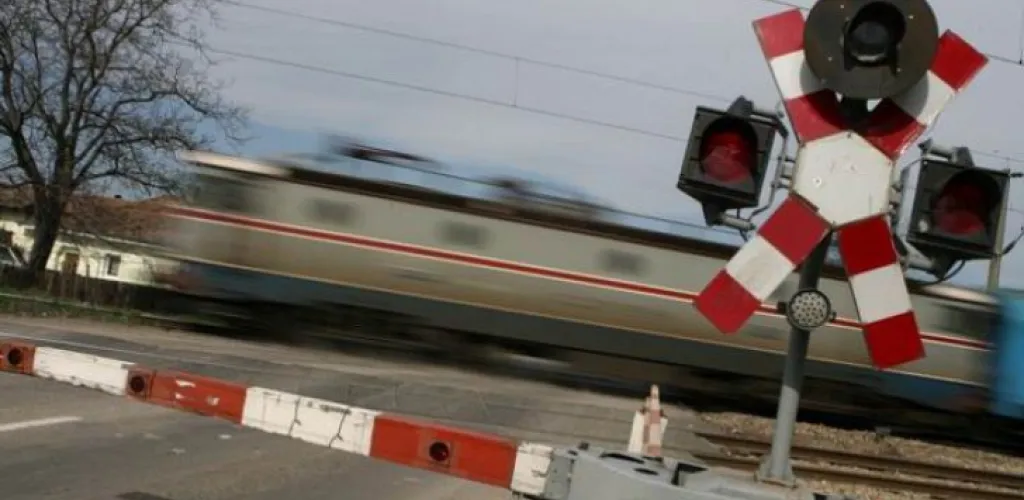
On lines with medium traffic, you will find crossings equipped with red flashing lights and, usually, audible signals. These activate tens of seconds before the train passes.

Crossings with simple signaling
On secondary lines or with light traffic, there are only static warning signs – Saint Andrew’s Cross and pre-warning panels. These represent the most dangerous category, as the responsibility for ensuring safety lies entirely with the driver.
Saint Andrew’s Cross – meaning and obligations
Saint Andrew’s Cross is a large X-shaped sign placed immediately before the crossing. This sign has a clear legal meaning: rail traffic has absolute priority over road traffic.
In the presence of this indicator, your duties as a driver are:
- Stop obligatorily in the immediate vicinity of the railway
- Check visually and auditorily in both directions
- Yield to any approaching train
- Cross only when you are sure that no train is coming
Do not rely solely on sight—modern trains can be very quiet, and their speed is often hard to gauge due to their size. A train that seems far away can reach the crossing much faster than you expect.
Traffic rules according to crossing type
At crossings with barriers or signal lights
- You are not obliged to stop if the barriers are raised and the lights are off
- You should still make sure before crossing
- Stopping is mandatory when the barriers start to lower or the lights turn red
- Never try to force a crossing when signaling systems are active
It is important to note that automated systems are synchronized to provide enough crossing time. Once the barriers start to lower, the train is already very close.
At unsignaled crossings
- Stopping is mandatory at the Saint Andrew’s Cross indicator
- Make a visual check in both directions over a sufficient distance
- Open the window to hear any approaching train
- Cross quickly but controlled once you have ensured it is safe
The most important safety rules
1. Always respect signaling
Whether it is lights, audible, or mechanical signals (barriers), these must be respected without exception. In the case of unsignaled crossings, stop, proceed with caution, and cross only when you are absolutely sure.
2. Never overtake in the crossing zone
Overtaking near or on the railway is prohibited and extremely dangerous. Reduced visibility and maneuvering time can turn a pass into a tragedy. Do not pressure other drivers to cross faster.
3. Do not force the crossing
Even if the barriers have just started to descend or the signal has just turned red, do not attempt to force the crossing. Accidents at level crossings are almost always fatal, and penalties for such violations are severe—license suspension and substantial fines.
The braking distance of a train is hundreds of meters, even when the driver applies emergency braking. A train cannot stop for you.
4. Do not stop on the railway
Always ensure there is enough space on the other side of the crossing before starting to cross. If traffic is blocked beyond the crossing, wait before crossing.
5. Procedure in case of a breakdown on the railway
If, for any reason, your vehicle stalls on the railway and will not start again:
- Leave the vehicle immediately and remove all occupants
- Call 112 and report the emergency
- Move away to at least 100 meters from the railway
- Try to warn approaching trains by signaling broadly
- Do not push or tow the vehicle off the tracks if you hear or see a train
CFR provides emergency numbers displayed at most crossings—use them to notify the railway authority directly.
Technical and legal aspects
Penalties for breaking the rules
- Fine of 9-15 penalty points
- Driving license suspension for 90-120 days
- In case of an accident, criminal liability for bodily injury or murder
Why are these crossings so dangerous?
From a physical standpoint, several factors make these crossings extremely risky:
- Mass of the train: Even a passenger train weighs hundreds of tons, and a freight train can exceed 2,000 tons
- Braking distance: At 100 km/h, a train needs over 1,000 meters to stop completely
- Actual speed vs. perceived speed: Due to its size, a train traveling at 120 km/h may appear to move much slower
- Noise: Modern trains are much quieter than older ones, especially on well-maintained tracks
Special situations
Multiple crossings
Some locations have two or more parallel tracks. In this case:
- After a train has passed on the first track, re-check before continuing
- Do not assume that nothing is coming on the other track
- Some trains can obscure visibility toward other lines
Adverse weather conditions
In fog, heavy rain, or snow:
- Visibility and hearing distance are dramatically reduced
- Be even more prudent and allow extra time for ensuring safety
- The approaching speed of a train can be hard to gauge
Night-time crossings
In conditions of reduced visibility:
- The train’s headlights may seem farther away than they actually are
- Signal lights are easier to notice
- Noise can be the first indicator of a train approaching
Tips for beginner drivers
If you are new to driving and have little experience with level crossings:
- Don’t rush—take the necessary time to ensure complete safety
- Practice identifying the sound of an approaching train
- Learn to correctly judge the speed and distance of a train
- Always respect the rules, even if other drivers appear to ignore them
In conclusion, railway level crossings require maximum attention and strict compliance with traffic rules. There is no “quick crossing” that justifies the risk of an accident. A few seconds of prudence can make the difference between a safe crossing and a tragedy.