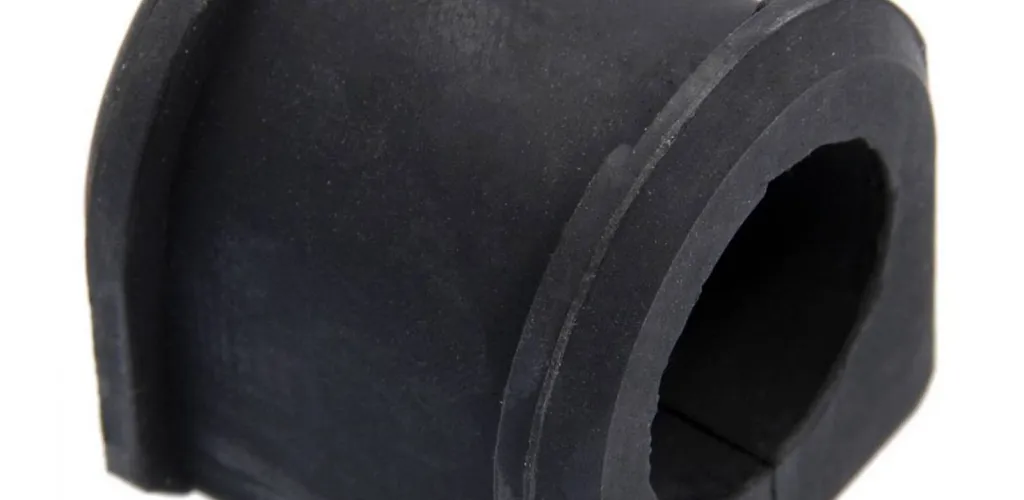
- Stabilizer bar bushings mount and allow controlled bar rotation to distribute axle forces.
- Rubber compounds include standard, polyurethane, and reinforced varieties.
- Oil leaks rapidly ruin rubber; fix leaks promptly to protect bushings.
- Check bushings during service: inspect cracks, wear, looseness, and oil traces.
Stabilizer bar bushings are essential components of the suspension system, responsible for mounting the stabilizer bar to the vehicle’s chassis and enabling its correct operation. These seemingly simple parts have a major impact on the car’s behavior in corners and on ride comfort.
How stabilizer bar bushings work
The stabilizer bar is constantly flexed and under tension, which puts stress on the bushings. Stabilizer bar bushings bear a large part of the forces that load the stabilizer bar in corners. In practice, they allow the bar to rotate in the mounting bushings in a controlled manner, redistributing the suspension forces between the two wheels on the same axle.

In corners, the stabilizer bar twists, and the bushings must allow this movement while keeping the bar properly positioned. Mechanical stresses are intense, especially in fast cornering or on rough roads.
What the bushings are made of
Bushings are made from different types of rubber, which over time wear out and lose their effectiveness. There are several types of compounds:
- Standard rubber — the most common, offering a good compromise between price and durability
- Polyurethane — more resistant and with longer service life, but also more expensive
- Reinforced rubber — used in sports vehicles or heavier ones
Over time, the rubber hardens and starts to crack. This degradation process is accelerated by:
- Exposure to extreme temperatures
- Contact with chemical substances (road salt, detergents)
- Engine or transmission oil
- Mechanical wear from normal operation
Effects of oil on bushings
If oil reaches the bushings, the oil softens them and they begin to disintegrate immediately. The oil dissolves the chemical composition of the rubber, turning it into a soft mass that can no longer perform the clamping function. For this reason, any oil leak from the engine, transmission or differential must be remedied urgently, not only to prevent lubricant loss but also to protect the rubber components of the suspension.
Where stabilizer bars are mounted
Stabilizer bars are mounted most often on the front axle of the car. Some sports cars or premium models, however, have stabilizer bars on the rear axle for a more balanced road behavior. The configuration varies depending on the vehicle type and the manufacturer’s requirements for cornering behavior.
When and how to check the bushings
Try to check the integrity of the bushings every time you service the car. The check is relatively simple and can prevent more serious problems:
- Lift the car on a lift or jack
- Visually inspect each bushing for cracks, wear or deformations
- Check if the bushings have become too soft or enlarged
- Move the bar manually to detect abnormal play
- Check for oil traces on or around the bushings
Replacing the bushings
If one of the bushings is in poor condition, it will affect the other fairly quickly. In this case, try to replace both. This happens because:
- A worn bushing will transfer more load to the other
- Both bushings have the same age and wear, and accelerated wear of one indicates the other is near its limit
- The imbalance created by a worn bushing will accelerate deterioration of the other
The replacement cost is relatively small compared to the benefits: better cornering, reduced suspension noise, and overall improved comfort. New bushings will allow the stabilizer bars to fulfill their optimal role in reducing body roll in corners.
Photo source: shop.febest.eu