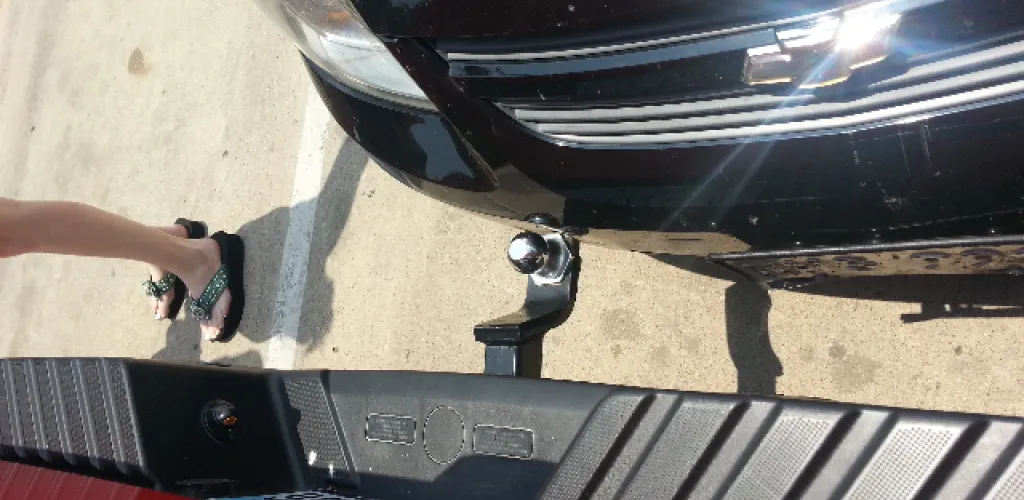
- Romania does not explicitly ban driving with a tow hitch without a trailer.
- All coupling devices must be RAR homologated and carry a visible label.
- One- or two-trailer towing requires homologation, maneuverability, correct dimensions, and system compatibility.
- Unused hitches can worsen crashes, injure pedestrians, and obstruct license plates.
Tow hitch without a trailer – what the law says in Romania
Installing a tow hitch raises important questions about the legality of circulating with this device when a trailer is not actually being towed. This situation fuels debates among drivers, especially given that a hitch can worsen the consequences of a rear-end collision. Let us analyze exactly what Romanian law provides in this regard.
In Romania, traffic legislation does not explicitly prohibit driving with a coupling device mounted on the vehicle in the absence of a trailer. Unlike some other European countries that have clear regulations in this sense, our legislation focuses on actual towing standards.
However, this apparent permissiveness does not mean that any hitch can be mounted. The law clearly specifies that all coupling devices must be RAR homologated and bear a visible label demonstrating this.
Differences in European Legislation
For a broader perspective, it is useful to know that:
- Some European countries completely ban driving with a tow hitch without a trailer attached
- Other countries allow this practice provided the hitch does not obstruct the visibility of the license plate
- Romania does not have an explicit position in this regard, focusing on the regulation of actual towing
Tow regulations in Romania
When used effectively for towing, the coupling device must meet strict criteria. Under current law, coupling a vehicle with one or two trailers can be carried out only if:
Mandatory Technical Requirements
- Homologation and compatibility - the elements that comprise the coupling device are homologated and compatible
- Maneuverability - the vehicle combination can achieve the minimum turning radius of the towing vehicle
- Legal dimensions - the dimensions of the vehicle combination do not exceed the limits set by law
- Compatibility with braking, lighting and signaling systems - the coupling elements of braking, lighting and signaling systems are compatible
- Clearance - the vehicles that make up the assembly do not touch when passing over bumps, curves, or direction changes
Speed limits for towing
When actually towing a trailer, the legal maximum speed is reduced by 10 km/h compared to the maximum permitted speed for the category of the vehicle, but only outside built-up areas.
Exception for bicycle carriers
This speed reduction does not apply when the coupling device is used for a bicycle carrier, since it does not constitute a trailer in the legal sense of the term.
Practical and safety aspects
Risks of an unused tow hitch
- Can aggravate the consequences of a rear collision
- Cause additional injuries to pedestrians in case of an accident
- Damage vehicles behind in the event of a collision
- Obstruct the visibility of the license plate if poorly positioned
Recommendations for tow hitch owners
- Periodically check whether the hitch obstructs the license plate
- Ensure the device is RAR homologated
- Keep the homologation documentation in the vehicle
- Consider removing the hitch when not in use for extended periods
Penalties for non-compliance
Non-compliance with towing regulations is punished with a Class IV fine, namely 9 to 20 penalty points. This sanction applies mainly to:
- Use of non-homologated devices
- Exceeding speed limits during towing
- Non-compliance with coupling technical requirements
- Forming non-conforming vehicle assemblies
Conclusion
Although Romanian law does not explicitly ban driving with a tow hitch without a trailer, owners of these devices must ensure they meet all homologation technical norms and be aware of the additional safety risks involved. In the context of road safety, it is advisable to evaluate whether it is necessary to keep the hitch mounted on the vehicle.