- Rust is the main foe, targeting sills, rear fenders, headlights, and suspension.
- High-mileage Mk3s risk transmission and suspension wear; owners praise balanced handling.
- Wide engine lineup from 1.4 to 2.9 VR6, plus 1.9 diesel options.
- Real-world fuel economy varies by engine; e.g., 1.8 90hp mixed 6.6 L/100km.
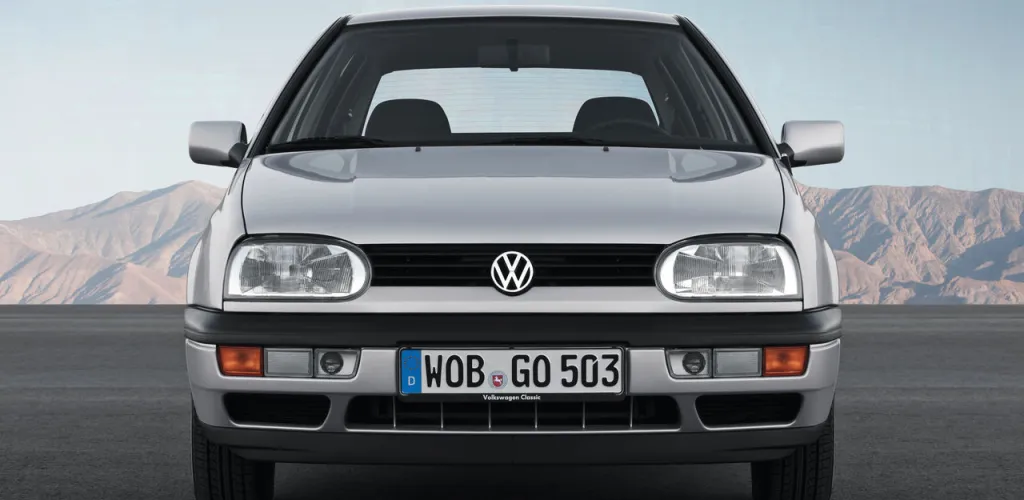
Volkswagen Golf Mk3 is the third generation of the iconic German model, launched in Europe in August 1991 and in Romania in the following years. Considered by many experts a transitional Golf, Mk3 brought modern technologies while preserving the mechanical simplicity that made the previous generations famous. After decades of use, this generation has become a popular choice for automotive enthusiasts seeking a reliable car at an affordable price.
Based on real owner experiences and technical analysis, Mk3 stands out for the solid Volkswagen build, but it is not without age-related challenges. Rust is the main foe of these vehicles, while the transmission and suspension require extra attention on high-mileage models.
Common problems identified in the VW Golf 3
Rust - the main threat
[Rust] is the most serious problem of the Golf 3, affecting especially:
- Sills and weld areas
- Rear fender near the spare wheel
- Bodywork around the headlights
- Suspension components
Transmission problems
[Automatic transmission] (where available) can develop problems at high mileage, while manual transmissions are generally reliable. Main failures include:
- Worn synchronizers in manual gearboxes
- Hydraulic problems in automatics
- Clutch wear, particularly on sport models
Suspension and steering
Suspension components require periodic replacement:
- Shock absorbers lose efficiency after 100,000-120,000 km
- Stabilizer bushings wear frequently
- Tie rods and ball joints require attention
Available engines and technical specs
Petrol engines
- 1.4-litre: 59 hp, 116 Nm - ideal for city driving, low consumption
- 1.6-litre: 99 hp, 140 Nm - the perfect balance between performance and economy
- 1.8-litre (75 hp): 145 Nm - reliable and durable
- 1.8-litre (90 hp): improved version, more responsive
- 2.0 GTI 16V: 150 hp, 180 Nm - for performance enthusiasts
- 2.8 VR6: 174 hp, 235 Nm - the range’s benchmark engine
- 2.9 VR6: 187 hp, 245 Nm - the top of the line
Diesel engines
- 1.9 D: 63 hp, 124 Nm - economical but less refined
- 1.9 SDI: 63 hp, 125 Nm - the improved version
- 1.9 TDI: 108 hp, 235 Nm - the most efficient engine in the range
Driving experience and performance
Road behavior
Owners consistently appreciate the Golf 3’s balanced character. Mihai Razvan, owner of a 1.8 with 90 hp, describes the experience: “It’s a light driving feel because this sport suspension somehow helps with steering, acceleration is easy, and the comfort of the Recaro seats is indescribable.”
Alexandru Cosma adds: “In the city it’s easy, the car is small and slips through without issues. It’s very easy to drive on long trips; the faster you go, the easier it handles.”
Real fuel consumption
Owner experiences provide a clear picture of real-world consumption:
Engine 1.8 (90 HP):
- Mixed: 6.6 L/100 km
- Urban: 7-12 L/100 km (depending on driving style)
- Extra-urban: 6.5-7 L/100 km
Engine 2.8 VR6:
- Urban: 20-25 L/100 km
- Extra-urban: 15-17 L/100 km
Engine 1.8 (75 HP):
- Extra-urban: 7.5 L/100 km
Reliability in long-term use
Engines - the strong point
Golf 3 engines are generally very reliable. The experience of Andrei Vlăsceanu with the VR6 engine confirms this reputation: “2.8 VR6 installed for 8 months, the only problem was the water pump; I have driven at least 150 km daily in the last 8 months.”
Maintenance challenges
Mihai Razvan identifies the main challenge: “Minor problems have been and are mostly due to aftermarket parts because OEM parts are not fully available (thermostat stuck, bearings, etc.).”
Critical components
Cristian Uta’s experience illustrates the importance of quality service: “I had problems when laziness pushed me to have the clutch kit replaced at a shop; from Bucharest to Sighișoara I ended up with three mounting bolts between the gearbox and the engine block, differential bearings broken.”
Prices on the second-hand market
The Golf 3 market has contracted significantly, most examples being either restored by enthusiasts or taken off the road due to rust. Available examples range in price:
- Poor condition: €500-€1,500
- Average condition: €1,500-€3,000
- Very good condition: €3,000-€5,000
- Restored/rare examples: €5,000+
Buying guide and practical tips
What to check when buying
Body inspection:
- Check rust-prone areas carefully
- Inspect the sills by lifting the car
- Inspect the engine bay for signs of corrosion
Mechanical test:
- Listen to the engine at idle and under load
- Check the transmission operation across all gears
- Test the suspension on roads with bumps
Advice from experienced owners
Mihai Razvan recommends: “Be careful first of all with the engine. Other engine variants have been problematic (1.6 L, 1.4 L, 1.8 L 75 hp). Otherwise, focus on the mechanical and cosmetic aspects for safety.”
Andrei Vlăsceanu warns: “Think very carefully if you are willing to invest your time, money, and nerves to enjoy a car that is long past its prime. I think rust should be your first concern.”
Final recommendations
The Golf 3 remains a valid choice for those who appreciate:
- Simple and affordable mechanics
- Reasonable maintenance costs (with aftermarket parts)
- An active community of enthusiasts
- The potential for personalization
Cristian Uta sums it up perfectly: “Buy it and enjoy it; it’s worth it. Be mindful of rust; rust is at home on a Mk3.”
For those seeking an affordable collectible or restoration project, the Golf 3 offers an authentic VW experience at a reasonable price, provided you are prepared for the age-related challenges.
Photo source: volkswagen-newsroom.com