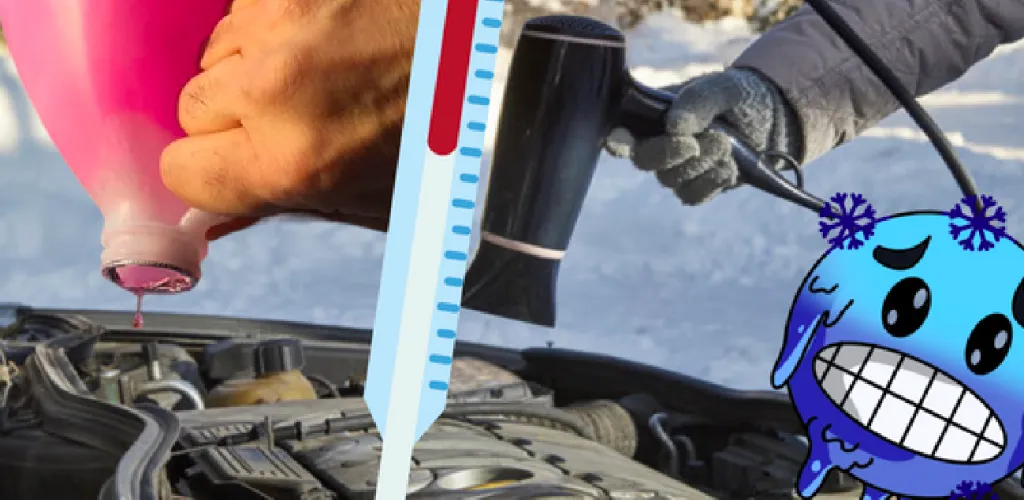
- Antifreeze cools engine and prevents freezing, protecting the cooling system year-round
- Standard 50:50 mix protects to -37°C and maintains heat transfer
- For extreme conditions, 60:40 to -52°C or 70:30 to -64°C; avoid pure antifreeze
- Check levels monthly; replace at 40k-60k km; watch color, low level, odor
Antifreeze is a vital coolant in every vehicle, playing a crucial role in keeping the engine at its optimal operating temperature. Despite its critical importance, many drivers neglect maintenance of this essential fluid, which can lead to costly problems, especially in cold seasons.
Functions of Antifreeze in the Cooling System
The coolant with antifreeze serves two fundamental purposes in engine operation:
- Summer cooling: absorbs excess heat from the engine and dissipates it through the cooling radiator
- Freeze protection: prevents the coolant from freezing in the cooling system during winter
These properties make antifreeze an indispensable component for proper engine operation in any season.
Chemical composition and properties of antifreeze
Modern vehicle antifreeze is formed from a complex blend of chemicals, among which the main component is glycerol (ethylene glycol or propylene glycol), which can account for up to 70% of the composition.
Role of glycerol in antifreeze performance
Glycerol contributes to:
- Optimized viscosity: ensures proper flow through the cooling system
- Lubricating properties: protects the water pump and other moving components
- Thermal stability: maintains properties under extreme temperatures
Freezing temperature: -38°C and factors influencing it
Theoretical freezing point
According to manufacturers’ specifications, standard antifreeze freezes at -38 degrees Celsius. This temperature is determined under laboratory conditions, with pure antifreeze, undiluted.
Factors that can affect freeze resistance
In reality, antifreeze performance can be compromised by:
- Dilution with water: incorrect antifreeze/water ratio reduces protection
- Lapse of liquid: antifreeze loses properties over time
- Contamination: impurities can affect the freezing point
- Initial quality: not all brands offer the same performance
Optimal antifreeze-water mixture ratios
Standard 50:50 mix
Most manufacturers recommend a mixture of 50% antifreeze and 50% distilled water for:
- Protection down to -37°C
- Optimal heat transfer performance
- The ideal balance between protection and efficiency
Adapting to extreme conditions
For regions with very low temperatures, the ratio can be adjusted:
- 60% antifreeze, 40% water: protection down to -52°C
- 70% antifreeze, 30% water: maximum protection down to -64°C
Note: Do not use pure antifreeze (100%), as it can reduce heat transfer efficiency.
Checking and maintaining antifreeze
When to check level and quality
- Monthly: visual check of the expansion tank level
- Before winter: full check of concentration and condition
- At 40,000-60,000 km: complete replacement according to vehicle manual
Signs that antifreeze needs attention
- Color change: from green/red/blue to brown/rust
- Altered consistency: presence of particles or gel-like substances
- Unusual odor: overly sweet aroma may indicate leaks
- Constantly low level: possible leaks in the system
Testing antifreeze concentration
Using a refractometer
The most precise instrument for measuring antifreeze concentration:
- Place a drop of liquid on the prism
- Read the value on the graduated scale
- Interpret the result according to the manufacturer’s table
Hydrometer tests
A more accessible method:
- Draw fluid into a hydrometer
- Read the value on the float scale
- Compare with the recommended values
Risks of Freezing the Cooling System
Severe mechanical consequences
When antifreeze freezes, the following can occur:
- Cracking of the engine block: Ice expansion can damage cast iron
- Damage to radiators: Pipes can burst due to pressure
- Water pump failure: Ice blocks impeller rotation
Repair costs
Repairing damage caused by antifreeze freezing can cost:
- Engine block replacement: 5,000-15,000 RON
- Radiator repair: 500-2,000 RON
- Water pump replacement: 300-800 RON
Recommendations for the cold season
Preparing the vehicle for winter
- Checking concentration: test frost protection
- Inspecting leaks: check hoses and clamps
- Cleaning the system: perform a flush if necessary
- Filling the level: use only compatible antifreeze
Choosing the right antifreeze
- G11 (IAT): for older vehicles, green color
- G12 (OAT): for modern cars, red/pink color
- G13: current standard, violet/yellow color
Important: Do not mix different antifreeze types, as they can react chemically and lose properties.
Conclusion
Maintaining a functional cooling system with quality antifreeze is essential for engine longevity. Regular concentration checks and periodic coolant replacement are a small investment compared with the costs of major repairs. In Romania’s climate, properly maintained antifreeze provides adequate protection, but for trips in mountainous areas or countries with harsher climates, it is prudent to check and adjust concentration for extra protection.