- Call emergency services (112) and provide location, vehicles, victims, hazards.
- Most victims should stay in the vehicle to avoid spinal injuries.
- Invisible injuries like cervical spine fractures and brain injuries can worsen with movement.
- Only intervene if there is fire or imminent fire risk.
The number of road traffic accidents in Romania is steadily rising, and how we intervene as drivers or bystanders can mean the difference between life and death. First aid knowledge is essential, but very few road users know exactly how to proceed correctly when faced with an entangled victim. A wrong intervention can turn a treatable injury into permanent paralysis.
In this article we will analyze the situations in which it is permissible to remove a victim from the vehicle and the safety protocols you must follow to avoid worsening their condition.
Initial steps after a road traffic accident
Regardless of the accident location or its severity, the first thing you must do is call emergency services at 112. When speaking with the dispatcher, provide the following information in this order:
- Exact location of the accident (kilometer, visible markers, intersection)
- Number of vehicles involved
- Approximate number of victims
- Apparent condition of the victims (conscious/unconscious, visible bleeding)
- Imminent hazards (vehicles on fire, fuel leaks, heavy traffic)
Operators at 112 are trained to guide you step by step in providing first aid until specialized teams arrive. If the accident occurs in a city, SMURD units usually arrive in 8–15 minutes. In rural areas, response time can exceed 30–40 minutes, a situation in which your knowledge can save lives.
The golden rule: when NOT to remove the victim from the car
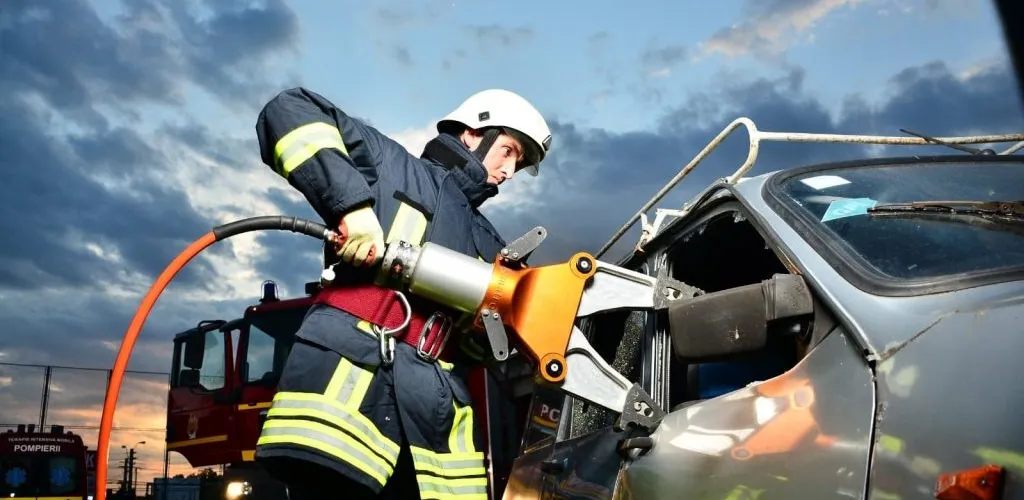
In the vast majority of accidents, the victim should be left in the vehicle until the specialized teams arrive. This is due to the risk of spinal injuries, which can be fatally aggravated by improper handling.
Invisible injuries that can become fatal
In the aftermath of a crash, the victim may suffer:
- Fractures of the cervical spine – the neck area, extremely vulnerable
- Injuries to the thoracic and lumbar spine – can lead to paralysis
- Pelvic fractures – with risk of internal bleeding
- Traumatic brain injuries – requiring total immobilization
The key problem is that these injuries are not visible to the naked eye. A victim may appear conscious and able to move, but a nondisplaced fracture of the cervical vertebrae can become a severing of the spinal cord with the slightest movement. In emergency medicine there are dozens of documented cases where victims who would have survived minor injuries ended up completely paralyzed due to improper handling at the scene.

Even if the victim is conscious and asks to be removed from the car, explain calmly that it is safer to wait for the firefighters and paramedics, who have specialized immobilization equipment (cervical collar, spinal board).
Critical situations when you MUST intervene immediately
There are, however, scenarios where leaving the victim in the vehicle means certain death. In these cases, the risk of spinal injury becomes secondary to the imminent danger:
1. Fire or imminent fire risk
If you observe flames under the hood, massive fuel leaks, or a strong gasoline/diesel odor, you have very little time. Fire can spread extremely quickly, and cabin temperatures can become lethal in less than 2 minutes.
Before removing the victim:
- Disconnect the battery if possible (loosen the negative cable)
- Turn off the ignition of all involved vehicles
- Do not use a mobile phone near fuel leaks
- Check for a functional extinguisher nearby
2. Submersion in water
If the vehicle has fallen into a river, lake, or canal, you have roughly 30–90 seconds before the car sinks completely or the windows yield to water pressure. In this situation, every second counts.
Try to break a side window (not the windshield, which is laminated and very resistant) using a sharp, hard object applied to the corner of the glass. The head supports of the seats can be used if needed.
3. Inundation of the cabin with toxic smoke
In electric or hybrid vehicle crashes there is a risk of toxic gas release from damaged batteries. For diesel engine vehicles, thick black smoke can cause rapid asphyxia.
Correct extrication technique
If you are in one of the critical situations described above and must extricate the victim, follow this protocol strictly:
Extrication preparation
- Rapidly assess the victim’s position and the optimal access path
- Request help from other bystanders – do not attempt alone if possible
- Inform the victim of your intention, even if they appear unconscious
- Check whether the seatbelt can be released (sometimes the mechanism jams)
Rautek extrication procedure
This is the standard technique used by emergency services:
- Positioning: Position yourself laterally to the victim, behind them if possible
- Grasp: Slip one arm under the victim’s armpit and support the head and neck with your forearm
- Stabilization: With the other hand, grasp the victim’s opposite wrist and pull them toward you
- Maintaining axis: Keep the head, neck, and spine on the same axis throughout the movement
- Extrication: Move the victim out of the vehicle with slow, controlled motions
- Placing: Place the victim on a flat, rigid surface, maintaining spinal alignment
Throughout the maneuver, the spine must remain straight. Any rotation or sudden bending can sever the spinal cord in a fracture.
If you are alone
Extracting an unconscious victim by a single person is extremely difficult, especially if the victim is heavier than you. Focus on:
- Maintaining an open airway
- Stabilizing the neck with your hands until help arrives
- Monitoring breathing and pulse
After extricating the victim
Immobilization and positioning
- Lay the victim on a flat, rigid surface (avoid soft ground)
- Stabilize the head using objects on both sides (rolled jackets, bags)
- DO NOT put anything under the head to lift it
- Cover the victim with blankets or clothing to prevent hypothermia
Checking vital signs
In this order, check:
- Consciousness: Talk to the victim, check response to stimuli
- Breathing: Bring your ear close to the victim’s mouth, watch chest movement
- Pulse: Check the carotid artery (in the neck, lateral to the Adam’s apple)
When to start resuscitation
Start cardiopulmonary resuscitation (CPR) immediately only if:
- The victim is NOT breathing at all or only occasionally breathes
- You do not feel a pulse
- The victim is unconscious
For victims with suspected spinal injuries, CPR must be modified:
- Avoid hyperextension of the neck when opening the airway
- Use the jaw thrust technique instead of the head tilt
- Focus on high-quality chest compressions (5–6 cm depth, 100–120/min)
Common mistakes that can be fatal
Moving the victim out of curiosity
Many well-intentioned people try to remove the victim to better assess injuries. This is the most dangerous impulse — even a visual assessment can miss spinal injuries.
Offering water or food
Never give water, food, or medications to an accident victim. This can require emergency surgery, and a full stomach increases the risk of aspiration.
Removing a motorcycle helmet
Always leave the helmet on, unless the victim is not breathing and you must perform resuscitation. Removing the helmet can cause fatal injuries to the neck.
Excessive warming of the victim
While hypothermia is dangerous, direct heating with flames or other heat sources can cause severe burns to a victim who cannot signal pain.
Legal aspects of intervention
In Romania, the law protects you when you provide first aid in good faith. According to Law 95/2006, anyone who provides first aid in an emergency cannot be held legally responsible for damages caused to the victim, provided they acted:
- Within the limits of their knowledge
- Without intent to harm
- In a reasonable attempt to help
However, failing to assist a person in danger is a crime and is punishable under the Penal Code. Calling 112 fulfills your minimum legal obligation.
Preparation for emergency situations
As a responsible driver, you should:
- Take a first aid course (8–16 hours, offered by the Red Cross)
- Keep a complete and checked first aid kit in your car
- Have onboard a reflective triangle, a reflective vest, and a fire extinguisher
- Know how to quickly disconnect your vehicle’s battery
- Know the locations of hydrants and emergency numbers on common routes
A correct intervention at an accident can save lives, but a rushed intervention can turn a recoverable victim into a permanent paraplegic. When in doubt, follow the principle “do no harm first” and wait for professionals.