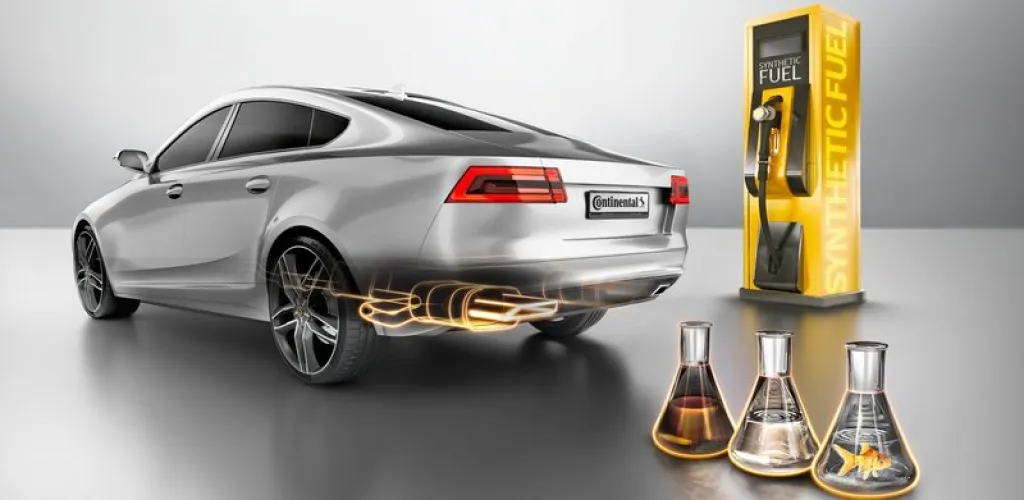
- E-fuels are hydrogen-CO2 liquids that work in current engines and gas stations.
- They can cut CO2 emissions by up to 90% via a closed carbon cycle.
- They preserve heritage cars and require no engine modifications, just existing infrastructure.
- Production uses roughly five times more energy than the final fuel contains.
Prices at the pump have climbed to alarming levels in recent years, and the upward trend shows no sign of stopping. The European Union has already set that from 2035 new passenger cars with internal combustion engines will no longer be sold in Europe. In this context, major manufacturers such as BMW and Porsche are investing heavily in the development of synthetic fuels, seen by many as a potential salvation for classic engines.
What are synthetic fuels (e-fuels)?
Synthetic fuels (e-fuels) are liquids produced through chemical processes that combine hydrogen (H₂) with carbon dioxide (CO₂) captured from the atmosphere or from industrial sources. The resulting liquid has properties nearly identical to conventional gasoline or diesel and is directly compatible with existing internal combustion engines.
The production process relies on Fischer-Tropsch synthesis or methanol synthesis, followed by refining. Thus, hydrocarbons with molecular chains similar to fossil fuels are produced, meaning they can be used without modifications to engines or the existing distribution infrastructure.
Advantages of synthetic fuels
Drastic reduction of CO₂ emissions
The most important advantage of e-fuels is their potential to reduce carbon dioxide emissions by up to 90% compared with fossil fuels. This is possible because the carbon released during burning is the same carbon captured earlier to make the fuel, creating an almost closed loop.
Complete compatibility with existing infrastructure
Unlike electric vehicles, which require a completely new charging infrastructure, synthetic fuels can be distributed through the current network of gas stations. Existing cars can use these fuels without any technical modifications, making the transition much simpler and cheaper.
Preserving automotive heritage
For lovers of classic and sports cars, e-fuels represent an ideal solution. Collectible cars and iconic sports cars can continue to run without contributing significantly to pollution, preserving the authentic driving experience of an internal combustion engine.
Higher energy density
Synthetic fuels offer a much higher energy density than current batteries. This means extended range and fast refueling times, areas where electric vehicles still face disadvantages.

Challenges and disadvantages of synthetic fuels
High energy consumption in production
Arguably the biggest challenge is the large amount of energy required to manufacture synthetic fuels. The electrolysis process to produce hydrogen and the subsequent fuel synthesis require roughly five times more energy than the energy stored in the final fuel.
For the process to be truly green, this energy must come exclusively from renewable sources – wind, solar, hydro. Otherwise, the total carbon footprint could be even higher than that of fossil fuels.
Lower energy efficiency compared to electric vehicles
In a direct comparison, an electric vehicle uses energy far more efficiently. From the initial electrical energy:
- Electric vehicle: about 70-80% reaches the wheels
- Vehicle running on e-fuels: only about 10-15% reaches the wheels
The rest of the energy is lost in the fuel production process and in the thermal efficiency of the internal combustion engine.

High production costs
Currently, the production cost of synthetic fuels is 3-5 times higher than that of conventional gasoline. Although price reductions are anticipated with industrial-scale production, it remains to be seen whether they will become economically competitive.
Need for renewable energy
To produce sufficient amounts of e-fuels to replace current fuel consumption, enormous capacities of renewable energy production would be required. Experts estimate that capacity would need to double or even triple the current green energy capacity, just for the automotive sector.
Ideal applications for synthetic fuels
Aviation
The aviation industry is perhaps the most suitable field for e-fuels. Aircrafts require very high energy density, and current battery technology cannot meet this requirement. Synthetic fuels for aviation (Sustainable Aviation Fuel – SAF) are already tested and certified by companies like Lufthansa and KLM.
Maritime transport
Cargo and cruise ships burn vast quantities of fuel. Electrification is extremely challenging due to the weight of batteries required. E-fuels or derivatives such as e-methanol and e-ammonia present viable options for decarbonizing maritime transport.
Motorsport and collectible vehicles
Porsche has already announced its use of synthetic fuels in motorsport competitions. Formula 1 plans to use 100% synthetic e-fuels starting in 2026. For classic and collectible cars, this is a perfect solution to keep them functional and legal.
Automakers’ stance
Porsche – a pioneer in e-fuels
Porsche has invested over $75 million in building a pilot plant in Chile, in collaboration with Siemens Energy. The Haru Oni facility uses Patagonian wind to produce 130,000 liters of e-fuels annually in the pilot phase, with expansion plans to 55 million liters by 2025 and 550 million by 2027.
BMW and other German manufacturers
BMW, along with Audi and other German brands, continues to support the development of e-fuels as an alternative to full electrification. They argue that a technology-neutral approach, including both electric vehicles and combustion engines running on e-fuels, offers greater flexibility.
Ferrari and premium brands
Ferrari has stated that it sees synthetic fuels as the future for its iconic V12 engines. CEO Benedetto Vigna has confirmed that the brand will continue to produce internal combustion engines as long as legislation allows, using e-fuels to meet emission standards.
The future of synthetic fuels in the context of European legislation
Although the EU has set that from 2035 new cars with internal combustion engines will no longer be sold, there is an important exception: vehicles that use exclusively carbon-neutral synthetic fuels may still be sold.
This means that manufacturers investing in e-fuels could continue to market models with traditional engines, provided they are certified to run only on such fuels. However, the practical implementation of this exception remains unclear.
Comparison: E-fuels vs electric vehicles
For the individual consumer
Electric vehicles remain the more efficient and likely cheaper option for the majority of drivers. Operating costs are lower, and charging infrastructure is expanding rapidly. E-fuels could be an option for those who want to retain their existing cars or for use cases where electrification is impractical.
Environmental impact
Both technologies can be green if the energy used comes from renewable sources. Electric vehicles are more energy-efficient, but e-fuels have the advantage of rapidly decarbonizing the existing fleet without the need to replace vehicles.
Conclusion
Synthetic fuels represent a fascinating technology with real potential to extend the life of the internal combustion engine. Yet the challenges are substantial: high costs, the need for enormous amounts of renewable energy, and lower energy efficiency relative to direct electrification.
Most likely, e-fuels will not completely save the internal combustion engine in the mass-market auto segment, but they will find niche applications in aviation, maritime transport, motorsport, and for preserving collectible vehicles. For the majority of drivers, the future remains electrified, but e-fuels offer a valuable alternative for cases where electrification is not yet practical or for those who want to maintain the experience of a classic engine without pollution.