- No engine modifications; identical to civilian models.
- Trunk equipment includes braking distance device, breathalyzer, radar, and auxiliary siren battery.
- Roof equipment includes siren, GPS antennas, warning lights, controlled from a central panel.
- Price mainly reflects specialized equipment, communications systems, and extra electrical installations.
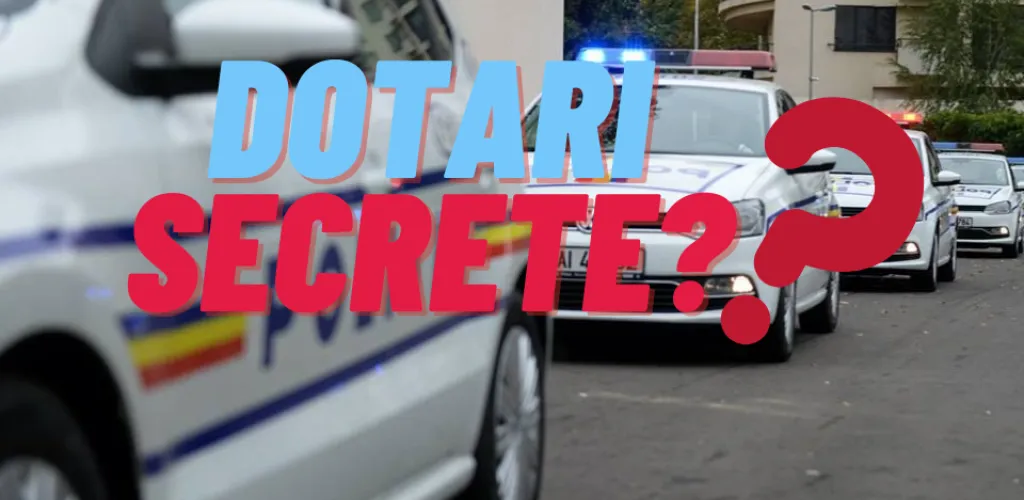
Romania’s Traffic Police vehicles are equipped with special gear that allows officers to perform their duties under optimal conditions. Although they look identical to civilian cars on the outside, they hide inside the cabin and in the trunk a range of professional equipment designed to ensure compliance with traffic laws.
The Road Traffic Director is part of the General Inspectorate of the Romanian Police and is responsible for supervising road traffic. To perform this mission effectively, officers require specialized equipment that enables them to accurately document violations and maintain road safety.
Standard Equipment in Police Vehicles
Each road officer has standard equipment, and the service car comes with a series of specialized fittings that facilitate fieldwork. Regardless of the make or model of the vehicle used, the equipment remains the same to ensure uniformity in operation.
Equipment in the trunk of the police car
- Braking distance measurement device — a precise instrument for calculating the stopping distance of vehicles in the event of accidents
- Auxiliary battery for the siren — ensures continuous operation of warning systems even if the main battery fails
- Breathalyzer (etilotest) — a licensed device for testing drivers suspected of driving under the influence
- Radar gun — equipment for measuring vehicle speeds to detect speed violations
External communication and signaling systems
On the roof of police vehicles there are several components:
- Siren with loudspeaker — the audio system allows communication with other road users and warnings in emergencies
- Multiple GPS antennas — provide precise localization and communication with the dispatch center
- Warning lighting system — rotating beacon and strobe lights for increased visibility
All of these systems are controlled from inside the vehicle via a centralized control panel, allowing the officer to operate quickly and efficiently the equipment according to the encountered situation.
Technical characteristics of the vehicles
Engine modifications
Contrary to the expectations of many drivers, Police Traffic cars do not feature engine-level modifications or power increases. They come identical to the versions marketed to the public, preserving the same factory specifications.
This approach has several advantages:
- Lower maintenance costs — using standard parts available in the dealer network
- Increased reliability — avoiding issues generated by aftermarket modifications
- Quick availability — direct purchase from the manufacturer’s stock
- Fleet uniformity — standardized maintenance and repair procedures
Economic considerations and cost justification
The high price of a road police vehicle compared to a civilian one is mainly due to:
- Specialized equipment — professional measuring and control gear
- Communication systems — GPS technology and professional radio
- Additional electrical installations — wiring and connectors for all devices
- Certification and homologation — special procedures for intervention vehicles
These investments are justified by the need to provide road officers with the tools necessary to fulfill their public safety mission and comply with traffic laws.