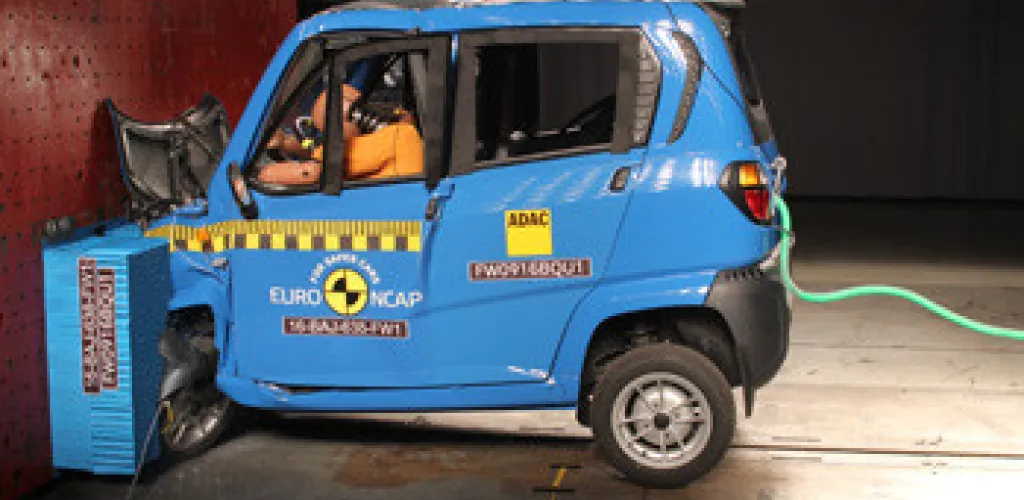
- Euro NCAP rates cars 1–5 stars to guide European buyers.
- Frontal tests at 64 km/h; side tests at 50 and 32 km/h; pedestrian at 40.
- Testing is voluntary; full assessments require four vehicle types.
- Established in 1997, Euro NCAP is a private Brussels-based safety authority.
Euro NCAP (European New Car Assessment Programme) is the European standard for evaluating vehicle safety, providing consumers with crucial information about the protection cars offer in the event of a crash. These ratings, expressed on a 1 to 5 star scale, influence the purchase decisions of millions of European drivers and push automakers to develop increasingly safer vehicles.
Understanding the meaning of Euro NCAP stars and the testing process can help you make an informed decision when choosing your next car, knowing exactly what level of protection to expect in various crash scenarios.
About the Euro NCAP Organization
Euro NCAP was established in 1997 for the UK Department of Transport and is headquartered in Brussels, Belgium. Over time, the organization has gained support from many European governments and the European Union, becoming the reference authority in vehicle safety testing.
The organization tests and publishes detailed reports on new cars, offering a rating expressed by the number of stars earned. As a private research company, Euro NCAP is not mandatory for manufacturers, but most choose to test their vehicles to demonstrate the level of safety.
Types of Euro NCAP Tests
Frontal impact test
The frontal impact test takes place at a speed of 64 km/h, the vehicle colliding into a specially designed deformable wall to simulate a crash with a car of similar weight and structure. This test evaluates front occupant protection and the effectiveness of restraint systems.
Side impact tests
There are two variants of side impact tests:
- Classic side impact: performed at 50 km/h with a movable barrier
- Pole impact: test performed at 32 km/h to simulate a collision with a narrow fixed object
These tests verify occupant protection in side crashes, a critical area given the limited deformation space.

Pedestrian safety test
The pedestrian safety test is performed at 40 km/h and evaluates the exterior design of the vehicle, measuring impact forces on the hood, headlights and bumper. This test has become increasingly important as urban traffic grows.
Testing and Selection Process
Car manufacturers are not required to have their vehicles tested by Euro NCAP, as the organization is private. However, most manufacturers submit entry-level models for testing, because they represent high-volume sales.
An important aspect to understand is that a full set of tests requires four different vehicles—one for each type of crash. This explains why very expensive or luxury models are rarely tested—the cost of destroying four high-end cars for research is prohibitive.
Annually, Euro NCAP tests about 35–40 new models, selected based on popularity and relevance to the European market. Currently, around 90% of cars sold in Europe have received a Euro NCAP rating.

The Star Rating System and Its Meaning
All tested cars receive a score between 0 and 5 stars. Until 2001, the maximum was 4 stars; the system was extended to better reflect technological evolution.
Detailed star classification
- 5 stars: Excellent protection after impact. The vehicle is robust and equipped with [safety systems] that can prevent accidents
- 4 stars: Good protection after impact. Collision avoidance systems may be present, but not at the level of 5-star models
- 3 stars: Moderate protection with the absence of advanced accident avoidance systems
- 2 stars: Minimal protection and absence of modern safety systems
- 1 star: Minimal protection, the vehicle is considered unsafe by current standards
Evolution of Testing Standards
An important aspect to understand is that Euro NCAP ratings cannot be directly compared across different years. Safety technology evolves rapidly, and tests are continually updated to reflect reality and current systems.
For example, Renault Megane received 5 stars in 2001 for the first time, and the Mercedes E-Class continues to receive 5 stars in 2018. This does not mean the Megane offers the same level of safety as the current E-Class — standards in 2001 were far more permissive than current ones.
Each vehicle is evaluated in the context of the technologies available at the time of testing and cannot be retested under later standards. This ongoing evolution ensures that ratings remain relevant and reflect real progress in the industry.
Importance of Ratings for Consumers
Euro NCAP ratings do not mean that a car with fewer stars is necessarily unsafe; rather, it means it does not offer the same level of protection as direct competitors in the same category and period.
Euro NCAP tests only standard production vehicles, exactly as they can be bought by consumers, without modifications or special equipment. This ensures that the information is relevant to real-world purchase decisions.
Limitations of the Euro NCAP System
While Euro NCAP provides valuable information, the system has limitations:
- Not all vehicles are tested due to cost
- Tests do not cover all possible crash scenarios
- Evaluation is based on technologies available at the time of testing
- Luxury and sports vehicles are underrepresented
Despite these limitations, Euro NCAP remains the most important auto safety standard in Europe, guiding both consumers in their choices and manufacturers in developing safer vehicles.