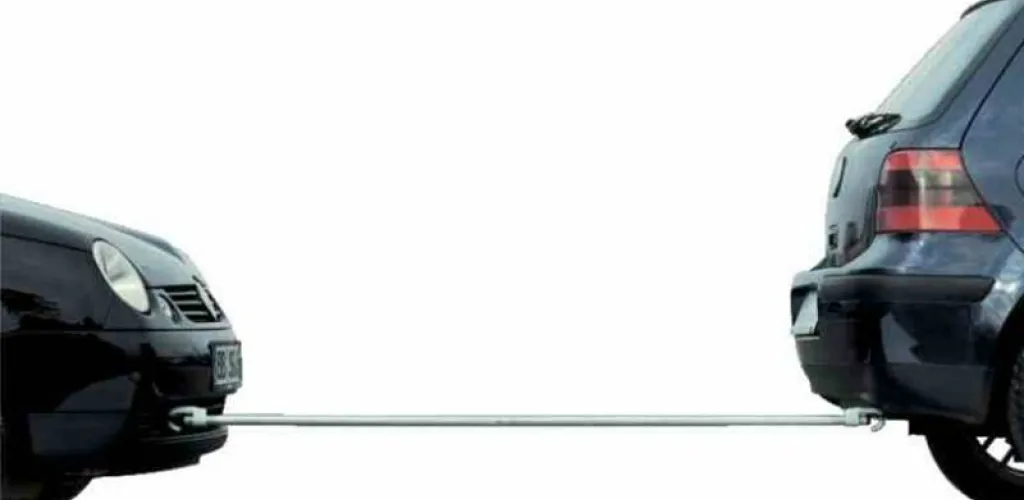
- Tow rope/strap rated 2–3 tons, tow hooks, reflective triangle, indicators, and hazard lights.
- Check rope condition before towing to prevent snapping.
- Romanian rules: visible indicator or hazard lights; licensed driver; ignition on.
- Starting technique and limits: communicate signals, start in first gear, accelerate gradually, obey 25 km/h.
Every driver may face a situation where they need to tow or be towed with their own vehicle. Whether it is an unexpected mechanical breakdown, a dead battery that prevents the engine from starting, or a fault in the fuel system, knowing the rules and correct towing techniques is essential. This guide provides all the information you need to perform a safe tow, respecting both legal regulations and best practices to protect both vehicles.
Before starting the towing process, it is important to assess the situation. If you are not experienced in this type of operation or you do not have the necessary equipment (a sturdy tow rope/chain, proper attachment points), it is recommended to call a professional auto platform or roadside assistance services. An incorrect tow can damage the transmission, steering, or suspension, and repair costs can far exceed the price of a professional service.
Equipment needed for towing
- Tow rope or towing strap — sturdy, with a capacity of at least 2–3 tons
- Tow hooks — both vehicles must have suitable anchorage points
- Reflective triangle — for signaling the vehicle being towed
- Visible indicator — to inform other road users
- Hazard lights operational on both vehicles
Always check the condition of the tow rope before use. A worn or damaged rope can snap during towing, creating a dangerous situation in traffic.
Legal rules for towing vehicles
According to current Romanian road traffic laws, there are several strict regulations you must comply with:
Requirements for the towed vehicle:
- Must display a visible rear indicator to inform other road users
- In the absence of a special indicator, hazard lights must be activated
- At the wheel there must be a person with a valid driving license for the relevant category
- The vehicle must have the ignition on to operate power steering and power brakes
Requirements for the towing cable:
- The distance between vehicles must not exceed 4 meters when using a textile rope
- For any distance greater than 2 meters, the rope must be visible and brightly colored (red, orange, or yellow)
- The rope must be securely fixed to the anchorage points of both vehicles
Driver limits:

- Any driver is permitted to tow a trailer or a vehicle with a maximum authorized mass of up to 3,500 kg
- The maximum permitted speed is 25 km/h in built-up areas
- The towing driver must have hazard warning lights on for maximum visibility
- Towing on highways and expressways is prohibited
Proper starting and driving technique
Starting from a standstill
Starting is the most critical moment of towing. Proceed as follows:
- Communicate with the driver of the towed vehicle — establish clear signals for start, stop, and emergency situations
- Start in first gear by releasing the clutch — even though this may wear the clutch slightly, it is necessary to avoid jerky movements that could snap the rope
- Accelerate gradually and smoothly — engine speed should be increased progressively, avoiding any abrupt movement
- Release the clutch slowly — until you feel the towed vehicle begin to move
Avoid gripping or snapping the rope with sudden accelerations. A snapped rope can rebound violently and cause material damage or injuries.
Driving while towing
Once you have started moving, follow these principles:
For the towing driver:
- Maintain a steady speed, without abrupt acceleration or braking
- Constantly check the mirrors to monitor the towed vehicle
- Signal any direction changes or maneuvers well in advance
- Allow more space for turns — the towed vehicle has a larger turning radius
- Monitor the engine temperature — towing adds extra load to the cooling system
- Avoid hard braking — alert in advance by lightly pressing the brake pedal to activate the brake lights
For the towed vehicle driver:
- Start the engine or at least turn the ignition on to activate power steering and power brakes
- Synchronize acceleration and braking with the towing vehicle
- Maintain the correct tension in the rope — do not let the rope slacken completely, but also avoid over-tensioning
- Be attentive to every maneuver initiated by the lead vehicle
- Do not attempt to overtake or perform other maneuvers not signaled by the lead vehicle
- Brake gently before the lead vehicle brakes to avoid pulling the rope tight
Technical aspects to consider
Checking vehicle compatibility
Before starting to tow, ensure that the towing vehicle has the necessary power. Check:
- Mass ratio — ideally, the towing vehicle should have a mass at least equal to that of the towed vehicle
- Engine power — a turbocharged engine is preferable for towing; small naturally aspirated engines (sub-1.6 L) may suffer
- Cooling system condition — ensure the radiator functions correctly and that the cooling fluid level is optimal
- Transmission condition — a worn gearbox can suffer permanent damage due to the extra load
Protecting the towing vehicle
Towing places high stress on several systems:
Engine and transmission:
- Use lower gears to reduce engine load
- Avoid overloading the engine — if the RPM stays above about 3,000, the speed is too high
- Monitor engine temperature — if it rises abnormally, stop to cool
Braking system:
- Brake early and progressively
- The braking system must be capable of handling the weight of both vehicles
- Check the brake fluid level before towing
Suspension and wheels:
- Tire pressure should be at the maximum recommended level
- Avoid potholes and sudden irregularities that can damage the suspension
Special situations and solutions
Towing on a slope
If you must tow on hilly roads:
- Uphill: use 1st or 2nd gear, maintain a constant RPM
- Downhill: use engine braking, do not press the brake pedal continuously as it can overheat
- Do not start towing from a steep incline — you may be unable to start moving
Towing vehicles with automatic transmission
Automatic transmissions have special restrictions:
- Some automatics do not allow towing with the driven wheels on the ground
- Consult the vehicle manual for the maximum distance and speed permitted
- In many cases, using a flatbed platform is preferable
Towing in adverse weather
In difficult weather conditions:
- Slow down even more than the legal limit
- Increase the safe following distance from other vehicles
- Avoid towing on snow or ice unless absolutely necessary
- Use additional lights for better visibility
Common towing mistakes to avoid
- Using a rope that is too weak — can lead to breakage and accidents
- Too high speed — reduces control and increases accident risk
- Poor communication between the two drivers
- Neglecting to check the anchorage points — they can give way under load
- Towing over long distances when the vehicle requires a platform
- Ignoring signs of engine overheating
- Sudden braking which can lead to a rope impact
When to call professional services
There are situations where towing with another passenger car is not recommended:
- The vehicle has steering or braking system defects
- The distance to the destination is greater than 10–15 km
- The route includes highway or expressway sections
- Weather conditions are dangerous
- You lack towing experience
- The towed vehicle has an automatic transmission with restrictions
In these cases, the cost of a professional towing service (approximately 150–300 RON depending on distance) is justified given the risks and potential damage.
Conclusion
Towing a vehicle correctly requires preparation, proper equipment, and strict adherence to safety rules and traffic laws. Although it may seem like a simple operation, there are numerous technical and legal aspects to consider. The number one priority is the safety of all road users — both those involved in the towing and the other drivers. When in doubt or when the situation exceeds your technical capabilities, do not hesitate to call professional towing services.