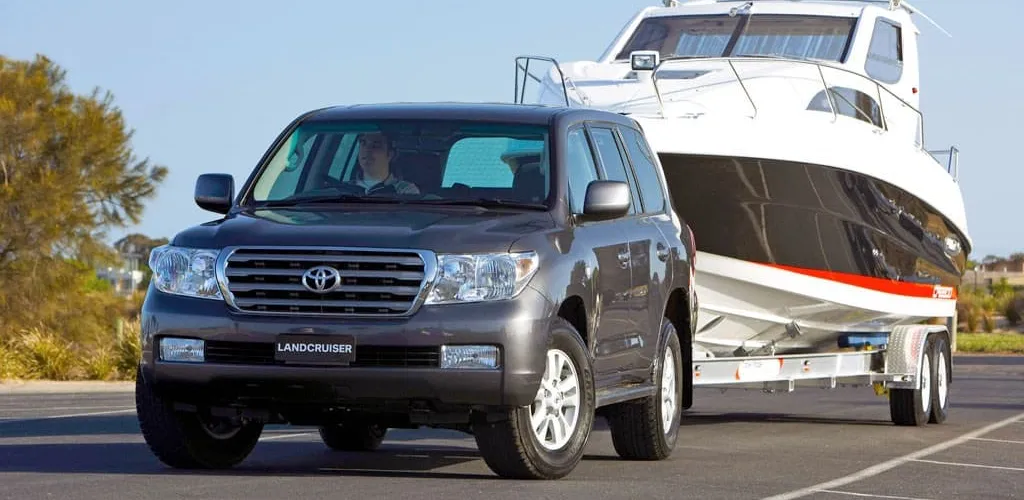
- Check owner’s manual for towing limits: max weight, tongue weight, brakes, tire pressure.
- ESP adapts to trailer, but driver must slow down and adjust style.
- Hill Start Assist and Hill Descent Control help manage inclines and declines.
- Visibility and braking degrade; extend mirrors, add cameras, and ensure trailer brakes.
Many Romanian drivers use their personal car to tow various types of trailers—from car platforms and freight trailers to bike racks or other vehicles. While it may seem like a straightforward operation, towing directly affects several vehicle systems and requires adapting your driving style to maintain safety on the road.
Understanding these aspects is crucial for any driver who wants to use their car’s towing capacity with maximum safety.
Checking Your Vehicle’s Towing Capacity
Before attaching any trailer to your car, consulting the owner’s manual is essential. Each car model has precise specifications regarding:
- Maximum towing weight - varies depending on engine type and transmission
- Maximum tongue weight - usually between 50-100 kg
- Brake system configuration - for trailers with their own brakes
- Recommended tire pressure - which should be adjusted for the added load
Ignoring these limits can lead to overloading the engine, transmission, and braking system, with substantial repair costs.
How towing affects safety systems
Electronic Stability Control (ESP/ESC)
The electronic stability control adjusts automatically when it detects a trailer attached. The system monitors:
- Lateral movements of the car-trailer assembly
- Tendency of the trailer to snake at high speeds
- Stability in curves and during lane changes
However, ESP cannot completely compensate for driving errors, and the driver must adapt speed and driving style.
Hill Start Assist and Hill Descent Control
These systems become extremely useful when you tow a trailer:

- Hill Start Assist prevents rollback when starting on an incline under load
- Hill Descent Control maintains a constant speed when descending an incline, reducing brake usage
Limitations of assistance systems
Parking sensors lose effectiveness when a trailer is attached because:
- They detect the trailer as a permanent obstacle
- They cannot accurately assess the distance to objects behind the trailer
- Automatic parking systems typically deactivate
Adaptive cruise control (ACC) can operate poorly with trailers that have their own brakes, because the system does not coordinate the car’s braking with the trailer’s braking.
Critical Safety Considerations
Reduced visibility
Towing a trailer significantly affects your field of view:
- The blind spots increase considerably
- The length of the combined vehicle can double the vehicle’s size
- Reversing maneuvers become much more complex
Recommended solutions:
- Install additional or extended mirrors for better visibility
- Use a camera system for reversing
- Enlist the help of a person for maneuvering in tight spaces
Braking system
Towing significantly affects braking performance:
- Stopping distance increases proportionally to the trailer’s weight
- The car’s brakes are overworked if the trailer has no brakes
- Emergency control becomes more difficult
Recommendations:
- Check the condition of brake pads and discs before long trips
- Use engine braking to reduce the load on the braking system
- Maintain a larger following distance from the vehicle in front
Technologies that remain functional
These systems continue to operate normally and are extremely useful:
Adaptive headlights
- They automatically steer based on direction of travel
- They improve visibility in curves, partially compensating for the trailer’s increased length
Forward collision warning
- Detects vehicles ahead and warns the driver
- Can initiate emergency braking if necessary
Blind-spot monitoring
- Remains functional for detecting vehicles from the sides
- Partially compensates for reduced visibility
Adapting Your Driving Style
Route planning
- Choose routes with gentler grades
- Avoid very narrow roads or tight curves
- Check weight restrictions on certain roads
Driving techniques
- Gradual accelerations and braking to avoid sudden trailer movements
- Taking curves at reduced speed to prevent tipping
- Increased following distances from other vehicles
- Frequent mirror checks to monitor the trailer
Specific maintenance
Regular towing requires extra attention to:
- Engine oil changes — shorter intervals due to increased load
- Coolant level — the engine runs hotter
- Transmission checks — automatic transmission overheats more easily
- Tire wear — accelerates on the driven axle
Trip Preparation
Before every trailer trip:
- Check electrical connections — lights, signals, and illumination
- Check tire pressures — both on the car and on the trailer
- Secure the load — ensure even weight distribution
- Test the brakes — at low speed, in a safe area
- Adjust the mirrors — for optimal visibility
Towing a trailer does not have to be risky if you respect your vehicle’s limits, adapt your driving style, and understand how the car’s systems work in these conditions. Caution and proper preparation are the keys to a safe and trouble-free experience.