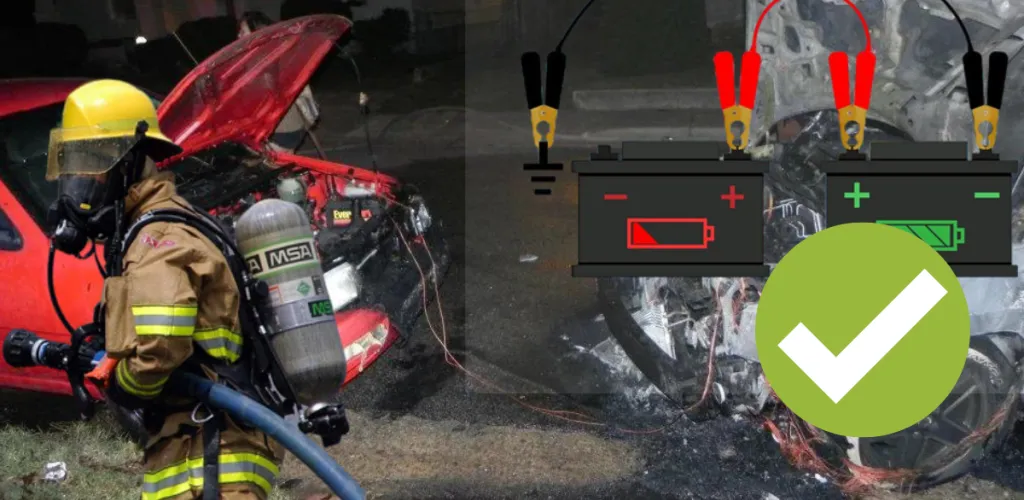
- Incorrect jumper cable order causes dangerous short circuit and potential system damage
- Follow proper procedure: connect positive to positive first, then negative to ground, before starting
- Disconnect quickly after recharge to avoid alternator overload and damage
- Consequences: smoke, overheated cables, melted insulation, possible ECU and alternator damage
Many drivers perform their own car maintenance, whether out of passion for automobiles or to save money. Regardless of the reason that drives you to maintain your vehicle yourself, it is essential to understand the basics, including the correct connection of jumper cables. An apparently minor mistake can have devastating consequences for the car’s electrical system.
Even for those with experience, mistakes can happen. Today we will analyze in detail what happens when you connect jumper cables incorrectly to the car battery and how to avoid these dangerous situations.
Proper Cable Connection Procedure
To jump a car or to receive a jump from another vehicle, the standard procedure includes the following steps:
- Vehicle positioning: Align the two cars front-to-front or side-by-side, at a distance that allows the cables to reach.
- Lifting the hoods: Ensure that both engines are off.
- Connecting the positive cable: Attach the red (positive) cable first to the donor car’s positive terminal, then to the receiving car’s positive terminal.
- Connecting the negative cable: Attach the black (negative) cable to the donor car’s negative terminal, then to a metal ground on the receiving car (not directly to the receiving car’s negative terminal).
- Starting the engine: Start the donor car’s engine and let it idle or run at a low RPM for 1–2 minutes.
- Charging and starting: Allow the battery to charge and attempt to start the car that was not functioning.
Why the Order of Connection Is Crucial
The electrical system of a car operates with a 12V DC supply, and correct polarity is essential for the safe operation of all electronic components. When you connect the cables in the wrong order, you create a short circuit that can have disastrous effects.
First Rule: Quick Disconnection
After the discharged battery has recharged and the car has started, it is crucial to disconnect the cables as soon as possible. Many drivers believe that leaving both cars connected will charge the battery faster. This belief is false and dangerous — the alternator kicks in to charge the battery, and a prolonged connection can overload the electrical system.
Consequences of Misconnecting the Cables
Immediate Effects
When you connect the cables in reverse order, a major short circuit is created that produces visible effects within seconds:
- Smoke emission: The batteries will start releasing white or gray smoke rapidly
- Overheating of cables: The jumper cables will begin to melt quickly due to excessive current
- Extreme temperatures: Very high temperatures are generated around the engine area
- Melting and sticking: Melted cables can adhere to other engine components
Damage to the Electrical System
A misconnection can compromise:
- ECU (electronic control unit): One of the most expensive components
- Ignition system: Coils, spark plugs, and ignition wires
- Alternator: Can be irreversibly damaged
- Fuses and relays: The most vulnerable components to overvoltage
- Sensors and actuators: Sensitive electronic components affected by polarity reversal
Fire Hazards
In severe cases, incorrect connection can cause:
- The cables and plastic components to catch fire
- Ignition of fuel vapors
- General vehicle fire
How to Intervene in Case of Incorrect Connection
Rapid Intervention
If you notice the problem quickly, before starting the engine or just a few seconds after:
- Stop the donor car’s engine immediately
- Disconnect the cables quickly, starting with the negative
- Visually inspect for any damage
- Allow the systems to cool down before attempting a new try
With a bit of luck and rapid intervention, you can avoid irreparable damage.
When the Situation Becomes Serious
If you let the engines run with the cables connected incorrectly, in addition to melted cables and a burnt battery, extensive damage will occur:
- Compromise of the entire electrical system
- Deterioration of the ECU and sensors
- Major fire risk
- Repair costs that can exceed the vehicle’s value
Precautions for Safe Disconnection
Even when you have connected the cables correctly and charged the battery, you must be very careful during disconnection:
- Turn off the engine before disconnection
- Disconnect in reverse order: first the negative, then the positive
- Avoid contact between the cable ends: a simple touch can create a strong spark
- Move the cables away from the engine area before starting the car
Prevention Tips
Pre-Connection Checks
- Clearly mark the terminals: Check the + and - marks on the battery
- Use quality cables: Thin or damaged cables increase the risk
- Check the battery condition: A cracked battery should not be charged
- Read the owner’s manual: Some vehicles have special procedures
Safety Equipment
- Protective gloves
- Safety goggles
- Fire extinguisher nearby
- A flashlight for good visibility
When to Call a Specialist
There are situations where it is safer to call a specialist:
- The battery shows cracks or leaks
- The car has complex electronic systems (hybrid, electric)
- You are not sure about the correct polarity
- You already notice signs of damage
Remember that professional intervention costs far less than repairing an electrical system damaged by misconnecting the cables.