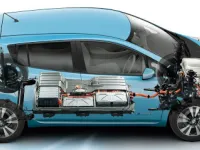
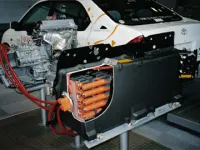
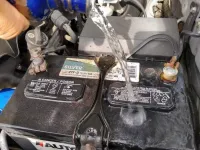
- 48V hybrids maintain a separate 12V system for basic functions.
- Jump-start uses the 12V battery, not the 48V pack.
- Connect red clamps to positive terminals on both batteries.
- Connect black clamp to donor negative and ground; start donor, then hybrid.
Introduction
48-volt hybrid systems are becoming more common in modern vehicles, providing efficient performance and lower emissions without the higher costs of traditional hybrids. When the 12V battery alone cannot start the engine, you still have practical options: charging from a wall outlet is the safest, but if the 12V battery is not drained completely and is in good condition, jump-starting with another vehicle can provide the energy needed to start.
This guide explains what 48V hybrids are, how their electrical architecture works, and how to safely jump-start a 48V hybrid using the 12V battery, including when you should avoid this method.
What are 48-volt hybrid systems
Modern hybrid cars are equipped with two distinct motors - one electric and one gasoline-powered - which work in tandem to optimize efficiency and reduce pollution. 48V systems represent a natural evolution from traditional 12V configurations, providing a higher voltage that allows the electric motor to generate greater torque and power.
These systems operate through selective electric assistance - the electric motor intervenes depending on road conditions and driving style, helping to save fuel. Batteries recharge automatically through energy recovery during braking or deceleration.
Electrical architecture of 48V hybrids
A crucial point to understand is that 48V systems do not completely replace the traditional 12V system. In reality, 48V hybrids maintain a dual configuration:
- 12V system: Powers classic consumers (radio, lights, comfort systems)
- 48V system: Dedicated exclusively to the electric motor and hybrid components
This architecture includes:
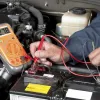
- A conventional 12V lead-acid battery for basic systems
- A separate 48V lithium-ion battery for electric assist
- A DC-DC converter that ensures interaction between the two systems
Jump-start procedure
When the 12V battery is discharged, you can use the classic jump-start method, because the starting process relies on the conventional 12V battery, not the 48V battery.
Steps for connecting the cables
1. Preparation and first cable (red - positive)
- Connect the red clamp to the positive terminal (+) of the discharged battery
- Attach the other red clamp to the positive terminal of the donor battery
- Verify that the donor car is off before connecting
2. Second cable (black - negative)
- Connect the black clamp to the negative terminal (-) of the donor battery
- IMPORTANT: The other black clamp should be attached to an unpainted metal surface under the hood of the car with the discharged battery, NOT directly to the negative terminal
- Choose a grounding point as far from the battery as possible for safety
3. Charging process

- Start the donor car and let it run for a few minutes
- Wait 2-3 minutes for the initial energy transfer
- Check if basic systems (dashboard lights, headlights) begin to function
4. Starting the hybrid car
- Try starting the car with the discharged battery
- If it doesn’t start immediately, wait a few more minutes
- After starting, let both cars run for at least 10 minutes
Safe disconnection
Disconnection should be performed in reverse order:
- Remove the black clamp from the grounding point
- Remove the black clamp from the donor battery
- Remove the red clamp from the donor battery
- Remove the red clamp from the previously discharged battery
Caution: Avoid clamp contact and keep them separate to prevent short circuits.
Hybrid car-specific precautions
Safety systems
Hybrid cars are equipped with multiple safety systems that automatically isolate the 48V battery in case of problems. This means there is no risk of electric shock during the jump-start procedure.
Additional electrical loads
Hybrid systems can have higher electrical loads than conventional cars. For this reason:
- Use high-quality cables with an appropriate cross-section (minimum 25 mm²)
- Ensure the donor car’s battery is in good condition
- Avoid leaving lights or climate control systems on during the procedure
Plug-in charging as an alternative
For hybrids equipped with an on-board charger, plug-in charging remains the safest option:
- Eliminates the risk of damaging sensitive electronic systems
- Allows a full and balanced charging of the battery
- Avoids thermal stress on the lithium-ion battery
When to avoid jump-starting with cables
Do not attempt jump-starting if:
- The 12V battery shows visible signs of damage (cracks, leaks)
- The hybrid system displays specific errors on the dashboard
- Outside temperature is very low (below -20°C)
- The battery has been fully discharged several times in a row
In these cases, consulting an authorized service or professional charging are the recommended options to avoid damaging the hybrid car’s complex systems.