- Right of way at unmarked intersections requires yielding to the right.
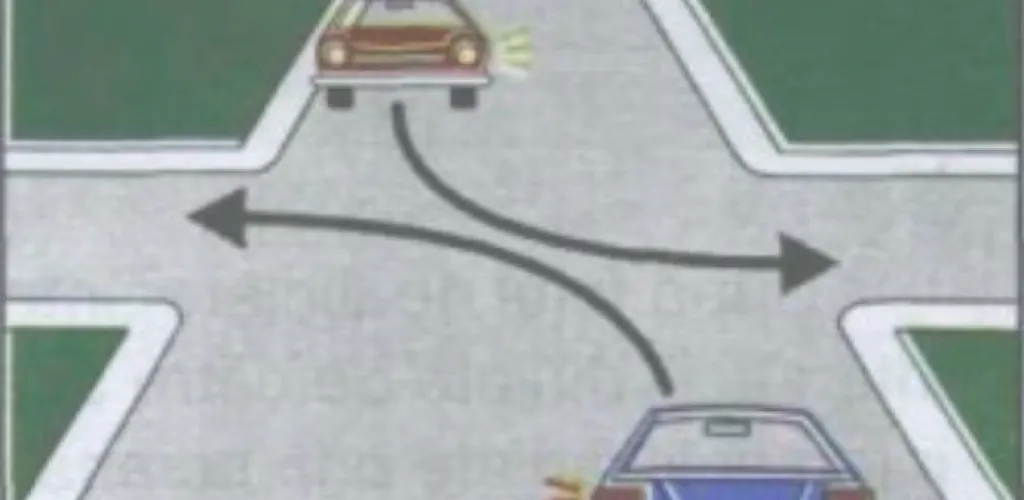
- Left turns at unmarked intersections must yield to opposite and right-side traffic.
- Equal-priority or Stop/Yield signs follow the right-hand rule; Stop requires full stop.
- Roundabouts give priority to vehicles inside; not yielding carries penalties in Romania.
Respecting the right of way is one of the fundamental pillars of safe road traffic. Under current law, drivers are obligated to yield to other road users in clearly defined situations. Failure to comply with this rule not only brings substantial legal penalties but also endangers the lives and physical integrity of both the offender and other road users.
Statistics show that failing to yield the right of way is among the top five causes of serious accidents in Romania, making understanding and applying these rules essential for all drivers.
What right of way means
Right of way, also known as general priority, is the fundamental rule applicable at non-controlled intersections or in situations where road users are on equal footing.
Application in unmarked intersections
In unmarked intersections, which are not marked with priority indicators and consist of public roads of the same category, vehicles arriving from the right have the right of passage. This means that if two or more drivers reach such an intersection simultaneously, the one coming from the right has the right to go first.
Turns and intersections
Drivers making a left turn at unmarked intersections must yield to vehicles coming from the opposite direction and from the right. This rule is essential to avoid collisions during direction changes.
Equal-priority situations at signs
In intersections controlled by signs with the same meaning (either both “Priority Road”, or both “Stop” or “Yield”), an automatic equal-priority situation is created. In this case, the basic rule applies again: the vehicle coming from the right has priority.
An especially important aspect arises in intersections where one road is signposted with “Yield” and the other with “Stop”. Both indicators signify a loss of priority, thus creating an equal-priority situation, and the right of way still applies.
Difference between the signs “Stop” and “Yield”
Although both indicate a loss of priority, there are important differences in their application:
The Stop sign is typically placed at intersections with reduced visibility. Drivers must come to a complete stop, check carefully, and only then merge onto the road with priority. This sign imposes heightened caution due to poor visibility conditions.
The Yield sign appears at intersections with better visibility. In this case, drivers can assess traffic by simply reducing speed, without the obligation to stop completely, provided that visibility is adequate and there is no other traffic with priority.
Left-of-way in roundabouts
Left-of-way is the basic rule at roundabouts. In these situations, vehicles already circulating inside the roundabout have priority over those entering.
This rule is essential to keep traffic flowing smoothly in roundabouts and to prevent gridlock. Drivers approaching a roundabout should reduce speed, observe traffic inside, and merge only when it is safe to do so.
Legal penalties for not yielding priority
Romanian traffic law provides severe penalties for failing to yield priority, reflecting the seriousness of this violation.
No incident (no consequences)
If a driver fails to yield but the action is observed by a police officer before any consequence occurs, the penalty applied is:
- 5 penalty points
- Suspension of the driving license for 30 days
This penalty applies even if the failure to yield did not lead to an accident, underscoring the preventive nature of the measure.
With an accident
If failing to yield results in a road traffic accident with material damage, penalties increase significantly:
- 6-8 penalty points (depending on the severity of the situation)
- Suspension of the driving license for 60 days
If the accident involved victims (injuries or fatalities), penalties may include criminal liability, with the possibility of prison sentences.
Other types of priority in traffic
In addition to right-of-way and left-of-way, traffic legislation provides for other situations where priority must be given:
Priority over opposing traffic
When making left turns or U-turns, drivers must yield to vehicles traveling in the opposite direction on the same roadway.
Ramp priority
When exiting from a restricted area (parking, fueling station, courtyard, etc.) onto the public road, drivers must yield to all vehicles on the public roadway, regardless of direction.
Special priority
Emergency vehicles (ambulance, fire brigade, police) that are on a mission and properly signaled with flashing lights and sirens have absolute priority. All road users must facilitate their passage, including by stopping, or by clearing the way.
Recommendations for correct right-of-way
To avoid dangerous situations and related penalties, every driver should:
- Know thoroughly the theoretical part of the priority rules and understand them completely
- Develop practical skills to correctly judge distance and speed of other road users
- Always signal intentions to change direction well in advance
- Maintain an appropriate speed that allows safe stopping if needed
- Be attentive to road signs and signals from other road users
- Adopt a defensive attitude in traffic, anticipating possible mistakes by others
Correctly yielding the right of way is not only about obeying the law; it is a responsibility toward one’s own safety and that of others. Each traffic situation must be treated with maximum caution, combining theoretical knowledge with prudent and correct application in real driving conditions.