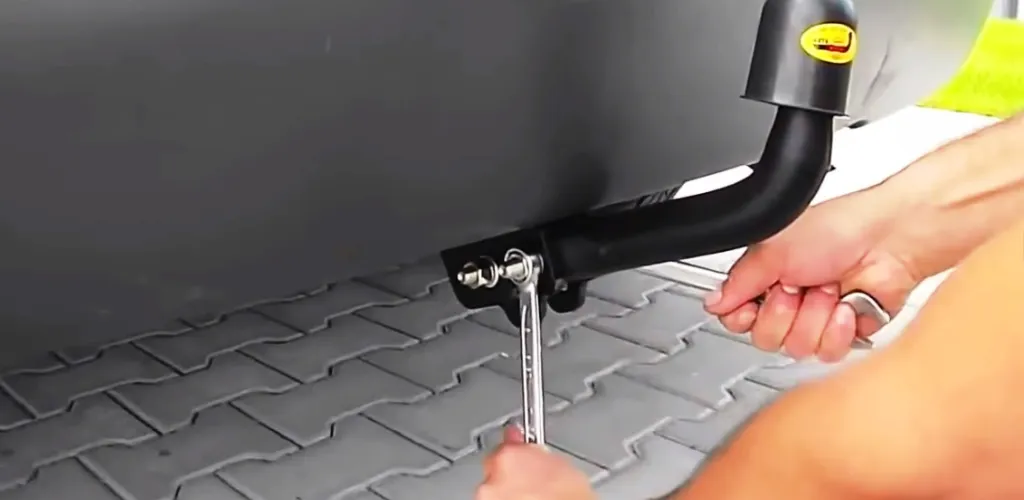
- Tow hooks are required only when towing; remove otherwise.
- Permanently mounted hitches are common and cause parking damage and safety risks.
- In crashes, hitches can puncture radiators, condensers, and other components.
- Repair costs can exceed 5,000–10,000 lei; vehicle may become uneconomical.
Road traffic in Romania has seen a steady increase in the number of vehicles equipped with tow hooks. While these hooks are essential for towing a trailer or caravan, permanently mounting them raises serious safety concerns and can cause material damage in the event of an accident.
This article explains the legal framework, typical collision scenarios, and practical safety recommendations to protect drivers and vehicles.
What the law says about tow hooks
The law is clear on this: a vehicle should be equipped with a tow hook only when it is towing something. Otherwise, the towing device should be removed. Yet, traffic reality shows that most owners choose to keep the hitch permanently mounted, either for convenience or from a lack of awareness of the regulations.
This practice leads to hundreds of bumps and road accidents each year that could have been avoided. The tow hook, although compact, becomes an extremely dangerous point of impact in a collision.
Minor parking accidents
Most drivers have at least once faced brushing against the tow hitch of the car parked in front. Due to its low position and slim profile, the hitch is almost invisible when maneuvering in tight spaces or reversing into a spot.
Damages caused in these circumstances include:
- Scratches on the bumper
- Cracks in the plastic
- Damage to the radiator grille
- Deformation of rear components of the vehicle
Although these damages may seem minor, repair costs can reach hundreds or even thousands of lei, depending on the model and the complexity of the protection system.
Severe damages in case of impact
The situation becomes dramatic when the impact with the hitch occurs during driving. Built from high-strength steel, the tow hook can easily puncture the car’s plastic protective cover and can cause severe damage to mechanical components.
Components vulnerable to impact
In a speed collision, the hitch can affect:
- Radiator: Puncturing it leads to coolant leakage and engine overheating
- Air conditioning condenser: Damage means loss of refrigerant gas and costly repairs
- Intercooler: On turbocharged engines, damage to this component affects engine performance
- Electric radiator fan: Damages to this element can lead to cooling problems
- Hoses and wiring: Breakage can affect multiple systems of the vehicle
Repair costs for such damages can easily exceed 5,000-10,000 lei, and in extreme cases the car can become beyond economical repair.
Risks for the owner of a tow-hitch vehicle
What many drivers do not realize is that permanently mounting the hitch also exposes them to significant risks. If they are rear-ended, the hitch becomes a focal point of the impact force, transmitting energy directly to the chassis frame rails.
Structural damage to the chassis
Frame rails are fundamental structural components of the vehicle, basically the car’s backbone. When bent or twisted by impact transmitted through the hitch, the consequences are severe:
- The chassis geometry is permanently altered
- The car may no longer be correctly aligned
- Tire wear becomes uneven
- Handling stability in corners is compromised
- Braking behavior becomes unpredictable
Repairing the frame rails requires specialized equipment (a body shop bench) and can cost between 3,000 and 8,000 lei. In many cases, complete straightening is not possible, and the car remains with permanent geometry defects.
Inability to achieve proper alignment
Even after professional repair, the vehicle may not be able to be aligned perfectly. This means the car will pull to one side, fuel consumption will increase, and on-road comfort and safety will be compromised.
Who is liable for damages?
This question raises complex legal issues. The situation is analyzed differently depending on the type of accident:
Parking accidents
If you brush against a parked car’s tow hitch, fault typically lies with you, even if the hitch should not have been mounted. Arguments:
- You have a duty to control parking maneuvers
- You must notice obstacles and avoid them
- Lack of attention is considered the primary cause
Nevertheless, there are situations where it can be demonstrated that the illegal presence of the hitch contributed to the damage, which can lead to shared liability.
Road collisions
In a road accident, fault determination becomes even more complicated:
- If you were rear-ended, you are usually at fault regardless of the hitch
- If you were hit from behind by a vehicle with a hitch, you can argue that damages would have been smaller without it
- In uninsured or priority violation cases, the presence of the hitch becomes an aggravating factor
Insurance practices vary, but in general:
- Payouts are for actual damages
- The illegal presence of the hitch can be used to argue for a reduced payout
- In court, a technical expert assessment can be requested to determine the hitch’s contribution to the damages
Safety recommendations
To avoid problems associated with tow hooks, here are some recommendations:
For tow hook owners:
- Remove the hitch when not in use
- If this is not possible, at least detach the ball (on detachable systems)
- Ensure you have proper paperwork for the mounted hitch
- Periodically check the mounting integrity
For all drivers:
- Be very careful when parking, check whether the car in front has a hitch
- Maintain a safe distance in traffic
- At red lights or in heavy traffic, give extra space to vehicles with a hitch
- If you have an accident with a tow hitch-equipped car, photograph all details
Conclusion
Although the law is clear regarding the use of tow hooks, enforcement leaves much to be desired. In a collision, fault depends on the circumstances, but in most cases the driver who caused the impact will be considered at fault, even if the hitch aggravated the damages.
To protect yourself, the best approach is still heightened road awareness and maintaining a safe distance. If you own a vehicle with a tow hitch, remove it when not in use—not only to comply with the law but also to protect your own car from serious structural damage in the event of an accident.