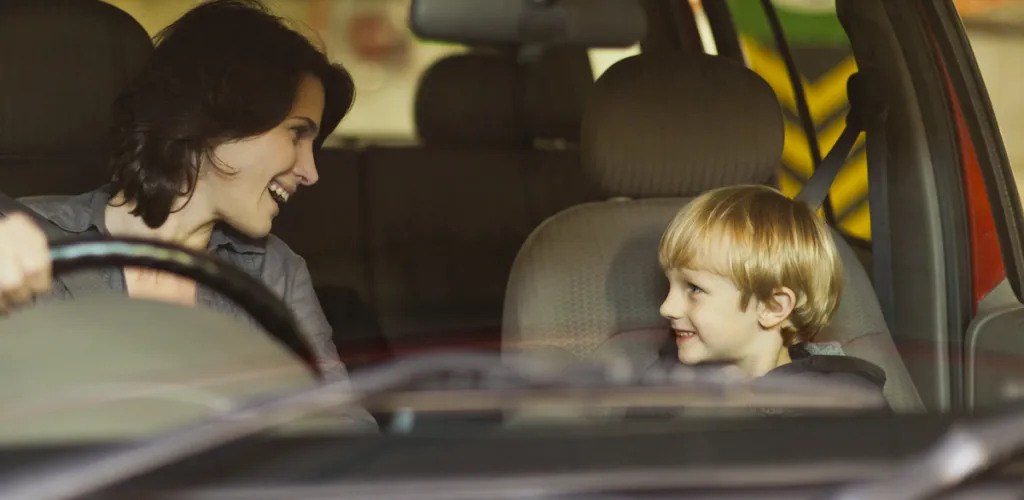
- Front seat allowed only if height ≥150 cm and age ≥12
- Under 135 cm: rearward-facing seat required; airbag must be deactivated
- Over 135 cm: front seat allowed with belt properly adjusted; avoid neck crossing
- Restraint systems: Group 0+ rear-facing; Group 1 can be forward- or rear-facing (prefer rear-facing)
Child safety in traffic remains an absolute priority for every responsible parent. While many children want to sit in the front seat, Romanian traffic law imposes strict regulations to protect young passengers. A very large number of drivers still do not respect these legal provisions, risking children’s lives and exposing themselves to substantial fines.
Understanding the rules for transporting children is not only a legal obligation but also a fundamental responsibility. This guide details all current legal aspects, clarifying minimum height, seat types, correct installation methods, and the consequences of non-compliance.
Fundamental legal criteria: height and age
Legislative framework update
Romanian legislation has undergone important changes in recent years. Previously, child transport rules were tied exclusively to the age of 12 years. Currently, the main distinction is made based on the child’s height, with a critical threshold of 135 cm.
This change reflects modern European safety standards, which recognize that physical development varies significantly from one child to another, and height is a more precise indicator than age for determining the appropriate protection system.
The basic rule for the front seat
A child may sit in the front seat only if they meet both conditions simultaneously:
- Minimum height of 150 cm
- Age of at least 12 years
Both criteria must be met cumulatively. Thus, even if a child is 11 years old but 155 cm tall, they cannot legally be transported on the front seat without a protective seat. Similarly, a 13-year-old with a height of 145 cm still requires a car seat.
Transport categories by height
Children under 135 cm:
- May be seated on the front seat only in exceptional circumstances
- Must be protected by an approved restraint system (special seat)
- Front-facing rearward seat is preferred when possible for maximum safety
- Front airbag must be deactivated if the seat is mounted rear-facing toward the direction of travel
- The vehicle’s seat belt does not provide adequate protection at this height
Children over 135 cm:
- May be transported on the front seat without a special seat
- Seat belt must be worn at all times during the trip
- The belt should be correctly adjusted: diagonal strap over the shoulder and chest, lap strap over the pelvis
- The belt must not pass over the neck or face – a sign that height is not sufficient
Restraint systems: types and categories
Classification of child seats by weight groups
Group 0+ (0-13 kg, approximately 0-15 months):
- Infant carrier rear-facing only
- Provides maximum protection for the baby’s head and neck
- Mounted with ISOFIX or the vehicle belt
- Mandatory on rear seats or front seat with airbag deactivated
- Includes an internal harness with 3 or 5 anchor points
Group 1 (9-18 kg, approximately 9 months - 4 years):
- Forward-facing or rear-facing seats (prefer rear-facing as long as possible)
- Internal five-point harness for optimal safety
- Extended side protection for head and trunk
- Can be installed via ISOFIX with Top Tether or the vehicle belt
Group 2/3 (15-36 kg, approximately 4-12 years):

- Used with the vehicle’s seat belt
- Includes guides for correct belt positioning
- Can be a full seat or a booster seat
- Lateral protection for the head at high speeds
The i-Size system (ECE R129)
The new European standard i-Size brings significant improvements:
- Classification by height, not weight
- Mandatory rear-facing transport until at least 15 months
- Mandatory side-impact tests
- ISOFIX compatibility as standard in all new vehicles
Correct installation: a step-by-step guide
ISOFIX system – safety standard
ISOFIX represents the safest seat attachment system:
- Rigid metal connectors integrated into the child seat
- Standard anchor points in the car chassis (between the seat cushion and backrest)
- Easy installation with a click, reducing the risk of error
- Superior stability in frontal or side impacts
- Mandatory for vehicles manufactured after 2011
ISOFIX installation steps:
- Identify ISOFIX anchorage points in the car (marked with symbols)
- Extend the seat’s connectors from the child seat
- Align connectors with the anchorage points
- Push firmly until you hear a locking click
- Check stability – the seat should not move more than 2 cm
- Connect the Top Tether (if provided) to the back of the seat or tailgate area
Installation with the vehicle belt
For vehicles without ISOFIX or with older seats:
- Read the seat manufacturer’s instructions carefully
- Place the seat on the car bench
- Route the belt through the marked points on the seat (usually red or blue)
- Fasten the belt buckle
- Pull the diagonal belt to remove slack
- Check belt routing according to the manual
- Test stability – maximum 2-3 cm movement in any direction
Common errors that compromise safety
Critical mistakes to avoid:
- Too loose belt – the seat moves excessively, drastically reducing protection
- Incorrect seat orientation for the child’s age (front-facing too early)
- Using a seat that is damaged after an accident or expired (older than 6-10 years)
- Placing the seat on a seat with an active airbag facing forward
- Incorrectly mixing ISOFIX and belt usage for the same seat
- Harness too loose – must pass the two-finger test (no more than that)
- Thick clothing under the harness – creates dangerous slack in a collision
Special rules for the youngest travelers
Children under 3 years – enhanced protection
For babies and very young children, the law imposes additional restrictions beyond simply the seat requirement:
Legal obligations:
- Transportation only under the supervision of an adult other than the driver
- Mandatory use of child restraint on rear seats under normal conditions
- Use only of the correctly sized restraint system for weight/height
- Explicit prohibition on holding a child in one’s arms – extremely dangerous even at low speeds
Scientific justification: Very young children have anatomical features that make them highly vulnerable:
- Head disproportionately large relative to the body (about 25% of total body weight)
- Developing bones and cartilage, fragile
- Spine and neck not fully developed
- Inability to reflexively protect themselves in a crash
Even at speeds of 30-40 km/h, the forces generated in a collision can be fatal for an unprotected young child.
Fines and legal consequences in 2025
Amount of current penalties
Non-compliance with child transport rules constitutes a class IV contravention, with severe penalties:
Fines and penalties:
- A monetary fine between 810 and 1,012.5 RON
- 4-5 penalty points on the driving license
- License suspension between 30-90 days in case of recidivism (second offense within 12 months)
- Retention of the vehicle registration certificate until deficiencies are corrected
- Vehicle immobilization in extreme cases of non-compliance
Concrete situations that trigger penalties
Common contraventions observed:
- Transporting a child under 135 cm without an appropriate seat
- Child under 12 years/150 cm in the front seat without meeting legal conditions
- A car seat not homologated to ECE R44/04 or R129 standards
- A damaged, expired, or incomplete car seat
- Visibly incorrect installation of the safety system (excessive slack)
- Transporting children under 3 years without adult supervision
- Active airbag with a rear-facing seat mounted in the front
- Harness not properly adjusted or too slack on the child’s body
Important notes: Road police have clear instructions to prioritize checks on child safety. Seasonal campaigns (start of holidays, festive periods) intensify these inspections. Absence of a car seat can lead to actions by child protection authorities in severe or repeated cases.
Front mounting – when is it legally allowed
Accepted exceptional conditions by law
Transporting a child on the front seat is allowed only in the following strictly defined situations:
- The child is over 12 years old AND at least 150 cm tall – both conditions met simultaneously
- All rear seats are occupied by other children who require car seats
- The vehicle has no rear seats available (two-seat cars, minivans, etc.)
- The rear seats are temporarily inaccessible for justified technical reasons
Requirements for front-mounted seats
Not every car seat can be legally mounted on the front seat. Mandatory checks include:
Manufacturer compliance:
- The seat’s manual must explicitly allow front mounting
- Homologation labels must confirm this possibility
- Specific front-m mounting instructions must be fully respected
- Some seats are certified exclusively for rear mounting
Approval and technical condition:
- Approved under European standards ECE R44/04 (phase 04 or newer) or i-Size ECE R129
- Visible and legible homologation label on the seat (orange with technical details)
- Suitable for the child’s current physics (weight/height within specified limits)
- In good working order – no cracks in plastic, damaged belts, missing parts, or defective buckles
- Not involved in previous accidents – structure may be invisibly compromised
Positioning and airbag management
Fundamental safety rule: Seats oriented rearward for safety can never be mounted in front of an active airbag. Deploying the airbag would violently push the seat back toward the rear seat in a crash, causing severe or fatal injuries to the child.
Correct procedure:
- Identify the airbag disable button/switch for the passenger side (usually in the glovebox or on the dashboard)
- Fully deactivate the airbag – check the dashboard indicator
- Consult the vehicle’s manual for model-specific procedures
- Some cars require a special key to deactivate
- Very new vehicles may deactivate airbags automatically when a child seat is detected
For front-facing seats mounted in the front:
- The airbag may remain active
- Move the child seat as far back from the dashboard as possible
- A minimum distance of about 25-30 cm between the child’s chest and the dashboard is recommended
- Check the vehicle manual for compatibility
Safety during trips
Preparation for long journeys
Proper trip planning significantly improves comfort and safety:
Breaks and monitoring:
- Stop every 2 hours maximum for very young children
- Periodically check the child’s position in the seat – slippage or shift may occur
- Watch for signs of discomfort – persistent crying, excessive sweating, facial redness
- Allow the child to move during rest breaks to prevent stiffness
Hydration and feeding:
- Offer fluids regularly, especially in warm weather
- Avoid large meals just before departure
- Light, non-allergenic snacks during breaks
- Do not feed during motion – choking risk during braking
Entertainment and engagement:
- Books, soft toys attached to the seat
- Music, age-appropriate audio stories
- Observation games for older children
- Avoid hard or sharp objects in the cabin – they can become projectiles in a crash
Adapting to weather conditions
Warm weather – overheating risks
- Check the seat temperature before placing the child – metal and plastic absorb heat
- Use side window sun protection – shades or approved films
- Adequate ventilation, but avoid direct blasting of air conditioning on the child
- Light, breathable clothing under the harness
- Do not completely cover the seat with blankets – airflow should be preserved
Cold weather – proper clothing
- Critical: thin clothing directly beneath the harness
- Thick jackets greatly reduce restraint effectiveness – create dangerous slack
- Correct test: adjust the harness with lightweight clothing, then add jackets/blankets over the harness
- After seating, cover with a blanket or jacket placed over (sleeves behind)
Advanced recommendations for mindful parents
Seat lifespan and replacement
Car seats have a limited usable life:
- The expiration date is printed on the seat (usually 6-10 years from manufacture)
- Plastics degrade over time, even without visible use
- Safety standards evolve – old seats may no longer meet current standards
- Replacement is mandatory after any accident, even minor – the structure may be invisibly compromised
Risks of second-hand seats:
- You may not know the full history – unreported accidents
- Missing or improperly replaced parts – voids homologation
- Lack of original manual – incorrect installation likely
- Outdated technology – modern seats are significantly safer
Acceptable exception: a seat from a close relative with a completely known history and full homologation documents.
Educating the child for safety
Forming correct habits from an early age:
- Constantly explain the importance of the seat and belt using age-appropriate language
- Do not start the car until everyone is correctly secured – personal example is essential
- Teach the child not to undo the belt or harness during the journey
- Reward cooperative behavior during seat installation
- Be consistent – no exceptions for short trips or “just to the corner”
For kids who resist:
- Allow choosing a special car-seat toy or reward
- Use safety-themed books or stories
- Create a predictable routine: music or story after seating
- Ignore manipulation-based crying – safety is non-negotiable
- Consult a pediatrician if resistance persists – there may be medical reasons
Essential periodic checks
Monthly checklist:
- [ ] Seat fixation stability (ISOFIX or belt)
- [ ] Condition of the seat’s internal belt (no wear, tears)
- [ ] Functioning buckles and adjusters
- [ ] Absence of cracks in the seat’s plastic data
- [ ] Readability of homologation labels
- [ ] Cleanliness of textile parts (dirt can hide damage)
- [ ] Check that the seat has not expired
After every road accident (even minor):
- Contact the seat’s manufacturer for guidance
- Most manufacturers require replacement after impacts above 10 km/h
- Some insurers cover the cost of a new seat
- Do not take risks – the structure may be invisibly compromised
Frequently asked questions – practical clarifications
My child is exactly 135 cm tall. Can they give up the car seat? For an exact height of 135 cm, it is recommended to continue using at least a booster seat until 150 cm or 12 years old. The legal threshold of 135 cm allows giving up the special seat, but optimal safety suggests continuing protective measures.
Can I use a car seat from the USA or other countries? No. In Romania and the EU, car seats must be homologated under European standards ECE R44 or R129. Seats homologated to standards from the USA, Canada, or other countries are not legal for use here, even if they look similar.
Is a simple, backless booster legal? Technically yes, if it is homologated under ECE R44/04 for group 3 (22-36 kg). However, safety is significantly reduced compared to seats with a full back that provide lateral head and trunk protection. The recommendation is to use only seats with a back.
Can I install the seat in the middle rear seat? Yes, this is actually the safest position statistically as it is farthest from lateral impact zones. Ensure: a 3-point belt (not just a lap belt), functional ISOFIX anchors if the seat requires them, and enough space for proper installation.
What if my car does not have ISOFIX? Use belt installation according to the seat’s manufacturer instructions. Although ISOFIX is simpler and reduces installation errors, a correctly executed belt installation provides equivalent safety when done precisely. Pay close attention to belt tensioning.
Conclusion – responsibility toward the most vulnerable
Child safety in traffic is non-negotiable. The rules governing the transport of children result from decades of scientific research, crash analyses, and impact tests. Each legal provision has a solid justification based on crash physics and the anatomical vulnerabilities specific to children.
Remember the essential rules:
- Under 135 cm in height: use an approved car seat, preferably on rear seats
- 135-150 cm in height: still recommended to use a car seat, at least a booster with a back
- Over 150 cm and at least 12 years old: may stop using a seat, belt mandatory
- Front mounting: only in exceptional cases, with all legal and safety conditions met
- Airbag deactivated: mandatory for rear-facing seats on the front
Investing in safety: a quality car seat (roughly 300-2000 RON for premium models) and a fine (810-1,012 RON) pale in comparison to the priceless value of a child’s health and life. Studies show that proper restraint systems reduce up to 71% the risk of death and 67% the risk of serious injuries in crashes.
Every driver’s responsibility is to stay fully informed, invest in a properly homologated safety system, and strictly follow all regulations. There are no “short cuts” or acceptable exceptions when it comes to child safety — every trip, no matter the distance, deserves complete protection.
Education and personal example shared with children about road safety will form lifelong habits that protect them. Invest today in the security of your little ones — it is the most valuable legacy you can leave.