- Seat belts prevent ejection and distribute crash forces across the body
- Pretensioners and force limiters reduce belt slack and chest load in crashes
- Front-seat death risk reduced by 50%, rear-seat by 75%, serious injuries by 45%
- Over 1 million lives saved; 3 in 4 crash deaths are belt-less
When it comes to road safety, the seat belt remains the most important passive protection in any vehicle. Whether it is the driver or passengers, this simple yet ingenious system can mean the difference between life and death in a fraction of a second. Invented more than 60 years ago by Volvo, the three-point seat belt has already saved more than a million lives worldwide.
While the belt may seem straightforward at first glance, the physics behind this safety system are complex and fascinating. Let’s analyze in detail why it matters so much and how it protects us in real-world crashes.
Main reasons to wear a seat belt
- Preventing ejection from the vehicle — In rollovers or side impacts, the belt prevents occupants from being projected out of the cabin
- Distribution of impact forces — The belt distributes deceleration forces across larger areas of the body (chest, pelvis, shoulders)
- Maintaining the correct position — Keeps the occupant in an optimal position for airbag deployment
- Protection of the spine — Prevents hyperextension and cervical injuries by maintaining a stable posture
How the seat belt works: technical perspective
Pretensioners
These devices activate on impact and “pull” the belt to remove slack. Pretensioners reduce the belt response time from about 200 milliseconds to just 15–20 milliseconds.
Force limiters
After the pretensioner has done its job, force limiters allow a small, controlled belt stretch to reduce chest pressure and prevent rib fractures.
Locking system in case of impact
In normal conditions, the belt can deploy smoothly for comfort. In a crash or abrupt deceleration, a pendulum or centrifugal mechanism locks the belt, turning it into a rigid restraint.
The physics at play — Why seat belts are necessary
To truly understand the importance of the belt, we must analyze the forces acting on the body during a crash:
At 50 km/h: An frontal impact exerts about 2 tons of force on an 80 kg person. Without a seat belt, the body continues to move at the initial speed until it hits an obstacle—usually the steering wheel, dashboard, or windshield.
At 40 km/h: The kinetic energy developed is equivalent to a fall from the third floor of a building — about 10 meters high.
Rear-seat passengers represent an additional risk: in a crash, they can be projected forward with a force exceeding 30 times their body weight, becoming “human projectiles” that threaten the occupants in front.
Statistics and concrete data on belt effectiveness
Reduction in death risk
- 50% reduction in risk for front occupants
- 75% reduction for rear occupants
- 45% reduction in risk of serious injuries
Impact on road safety
- Over 1 million lives saved since the introduction of the three-point belt
- 3 in 4 people who die in car crashes were not wearing a seat belt
- Survival rates increase dramatically even in high-speed crashes
Seat belt and modern safety systems
Seat belt does not work in isolation in modern vehicles. It is part of a complex ecosystem of passive safety systems:
- Airbags are calibrated to work best when the occupant wears a belt
- Pretensioner systems activate in tandem with airbags
- Weight sensors in seats detect the presence of passengers and adapt system response
- Force limiters prevent injuries caused by the belt itself
Legal aspects and penalties
Beyond safety considerations, not wearing a belt carries significant legal consequences in Romania:

For drivers:
- Fine between 145-290 RON
- 2 penalty points
- Responsibility for all minors in the vehicle
For passengers:
- Fine between 145-290 RON
- Applies regardless of position in the vehicle (front or rear)
- Does not exempt the driver from responsibility
Myths and misconceptions about seat belts
There are still many myths around wearing a seat belt:
“At high speeds it isn’t necessary” — False. Even at 30 km/h, the forces generated can cause serious injuries.
“Back seat belts aren’t as important” — False. Statistics show an even greater risk reduction for rear-seat passengers.
“It can hurt me in an accident” — While minor injuries caused by the belt can occur, they are negligible compared to injuries that would have occurred without it.
Recommendations for correct use
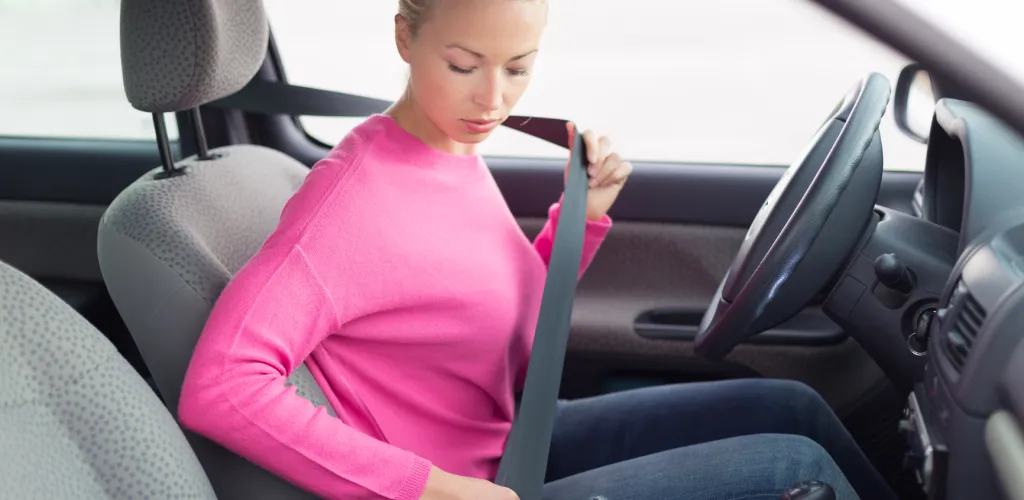
- The diagonal strap should pass over the shoulder and chest, not over the neck
- The pelvic strap should be positioned low on the hips, not on the abdomen
- No objects between the body and the belt (thick clothing, cushions, etc.)
- One person per belt — never two children sharing the same belt
- Adjust the seat before fastening the belt for optimal positioning
The seat belt remains the most effective and economical safety measure in automotive history. With minimal cost and simple operation, this ingenious system continues to save lives every day. Wearing it is not only a legal obligation but a responsibility toward your own life and toward other road users.