- BMW E46 (1997–2006) reintroduced all-wheel drive and Valvetronic engines
- E46 M3 uses 3.2L S54 with manual or SMG-II
- Owners praise quality, character, reliability, and value of the coupe
- Common issues include crankshaft pulley, water pump, transmission, leaks, and suspension
BMW E46 represents the fourth generation of the BMW 3 Series, produced between 1997 and 2006, and remains one of the most appreciated and sought-after generations in the Bavarian marque’s history. This generation introduced numerous technical innovations and set the standards for what a luxury sport sedan should be.
All-wheel drive, last offered in the 3 Series in 1991, was reintroduced for the E46 on the 325xi, 330xi and 330xd models. The E46 was the first 3 Series to be offered with a Valvetronic-equipped engine, alongside a range of advanced electronic features for its era, including satellite navigation, rain-sensing wipers and LED headlights.
Sport version: E46 M3
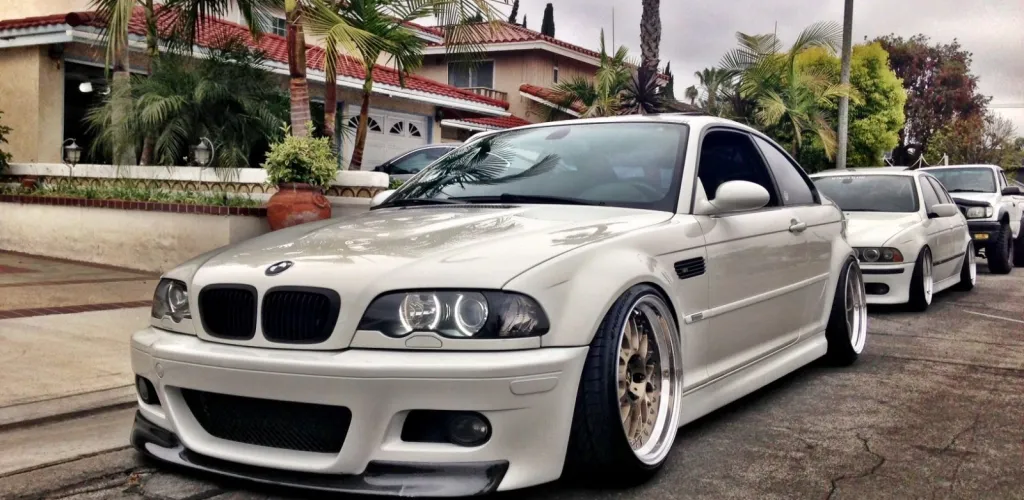
E46 M3 is powered by the BMW S54, a naturally aspirated inline-6 of 3.2 liters, available with a 6-speed manual or 6-speed SMG-II automatic. M3 was introduced late in 2000 and was produced only in coupe and convertible bodies.
After the introduction of the E90 Series 3 sedans at the end of 2004, the E46 began to be phased out. However, coupe and convertible E46 models remained in production until August 2006.
Real owner opinions about BMW E46
To provide an authentic perspective on this model, we collected responses from E46 owners who wrote reviews on DailyDriven, offering valuable insights into real ownership experience.
Why owners choose BMW E46 320d (136 HP)
Stoean Ciprian explains: “Ten years ago, it seemed like the best choice based on quality/reliability/price and above all it was a youthful indulgence.”
Alexandru Pipos adds: “I wanted this model for a very long time; it is a German car with real character, from the era when Germans still built proper cars.”

Lupsa Bogdan mentions: “I always liked the idea of owning a BMW E46. They are very good, durable cars, not to mention customization.”
Gavriloaie Adrian explains: “I didn’t know much about cars. I looked for a cheaper model. The diesel engine was cheaper. I heard stories that I wouldn’t have to deal with the timing and that there are many units available, even if slightly more expensive.”
Experience with BMW E46 320i (170 HP)
Costas Bogdan says: “I chose this car for power, comfort, the reliability of the old BMW six-cylinder engines, and the feeling of a near-classic coupe.”
Paul Alexandru adds: “The most beautiful sports car you can buy at 20 years old; it is a very stable and fairly powerful car and the interior offers good comfort.”
Common problems BMW E46 (1998-2005)
After analyzing owners’ experiences and common problems reported, we identified the main defects affecting this generation:
- Crankshaft pulley (Crankshaft damper pulley) - in particular the damper pulley
- Water pump and cooling system
- Problems with the transmission and clutch
- Fluid leaks (engine oil, gearbox, power steering)
- Injection pump (Injection pump) for diesel engines
- Suspension (bushings, shock absorbers, control arm bushings)
- Electrical system (sensors, ECU)
- Steering rack
- Vacuum system
Specific problem: crankshaft pulley
One of the most serious technical issues of the E46 is the failure of the crankshaft pulley (crankshaft damper pulley), which can cause major engine damage. This part acts as a damper for engine vibrations and when it breaks, it can affect timing and accessories.
Available engines on BMW E46
The engine range for the E46 was highly varied, covering the needs of all types of users:
Petrol engines
- 316i 1.9 L M43: 103 HP and 165 Nm
- 316i 1.6 L N40: 115 HP and 150 Nm
- 318i 1.8 L N46: 114 HP and 175 Nm
- 318i 1.9 L M43: 117 HP and 180 Nm
- 318i 2.0 L N42: 143 HP and 200 Nm
- 320i 2.0 L M52: 148 HP and 190 Nm
- 320i 2.2 L M54: 168 HP and 210 Nm
- 325i 2.5 L M54: 189 HP and 245 Nm
Diesel engines
- 318d 2.0 L M47: 114 HP and 265 Nm
- 320d 2.0 L M47: 134 HP and 280 Nm
- 330d 3.0 L M57: 201 HP and 410 Nm
M versions
- M3 3.2 L S54: 341 HP and 365 Nm
- M3 CSL 3.2 L S54: 355 HP and 370 Nm
Driving experience and fuel consumption BMW E46
The BMW E46 feels like a natural evolution of its predecessor, the E36, with a stiffer chassis and lighter parts. The styling is refined, curves are smoother and junctions are crafted with attention to detail.
Urban driving behavior
Birtar Catalin explains: “It drives very well, you don’t feel a lack of power, it’s not stiff at all, the manual gearbox doesn’t tire you out, only in traffic it consumes a bit more.”
Bogdan Caraman notes: “The steering is stiffer, which makes it somewhat harder to drive for a delicate driver, other drivers won’t find this inconvenient.”
Gherasim Bogdan adds: “Very easy to drive in the city, it’s not a Smart, but it’s not a full SUV either, so parking should not be a problem.”
Long-distance driving
Ciocan Razvan says: “On long trips it is a comfortable car and, as I said, a pleasure to drive.”
Modrea Marian explains: “On long trips it is exactly what you need: power, climbs up to speed quickly and consumes very little.”
Lupsa Bogdan adds: “On long trips it’s a pleasure to drive. It’s very stable, has very low consumption, and if you need it, the power isn’t lacking.”
Fuel consumption BMW E46 320d (136 HP)
Stoean Ciprian reports: “Consumption is 7.5 L/100 km mixed with a measured driving style.”
Alexandru Pipos, with modifications (stage 1 and hybrid turbo): “7 liters in town and 4 liters on the highway.”
Ilies Adrian notes: “Approximately 6-7 L/100 km outside town. 8-9 L/100 km urban. It depends on the driver—if you accelerate hard, the consumption can rise.”

Reliability of the BMW E46 from the owners’ perspective
The BMW E46 Series 3 is arguably the best 3 Series the Bavarians have ever built and one of the most popular BMWs of all time. Because of its incredible popularity, there are many examples on the used market in varying states of quality and condition.
Reliability of BMW 320d (136 HP)
Stoean Ciprian, with 10 years of experience: “The main issues are all related to suspension joints (bushings, shock absorbers, tie rod ends). I have spent on steering racks, reconditioned turbo, injectors, various sensors, vacuum hoses.”
Bogdan Caraman, with 371,000 km: “Reliability is its strong point. Up to 371,000 km I changed only consumables, suspension arms, clutch kit and drive belts.”
Ciocan Razvan warns: “The problem with this power unit (2.0 diesel 136 hp) is the injection pump, which in 2 years and a half I had to rebuild twice, costs exceeding 1300 lei each time.”
Reliability of BMW 320i (170 HP)
Costas Bogdan explains: “Quite reliable if maintained. For six-cylinder engines, if revisions have been done on time, no interventions are necessary. The timing is by chain and is robust, and the engine does not burn oil. I replaced the expansion tank, thermostat, coolant and the electric fan (2000 lei), engine and gearbox mounts (600 lei), CV joint cross (300 lei) and the clutch (800 lei).”
BMW E46 prices on the second-hand market
Based on the Romanian used car market analysis, prices for BMW E46 range between 1,000 and 4,000 euros on average, depending on year, mileage and overall condition.
Price examples:
- BMW E46 316i (1.9, 1999, 232,000 km): about €1,100
- BMW E46 320td (2002, 310,000 km): about €1,800
- BMW E46 318i (2.0, 2004, 200,000 km): about €2,700
Prices can vary significantly depending on:
- Body condition and rust level
- Maintenance history
- Modifications performed
- Available documentation
- Geographic region
Essential buying tips for a BMW E46
Experienced owners offer valuable advice for those looking to purchase an E46:
Mandatory technical checks
Ciocan Razvan recommends: “Drive the car yourself for a few kilometers and observe if it has issues. The car should ‘grab’ your seat a bit when you pull away a little more aggressively.”
Lupsa Bogdan warns: “The most important thing to check is engine wear, then rust, and not only on the body but what lies beneath it.”
Ilies Adrian adds: “Rust first, because it is an older car. Other aspects are mileage and where the car has been driven—highway or urban.”
Specific warnings
Bugeac Teodor cautions: “Be extra careful with the engine to avoid knocking, misfires, staying straight in curves, and not hitting potholes. The classic problem with this model is the failure of the rear axle mount due to rust.”
Stoean Ciprian offers a crucial tip: “It is not enough to be a driver to own a rear-wheel-drive car; you need to know how to drive.”
Buyer’s checklist
- Engine: check sound, vibrations and leaks
- Rust: thorough inspection of body and chassis
- Suspension: test on roads with bumps
- Cooling system: check water pump and thermostat
- Injection pump: for diesel engines, check operation
- Crankshaft pulley: visual inspection for cracks
- Documentation: maintenance and repair history
- Test drive: behavior in acceleration, braking and corners
The BMW E46 remains an excellent choice for auto enthusiasts seeking an authentic sports sedan, provided an informed purchase and proper maintenance.