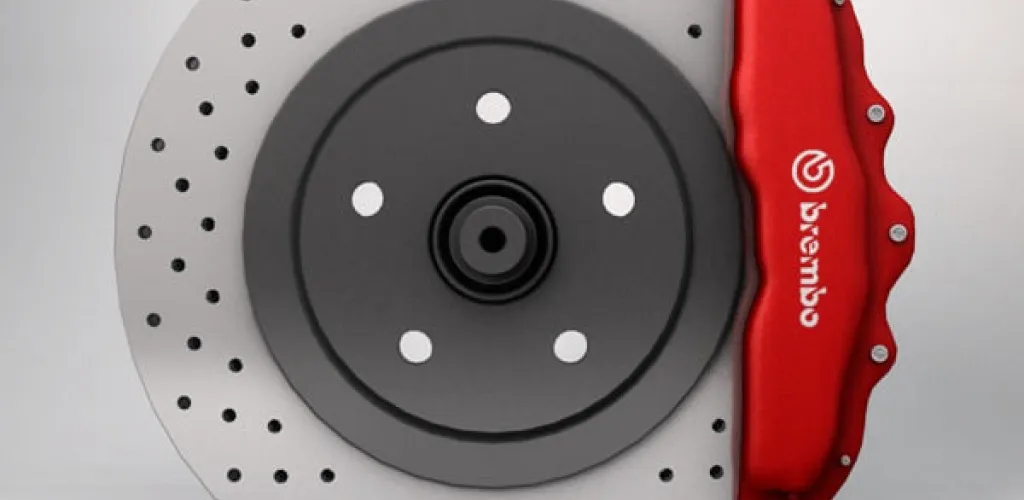
- Brake discs are clamped by pads via hydraulic pressure, with other actuation methods also possible.
- Cast iron is common; carbon-ceramic offers high performance at higher cost.
- Solid discs are cheap and simple, with limited cooling and braking capacity.
- Ventilated discs improve cooling and front-axle braking; drilled variants add cooling but lower durability.
Brake discs are among the most important safety components of any vehicle, playing a crucial role in braking performance and, by extension, in the safety of all road users. These parts are relied upon in every journey, responsible for slowing the vehicle or bringing it to a complete stop.
Understanding how they work and the types available can help you make informed decisions when it’s time to replace or upgrade the braking system.
Working principle of brake discs
A brake disc works in tandem with the caliper, which clamps a pair of two brake pads. When you press the brake pedal, the pads are pressed against the disc, creating the friction necessary to reduce the wheel’s rotational speed.
The most common disc braking systems for vehicles are hydraulically actuated. When you press the brake pedal, pressure is generated in the braking system through the brake fluid and the related components. There are other actuation methods – mechanical, pneumatic or electromagnetic – all applying force to both sides of the disc.
Materials used for brake discs
Cast iron discs
The most common brake discs are made of cast iron, ideal for normal operating conditions. They offer an excellent quality/price ratio and adequate performance for the vast majority of vehicles.
Carbon-ceramic composite discs
For high-performance applications, composite materials such as carbon-ceramic discs are used. They offer several advantages:
- Weight reduction: Much lighter than steel discs, contributing to a lower total vehicle mass
- Superior thermal resistance: Can withstand temperatures above 1000°C without warping
- High durability: Fatigue resistance and exceptional stopping power
- Main disadvantage: Significantly higher cost than conventional discs
Types of brake discs available
Solid discs
The simplest and most economical discs are solid (non-ventilated) discs. Their characteristics:
- Consist of a single solid metal disc
- Simple design and low manufacturing cost
- Heat up faster and have limited braking capacity
- Typically used on low-cost cars or on the rear axle
- Suitable for vehicles with moderate performance
Ventilated discs
These discs are built from two metal pieces with spaces between them, allowing air to flow through vents for cooling. Their advantages include:
- Improved cooling compared with solid discs
- Superior performance under heavy braking conditions
- Greater thickness to dissipate heat
- Primarily used on the front axle, where braking force is higher

Ventilated drilled discs
For higher performance or heavier vehicles (SUVs, wagons), ventilated discs with drilled holes are used. Their features:
- Holes on the lateral surface for additional cooling
- Prevent brake fluid boil and bubble formation
- Eliminate the “soft brake” phenomenon
- Lower durability due to stress points created by holes
- Increased risk of cracking over time
- Good performance-to-price ratio compared with ceramic discs
Slotted discs
Whether solid or ventilated, discs can have various grooves. The role of grooves is to:
- Capture and remove residues from the friction between pads and discs
- Maintain braking efficiency
- Accelerate pad wear compared with smooth discs
For optimal performance, a combination of ventilated and steel grooved discs delivers excellent results, while for generous budgets, the carbon-ceramic option represents the technology pinnacle.
How to extend brake discs life
Replacement rules
When changing brake discs, it is essential to also replace the pads to avoid:
- Imprinting the old pad profile onto the new surface
- Uneven contact and reduced braking efficiency
- Uneven and accelerated wear of the new discs
- Additional costs in the near future
Estimated service life
- Front axle: 30,000–40,000 km (faster wear due to higher braking force)
- Rear axle: 40,000–60,000 km (slower wear)
Factors that influence lifespan:
- Driving style (hard braking vs. progressive braking)
- Operating conditions (city vs. highway)
- Transmission type (automatic tends to wear faster than manual due to reduced engine braking)
- Quality of components used

General replacement rules
- Discs are always replaced on the same axle (both front or both rear)
- Acceptable wear difference: maximum 2–3 millimetres between the edge of the disc and the center
- Visual inspection can reveal excessive wear
Maintenance and cleaning
Squeaking of discs can be caused by:
- Dust and impurities accumulated on the surface
- Corrosive metal fibers in brake dust
- The bedding-in period of new pads and discs (the first hundreds of kilometres)
Solution: Use specialized products for cleaning brake dust to improve efficiency and eliminate unwanted noises.
Brake disc ovality: causes and symptoms
What brake disc ovality means
Ovality refers to a deformation of the disc, which no longer maintains a perfectly circular shape. This problem significantly affects braking performance and driving safety.
Symptoms of ovality
On the front axle:
- Steering wheel vibrations that oscillate left-right
- Vibrations more pronounced due to higher braking force
General symptoms:
- Pulsations in the brake pedal
- Uneven braking
- Accelerated pad wear
Note: Pedal pulsations can also be caused by incorrect mounting or insufficient cleaning of the brake hub.
Professional inspection
In specialized service centers, ovality can be measured precisely on the brake test stand, with results recorded in the inspection report as an exact percentage of deformation.

Main causes of brake disc ovality
Improper bedding-in
In the first 300–500 km after disc replacement:
- Avoid hard braking
- Respect the bedding-in period
- Discs have a limited number of heat-cool cycles
- During this period, the material is cured and establishes its final properties
Thermal shock
A very common cause is overheating followed by rapid cooling:
- Overheated discs plus contact with cold water = instant ovality
- Typical example: driving through a car wash immediately after intense driving
- This issue is NOT covered by warranty
- Avoid contact with cold fluids when discs are hot
Poor material quality
Low-quality discs may show:
- Premature deformation
- Low resistance to thermal cycling
- Problems detectable with a dial indicator in service
Recommendation: Always use original discs or discs from recognized manufacturers to benefit from higher quality and increased durability.
Conclusion
Brake discs are vital components for your safety and that of other road users. Understanding the available types, how they work, and maintenance rules will help you make the best decisions for your vehicle, ensuring optimal braking performance and controlled maintenance costs.
Photo sources: turbosquid.com, wikipedia.org, yourmechanic.com, autoworksofdestin.com