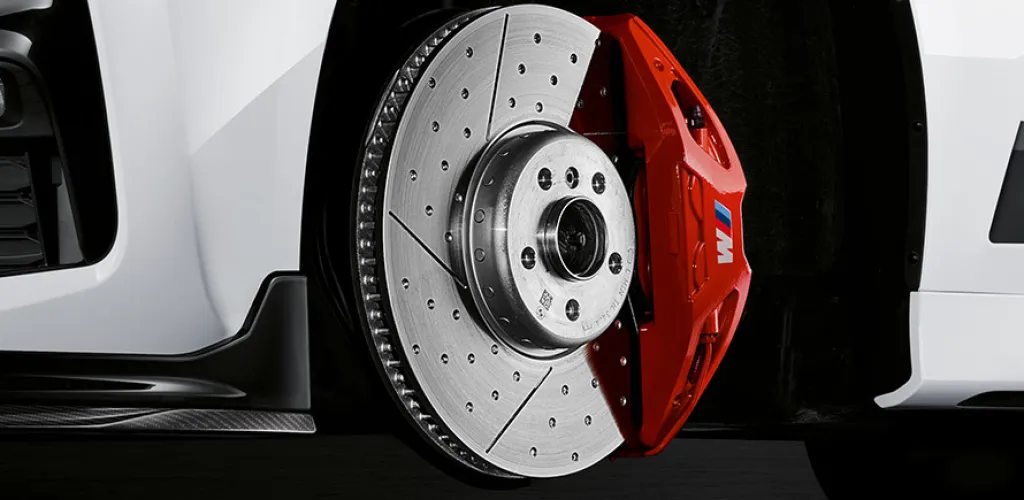
- Grooved discs evacuate gases and dust, self-clean, and improve cooling.
- Drilled discs offer superior heat dissipation, weight reduction, and ventilation.
- Normal driving discs reach ~200°C; track temps can reach 500–550°C.
- Indicators you need a brake disc upgrade: soft pedal, smoke, vibrations, longer stopping distance.
The braking system of a car is one of the most important safety components, and [Brake discs] play a crucial role in this assembly. As vehicle power increases, so do the demands on the [brake system], necessitating larger and more capable discs to handle the intense stresses.
In the world of sports cars and dynamic driving, two types of brake discs stand out for superior performance: grooved and drilled discs. Both variants are designed to manage heat more efficiently during intense braking.
Visual and functional differences between grooved and drilled brake discs
 ](/ecu-tuning)
These features are not just aesthetic - each groove and each hole serve a practical purpose: efficient heat dissipation generated during braking. This functionality becomes vital when discussing performance under extreme conditions.
Grooved brake discs - advantages and applications
The grooves on the surface of grooved discs not only help dissipate heat, but also perform other important functions:
- Gas and dust evacuation: The grooves allow the evacuation of hot gases and metallic dust resulting from pad wear
- Self-cleaning: The grooved surface keeps a cleaner contact surface
- Improved cooling: Airflow through the grooves aids in cooling the disc
Drilled brake discs - when performance is the priority
Drilled discs are preferred in high-performance applications due to:
- Superior heat dissipation: The holes provide an extended surface for heat transfer
- Weight reduction: The drilling reduces the overall mass of the disc, improving braking response
- Improved ventilation: The holes create a fan-like effect during rotation
Extreme temperatures brake discs operate at
 ](/ce-sunt-discurile-de-frana-si-ce-rol-au)

Normal traffic conditions
In everyday use, a standard brake disc can reach temperatures up to 200 degrees Celsius. This temperature may seem high, but any modern disc is designed to safely withstand this heat while maintaining braking efficiency.
Extreme circuit conditions
In track conditions or very sporty driving, disc temperatures can rise dramatically:
- 500-550 degrees Celsius - maximum operating temperature on track
- At these temperatures, standard discs lose efficiency
- Special materials in performance discs withstand these extreme conditions
Signs you need an upgrade to performance brake discs
There are clear indicators that your standard braking system can no longer handle the demands:
- Soft brake feel - when you feel the pads press on butter instead of metal
- Visible smoke during heavy braking
- Vibrations in the brake pedal at high temperatures
- Increased stopping distance after intense use
How to extend brake disc life
To increase the life of the brake discs in normal use, follow these simple rules:

After long-distance driving
- Don’t ride the brakes when the car is stopped
- Let the discs cool naturally
- Avoid hard braking immediately after stopping
Technical explanation
When the metal is heated and an external constant force is applied (as when the pads press), it can deform. This deformation can lead to ovalization of the discs, a problem that requires replacement and manifests as vibrations during braking.
Conclusion
Choosing between grooved and drilled brake discs depends on your driving style and specific requirements. For daily use, grooved discs offer a good balance between performance and durability. For high-performance or track use, drilled discs are the optimal choice, providing superior heat dissipation needed for extreme conditions.
Regardless of the choice, following proper usage practices will significantly extend the life of any brake disc.
Photo source: shop.advanceautoparts.com, bmw.ee