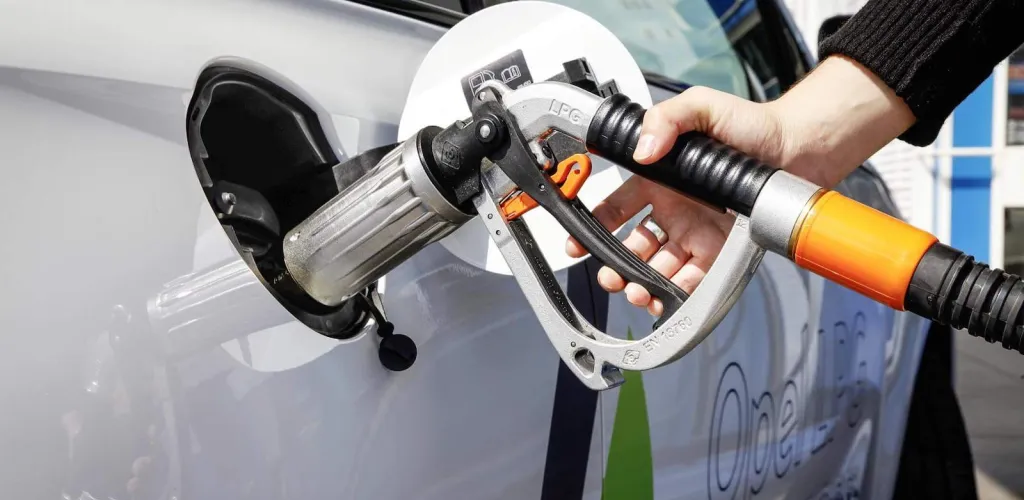
- CNG high octane (120–130) vs LPG (92–105), enabling higher compression.
- Thermal efficiency similar to petrol; clean burn reduces deposits.
- LPG uses 10–15% more volume per energy; CNG energy density lower.
- Fuel costs: CNG 5–7€, LPG 4–6€, petrol 9–12€.
Gas-powered engines, whether powered by compressed natural gas (CNG) or liquefied petroleum gas (LPG), are two popular alternatives to traditional petrol and diesel. CNG uses compressed methane at very high pressures (≈200 bar), while LPG is a propane/butane mix stored as a liquid at moderate pressures (5–15 bar).
Both fuels burn cleaner than petrol or diesel, with lower pollutant emissions and reduced cost per kilometer. However, there are significant differences in efficiency, performance, and practicality of CNG vs. LPG engines, especially in 2025 when European infrastructure and available technologies influence the usability of each option.
Below we compare CNG and LPG engines in detail from the perspectives of energy efficiency, fueling and maintenance costs, infrastructure availability, environmental impact, component reliability, and daily-use advantages/disadvantages.
Energy efficiency and engine performance
CNG and LPG engines operate similarly to petrol engines (spark-ignition), but fuel characteristics influence efficiency and performance.
Octane rating is a key differentiator: CNG has a very high octane rating, about ~120–130, vs LPG at ~92–105. The higher octane of natural gas allows for a higher compression ratio and more controlled combustion. In practice, a CNG-powered engine runs very smoothly, with stability resembling that of an electric motor.
Thermal efficiency of CNG and LPG engines is generally similar to petrol engines, with no major trade-offs. Industry sources confirm that a gas-optimized engine can achieve energy efficiency comparable to gasoline or diesel. Complete combustion and the gaseous nature of these fuels ensure a clean burn, reducing deposits and aiding long-term efficiency.
CNG has a specific energy of ~50 MJ/kg (pure methane) and LPG ~46 MJ/kg (propane/butane mix), but the in-tank energy density differs — natural gas compressed occupies more volume for the same energy, affecting range.

Engine power and throttle response remain close to petrol figures for both fuel types. Older generation installations showed small power losses — around 5–10% — especially for CNG due to lower fill density in cylinders.
However, in modern vehicles these power differences have become negligible, with bi-fuel and modern conversions delivering nearly identical performance to petrol. For LPG, volumetric consumption is slightly higher than petrol — typically around 10–15% — because LPG contains less energy per liter. Nevertheless, dynamic performance (acceleration, top speed) remains practically unchanged.
Fuel costs and maintenance
Fuel cost per kilometer is a primary driver for choosing CNG or LPG. Both offer significant savings compared to standard petrol or diesel. For example, in Europe the average fuel cost per 100 km is roughly ~5–7 € for CNG and ~4–6 € for LPG, compared with 9–12 € on petrol.
This translates to operating costs that are about 30–50% lower than petrol. LPG tends to be slightly cheaper than CNG in many markets due to lower per-liter price and reduced taxes in several countries. For example, in Poland, 100 km with LPG costs ~€4.70, while with CNG ~€5.23, both well below petrol (~€8.63).

Fuel cost savings make investing in LPG installation relatively quick to recover — estimated at around ~25,000 km driven, depending on consumption and local prices.
Installation and specialized maintenance costs
CNG equipment (tanks, valves, lines) must withstand pressures above 200 bar, which makes them more expensive. Experts estimate that a CNG installation is ~30–50% more costly than a comparable LPG installation. Additionally, CNG conversions are less common and require specialized service centers, whereas LPG conversions are widespread — in many markets, post‑sale LPG installation costs roughly €500–€1500 depending on the vehicle and technology used.
Regarding maintenance, both systems require attention, but in different ways. The main advantage of both fuels is clean combustion, which minimizes carbon deposits and oil contamination. As a result, engine oil properties are preserved longer and engine wear can be reduced, with some proponents noting that gas fueling can extend engine life.
LPG engines may require periodic valve-clearance checks more often than petrol engines, particularly older designs without hydraulic lifters. For CNG, maintenance focuses on the safety of the high-pressure gas system and tanks. CNG tanks require periodic inspections (in some countries every 3–5 years) and replacement per the manufacturer’s service life (often ~15–20 years).
Infrastructure availability in 2025
Fueling station availability varies dramatically between LPG and CNG, both in Europe and in Romania.
LPG (autogas) has a mature, extensive network: today it is the most widespread alternative fuel, with over ~48,000 LPG stations in the EU (roughly one out of four stations also offering LPG). In Romania there are nearly ~2,400 authorized LPG stations across the country — practically, you can refuel in most cities and on major routes.
CNG has a much more limited network. In the European Union there were around ~4,200 public CNG stations by the end of 2024 — more than ten times fewer than LPG stations. Distribution is uneven: countries like Italy, Germany, the Czech Republic, Sweden, and Spain have developed comparatively extensive CNG networks, while many other states have limited or no infrastructure.
Situation in Romania
Until recently, CNG availability in Romania was nearly non-existent at pumps. The situation began to change in 2023 with the opening of the first national CNG network, funded by a European co-financed project. Ten new CNG stations were opened along the Arad – Timișoara – Deva – Sibiu – Pitești – Bucharest – Constanța corridor, plus Drobeta and Craiova.
These join the existing pilot station in Râmnicu Vâlcea, bringing the country to 10–11 operational CNG refueling points. Even with this expansion, the infrastructure remains limited to major cities and routes; elsewhere, access to CNG is challenging.
Range and storage capacity
Thanks to higher energy density in the tank, LPG typically offers a higher range than CNG. Toroidal LPG tanks (mounted in place of the spare wheel) usually have a capacity of 40–60 liters, typically providing 400–500 km of range with LPG for a compact car, in addition to the petrol reserve.
CNG, by contrast, stores gas in cylindrical high‑pressure tanks: for passenger cars the typical capacity is around ~15 kg CNG (about 21–25 m³) distributed in one or more cylinders, translating to ranges of ~300–400 km under normal conditions.
Environmental impact
A central argument in favor of CNG and LPG is a reduced ecological footprint compared with conventional fuels. Both CNG and LPG burn cleaner and emit fewer pollutants.
CO₂ and greenhouse gas emissions
CO₂ emissions decrease significantly when using gas instead of petrol or diesel. The chemistry of the fuels results in lower carbon content and more hydrogen in the molecule, producing more water and less CO₂ on combustion.
According to data:
- LPG vehicles emit about ~15% less CO₂ than petrol equivalents
- Natural gas can reduce CO₂ emissions by ~25–30% versus petrol for cars and light commercial vehicles
- Even when compared with modern diesel, a CNG vehicle emits ~10–20% less CO₂
NOx and particulates
NOx and particulates are the areas where gas engines excel. Both CNG and LPG burn with minimal soot or PM emissions. Tests show gas engines emit up to ~95% fewer particulates than traditional fuels, significantly improving urban air quality.
NOx emissions are also substantially reduced with gas engines. A GPL vehicle can reduce NOx emissions by up to ~96% compared with a diesel equivalent.
Reliability and durability of components
The reliability of CNG or LPG engines depends heavily on installation quality and proper maintenance, but overall these systems have proven robust and durable.
Benefits of clean combustion
The primary benefit is clean combustion. Carbon deposits and valve seats are less prone to fouling, and oil remains cleaner for longer since gas does not mix with oil in the same way as petrol during cold starts and does not produce soot like diesel.
This means reduced wear on components, potentially extended oil-change intervals, and better internal engine protection.
Technical challenges and preventive measures
Gas combustion temperatures can be somewhat higher, which stresses exhaust valve seats. In modern engines valves are built from durable materials and hold up well; older engines can experience valve-seat recession if seats are not sufficiently hard.
Ignition and fuel delivery systems may require minor adjustments for reliable operation. Gas often requires a slightly higher ignition voltage — spark plugs should be in excellent condition, and ignition coils must be reliable; otherwise, misfires can occur.
Daily use advantages and disadvantages
LPG advantages
- Infrastructure is widespread: available almost anywhere in Europe and Romania
- Lower costs: the cheapest fossil fuel per kilometer
- Flexibility: excellent combined range (LPG plus petrol)
- Availability: many models and aftermarket conversions
- Maintenance: readily available specialized service centers
LPG disadvantages
- Parking restrictions: prohibited in underground parking due to gas properties
- Storage space: Toroidal tank reduces space for the spare wheel
- Periodic checks: the tank requires ISCIR inspections and replacement after ~10 years
CNG advantages
- The cleanest fossil fuel: most environmentally friendly option
- High safety: gas disperses rapidly in case of a leak
- Superior performance: very high octane, smooth operation
- No parking restrictions: allowed in underground parking
CNG disadvantages
- Limited infrastructure: very few stations, especially in Romania
- High initial costs: installation and equipment are expensive
- Lower range: fewer kilometers per tank compared to LPG
- Space and weight: tanks occupy significant space and add weight
- Specialized service: harder to find and more expensive
CNG vs LPG: quick comparison
| Aspect | CNG (Compressed Natural Gas) | LPG (Liquefied Petroleum Gas) |
|---|---|---|
| Composition and storage | Methane compressed at ~200 bar | Propane/butane liquefied at ~5–15 bar |
| Octane rating | ~120–130 (very high) | ~92–100 (high, similar to premium petrol) |
| Fuel cost | ~5–7 € per 100 km | ~4–6 € per 100 km (cheapest) |
| Installation cost | ~30–50% higher than LPG | ~1000€ aftermarket, affordable |
| Fuel stations | ~4,200 in EU, 10–11 in Romania | ~48,000 in EU, ~2,400 in Romania |
| Typical range | ~300–400 km on CNG | ~400–500 km on LPG |
| CO₂ emissions | ~25% lower vs petrol | ~15% lower vs petrol |
| Safety | Gas lighter than air, disperses | Gas heavier, prohibited in underground parking |
| Model availability | Few models available | Many models and aftermarket conversions |
Conclusion for 2025
In the 2025 context, LPG remains the most practical option for the majority of Romanian drivers due to its extensive infrastructure, lower costs, and flexibility. It is ideal for high-mileage users who want immediate fuel savings.
CNG represents the most ecological alternative for transport, well-suited for urban fleets, public transport, or users with fixed routes who have access to CNG stations. It is recommended for those who prioritize environmental impact and can plan routes around available infrastructure.
Both systems offer a driving experience similar to petrol, with reduced operating costs and meaningful environmental benefits, making them viable options on the path toward more sustainable transport.