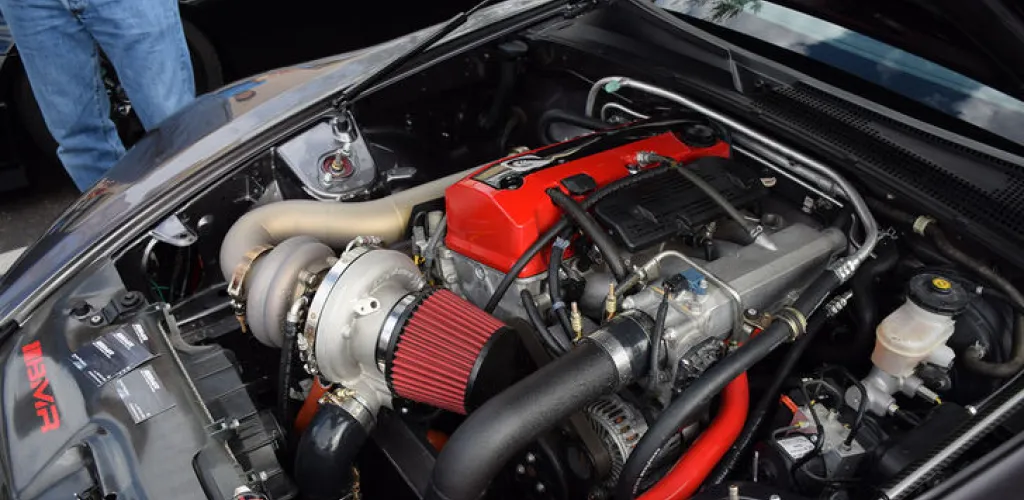
- Turbocharger uses exhaust energy to compress intake air and boost power
- First passenger-car turbo in 1962; BMW 2002 popularized turbo use in 1973
- Modern turbos dominate; few naturally aspirated engines remain
- Two main types exist: fixed-geometry and variable-geometry turbos; wastegate controls boost
The car turbocharger, also called a turbo, is one of the most important innovations in the automotive industry. This forced-induction system has revolutionized internal combustion engines, delivering a perfect balance of increased power and fuel efficiency.
In the current context of increasingly strict emission standards and downsizing trends, understanding how the turbo works and how to maintain it becomes essential for any driver. From the first implementations in the 1960s to modern engines, the turbo has evolved continuously to become an indispensable component.
Historical evolution of car turbochargers
Turbocharging by exhaust gases was first proposed in 1905 by Swiss engineer Alfred Büchi, and his invention laid the foundation for the future of internal combustion engines.
In commercial industry, it gained traction starting in the 1920s, achieving around 40% power gain. Initially, turbos were implemented on large engines—marine diesel, locomotives, and later aircraft engines.
Early implementations on passenger cars
The turbocharger was first developed on passenger cars starting in 1962 by General Motors for Chevrolet and Oldsmobile Jetfire models. These models were withdrawn from production a year later due to reliability issues.
In 1973, BMW introduced the first mass-produced car equipped with a turbocharger—the BMW 2002. Other manufacturers began offering turbocharged gasoline engines.
Because of high fuel consumption and the turbo lag phenomenon, known as the delayed turbine response, turbocharged engines disappeared a few years later, although they were more powerful than naturally aspirated engines.

Renaissance of the turbo in the modern era
Over time, the popularity of the car turbo grew, whether we are talking about turbocharged compression-ignition engines or spark-ignition engines. Currently, turbochargers dominate the automotive industry, so few manufacturers still offer naturally aspirated engines.
What is and how a car turbo works
Car turbocharger, also called a turbo or turbocharger, is a device that uses a portion of the exhaust gases produced by the engine. It is controlled by a wastegate valve through the car’s electronic control unit, depending on needs, thereby protecting the entire engine assembly.
Principles of operation:
- Boosting the engine by exploiting energy from exhaust gases
- Compressing the air entering the engine
- Increasing intake pressure and thus engine power
- Raising the maximum pressure in the combustion chamber
Adaptations required for turbo engines
To operate with a turbine, a turbocharged engine compared to a naturally aspirated engine must be adapted to withstand higher thermal and mechanical demands:

- More stressed engine and higher operating temperatures
- Significantly higher performance with increased maintenance
- More complex system requiring additional care
Turbochargers come in two major groups: fixed-geometry and variable-geometry.
Construction and components of the turbine
Turbocharger consists of a shaft, with the compressor rotor at one end and the turbine rotor at the other end.
The “cold” side – the compressor
These components sit inside a snail-shaped housing, made of aluminum on the compressor side. This is the “cold” side where we have:
- Relatively lower air temperatures
- The cleaner side of the turbocharger
- Responsible for compressing the intake air
The “hot” side – the turbine
On the turbine side, the gas reaches very high temperatures, up to 1000°C. Here we have:
- A more heat-resistant material – cast iron
- The darkest and dirtiest part of the turbine
- Responsible for capturing energy from the exhaust gases
Benefits of implementing a turbo
Environmental and performance benefits
- Lower pollutant emissions – in line with increasingly strict pollution standards
- Increased engine power – more power from smaller displacement
- Faster acceleration – improved throttle response
- Higher engine torque – available at lower revs
- Reduced fuel consumption – improved energy efficiency
- Downsizing – reduction of the total engine displacement
Main causes of turbo failure
The turbocharger, as designed, is expected to operate for the engine’s life without the need for special maintenance. However, turbo failures are usually caused by other technical faults or improper interventions.
Improper interventions
An improper reflash on the car, aimed at increasing power or reducing fuel consumption, can cause:
- Too high boost pressure on the turbine
- Significantly reduced lifespan
- Exceeding factory limits for shaft RPM
- High temperatures and insufficient lubrication
Entry of foreign bodies

Another cause of turbo failure is the entry of foreign bodies into the turbine housing or the compressor. Even small objects can cause:
- Damage to turbine blades
- Imbalance of the rotating assembly
- Irreversible damage to components
On the compressor side, impurities enter through:
- A defective, unsuitable, or clogged air filter
- Neglecting periodic revisions
On the turbine side, impurities can enter from:
- Impurities from the exhaust system
- Damaged gasket materials
Lubrication and oiling problems

Improper oil supply can be caused by:
- Using an inappropriate oil – incorrect specifications
- Oil pump failure – insufficient pressure
- Low oil level – reduced oil pressure
- Contaminated oil – no longer lubricates properly
These problems promote:
- Premature wear of turbocharger components
- Turbo seizure
- Affects the bearing system (axial and radial)
- Increased friction and temperatures
Exhaust system problems
Another possible cause is a clogged exhaust system, due to:
- Clogged diesel particulate filter (or equivalent)
- Clogged catalytic converter
- Increased backpressure in the exhaust system
Symptoms of a defective turbo
Power loss without smoke
One symptom is a loss of power without smoke, seen only in turbochargers with blocked variable geometry. In this case, check:
- The cause of the variable geometry blockage
- The vacuum or electronic actuator
- The turbine control system
Power loss with smoke
In cases of power loss accompanied by smoke, check:
- The intake path
- The intercooler (cracked or split)
- The power hoses (false air leaks)
- The EGR valve (stuck open)
- The turbine housing (overheating)

Causes of power loss with black smoke
- Defective or incorrectly adjusted fuel system
- Worn or dirty injectors
- Fuel pump misadjusted
- Engine wear – rings, valve seats, worn cylinder liners
Blue smoke – sign of advanced wear
If the engine emits a blue smoke (turbo restoration is recommended), main causes can be:
- Intake side problems
- Exhaust system resistance
- Turbine leaks
- Bearing oil flow path clogged
- Dirty compressor rotor
- Worn seal rings
Emergency situation – torn turbo
If you observe a thick white smoke from the exhaust and forced acceleration, the turbo is likely torn:

In this case:
- The turbo shaft breaks
- All oil passes through the turbo and is expelled to the exhaust
- Oil ignition occurs
- The engine keeps running on oil and does not stop
Emergency solutions:
- Block the intake with a cloth – hydraulic lock of the engine
- Shift into the top gear (manual transmission only) – brutal clutch release and braking
Turbo whine – causes and meanings
Any turbocharger that makes noise when accelerating should raise a question, unless there is a BOV (blow-off) valve present.
The BOV valve – normal sound
The BOV is a pressure-relief system present on turbocharged engines to:
- Produce a distinctive sound when shifting gears
- Prevent compressor surge
- Reduce wear on the turbine and the engine
Abnormal turbo whine
If a whine appears suddenly during acceleration:
- Do not ignore this noise
- Especially if it appears abruptly and not progressively
- If the sound turns into a loud whine, the turbine may be nearing the end

Boost leak – pressure losses
Not all whines originate from the turbine. On the intake path we can have:
- Loose or cracked hose (boost leak)
- Air leaks – the engine draws in false air
- Simultaneous power loss
- Easy to verify visually
Proper turbo maintenance
At engine start
When starting the engine, it takes about 4-12 seconds for the oil to be distributed from the engine to the turbo:
- Avoid moving the vehicle immediately
- Wait for the oil film to form
- Avoid abrupt accelerations
- Keep the engine revs low in the first minutes (below 2500-3000 rpm)
The importance of oil temperature
Oil parameters are different when the oil is cold:
- It is more viscous
- It cannot provide optimal lubrication
- It must reach operating temperature
Not all vehicles have oil temperature sensors. Monitor the coolant temperature:
- Reach operating temperature (85-95°C)
- Wait a few extra minutes to allow oil to warm up
- Oil warms up more slowly than coolant
Proper usage
Under normal use, the greatest wear comes from thermal stresses – temperature differences during starting and stopping.
Prevention of wear:
- Avoid sudden acceleration at low revs
- After 2000-2200 rpm you can accelerate fully
- Respect engine warm-up conditions
Cooling after effort
Turbo cooling is very important:
- After long drives
- After spirited driving
- Leave the car idling for at least 5 minutes
- The oil is very hot and helps cooling
Preventing clogging
At light-load driving, the turbo is stressed. City driving fosters turbo clogging:
- Every few weeks take a long drive on open roads
- Keep revs high (4000-6000 rpm, depending on engine)
- At least 20 seconds
- Reduce calamine deposits from inside the turbo
- Unclog the turbo and extend its life
Warranties for turbo repairs
When repairing or replacing the turbo, seek services that offer:
- Qualified personnel in the field
- State-of-the-art equipment for diagnostics
- Extensive turbo experience
- 12-month workmanship warranty with no mileage limit
- Rapid delivery of components
Proper turbo maintenance is the best investment you can make for engine performance and longevity. Following these recommendations, you will enjoy a functioning turbo for the vehicle’s life.