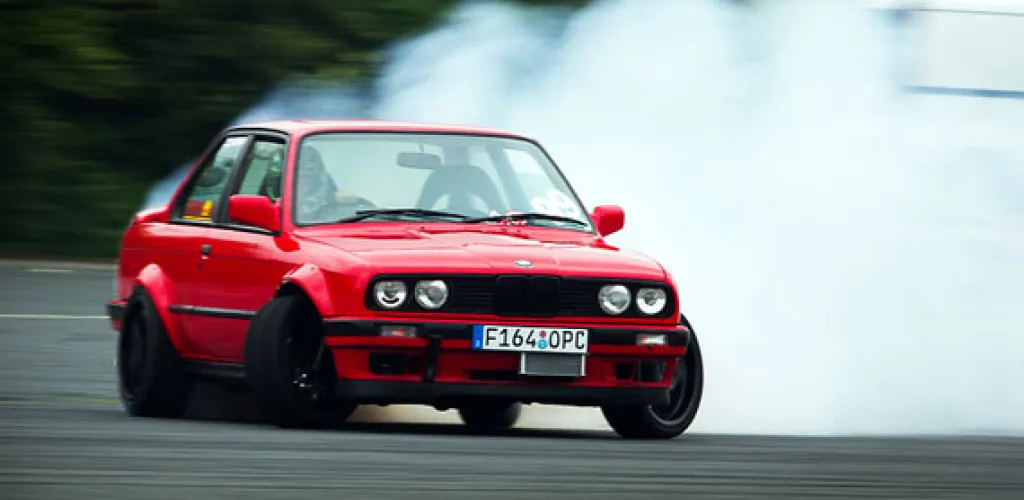
- Drifting should be practiced only in authorized spaces and learned progressively.
- Ideal car features: RWD, LSD, disable ESP/TC, balanced 50/50 weight.
- Popular drift models: BMW 3 Series, Nissan Silvia/240SX, Mazda MX-5, GT86/BRZ.
- Four drifting stages; Stage 1: initial cornering at 40-60 km/h, ~3000 rpm.
Important note: This article does not encourage drifting or street racing. We advise all readers to practice exclusively in spaces specially prepared and authorized for such activities.
Drifting is one of the most spectacular maneuvers in competitive motorsport, a technique that blends precision with total control of the vehicle under extreme grip conditions. For car enthusiasts or those who have recently earned their driving license, drifting can seem like a daunting challenge. The reality is that this technique requires hours of practice, patience, and a fundamental understanding of the physics of the car.
Before attempting any drifting maneuver, it is essential to understand that this technique is learned progressively, step by step. You will not succeed on the first try, and that is completely normal. The goal of this guide is to provide the theoretical and practical basics needed to start this path safely and to avoid mistakes that could damage the vehicle or create dangerous situations.
Choosing the Right Car for Drifting
Essential Technical Characteristics
To perform drifts under optimal control and safety conditions, the car should meet the following criteria:
- Drivetrain type: Rear-wheel drive (RWD) is ideal, while all-wheel drive can work in certain conditions. Front-wheel drive is incompatible with classic drifting.
- Power and torque: An engine with increased displacement and generous torque to allow controlled loss of traction.
- Center of gravity: Low position for increased stability in corners.
- Differential: A high-performance system, preferably with limited-slip (LSD), that should not fully lock the wheels.
- Electronic control: Ability to disable ESP and Traction Control.
- Weight: Balanced distribution between axles, with emphasis on a 50/50 split.
Popular Drift Models
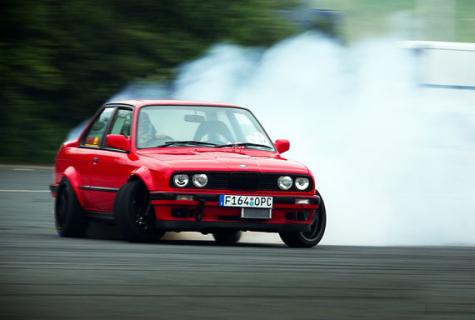
In the drift community, certain models have become iconic due to their ideal characteristics: BMW 3 Series (E36, E46, E90), Nissan Silvia/240SX, Mazda MX-5, Toyota GT86/Subaru BRZ, and Mercedes-Benz W124. These vehicles offer the perfect blend of power, control, and affordability.
The Four Fundamental Stages of Drifting
The drifting process can be divided into four distinct phases, each with its own peculiarities and techniques. Understanding and mastering these stages is crucial for performing maneuvers safely.
1. Initial Cornering — Preparation for the Drift
This is the positioning and preparation phase to induce oversteer. The entry speed into the turn should be between 40-60 km/h, depending on the tightness of the curve. The engine should be around 3000 rpm in second gear, providing sufficient torque to keep the rear wheels turning.

It isn’t the absolute speed that matters most, but the correctness of the execution. The car should steer so that at halfway through the turn it is approximately perpendicular to the circuit axis. If the turn is too flat, you will end the drift prematurely. If it is too tight, the car will start to spin out of control.
Important: The more you practice, the earlier you will initiate the drift and the longer you will be able to hold it.
2. Inducing Oversteer — Breaking Traction
This is the critical phase where you induce loss of traction at the rear wheels. There are several techniques to achieve this:
Power Over (sudden acceleration)
The most direct method for powerful cars. At the apex of the turn, accelerate abruptly to exceed the rear tires’ grip limit. The high torque causes controlled tire slip. Acceleration must be decisive — if it is too gradual, you will lose control.
Clutch Kick (clutch engagement)
This technique involves pressing and releasing the clutch quickly while maintaining throttle. This causes a sharp RPM spike and then a rapid torque transfer to the wheels, breaking traction. It is effective on cars with moderate power.
Shift Lock (lock by shifting gears)
Rapidly shifting to a lower gear at inappropriate RPM will momentarily lock the rear wheels. When you resume acceleration, the high torque from the lower gear will keep the drift. This technique places heavy pressure on the drivetrain.
Braking Drift (braking into the corner)
Accelerate toward the corner, then release the throttle and brake hard as you enter the curve. This creates a weight transfer from the rear to the front, dramatically reducing rear-wheel grip. Then steer and accelerate to maintain the drift.
Handbrake
The most accessible method for beginners. A quick pull on the handbrake during the turn locks the rear wheels instantly. The key is to release the brake at the right moment and accelerate to regain control. Although it is the simplest technique, it offers the least control over the drift angle.
3. Control and Sustaining the Drift — The Most Technical Part
This is the phase where real driving skill shines. Once the car’s rear starts to swing, you have only a few seconds to react. All maneuvers must be performed quickly, without hesitation.
Counter-Steering
As the car enters the drift, turn the steering wheel in the opposite direction to the turn — if you drift to the right, turn the wheel to the left. The amount of counter-steering directly depends on the drift’s intensity — the more the rear spins, the more you counter-steer.
Throttle Management
Keep your foot on the throttle at about 70-80% of capacity. The power transmitted to the rear wheels keeps the drift active. Adjustments are subtle:
- Too much angle at the rear: Ease off the throttle slightly to let the tires regain some grip
- Insufficient rear angle: Apply more throttle to increase the drift angle
- Never brake during the drift: Braking while drifting can lead to loss of control
Reading the Car’s Behavior
Learn to feel through the steering wheel and the seat the car’s exact position. The steering wheel conveys information about the front tires’ grip, while the car’s movement indicates the rear’s behavior. With experience, these adjustments become instinctive.
4. Ending the Drift — Returning to Normal Control
The final phase is often underestimated, but it is as important as the others. A sudden end to the drift can cause an opposite oversteer (pendulum effect), making the car very hard to control.
Controlled Exit Process
Gradually reduce throttle while progressively steering back toward the straight line. The movement should be smooth and gradual. Do not try to straighten the car abruptly — let it return naturally to its normal trajectory as the tires regain grip.
Maneuver Sequencing
- Reduce throttle to about 50%
- Begin turning the wheel toward the central position
- As the car straightens, continue reducing throttle
- When the car is nearly straight, return to normal throttle
- Complete the steering to a full straight
Practice this sequence first slowly, then gradually increase your execution speed as you gain confidence.
Technical Modifications Needed for Drifting
To practice drifting under optimal and safe conditions, the car requires a series of modifications and upgrades. These enhancements are not only about performance but primarily about safety and controllability.
Suspension System
The standard suspension of a production vehicle is not designed for the extreme stresses of drifting. Required modifications include:
Sport Springs and Dampers
Installing shorter and stiffer springs along with adjustable sport dampers reduces weight transfer and improves response in corners. A stiffer suspension provides more direct feedback and allows more precise trajectory adjustments.
Performance Anti-Roll Bars
Thicker anti-roll bars (especially on the rear axle) reduce lateral weight transfer and facilitate inducing the drift. They keep the car flatter in corners and offer more predictable handling.
Suspension Geometry
Adjusting camber, caster, and toe angles is essential. Moderately negative camber on the front improves grip in corners, while increased positive caster provides more natural counter-steer and better steering return.
Steering System
Steering must be precisely adjusted and offer rapid response. Consider:
- Eliminating play: Any play in the steering system should be removed
- Upgraded reinforced components: Stronger tie rods and ball joints
- Lock kit: For larger counter-steer angles (over 45-50 degrees)
Cooling and Lubrication System
Drifting subject the engine to sustained high RPM and extreme heat.
Enhanced Engine Cooling
Installing a higher-capacity radiator or an additional cooling kit is essential. Engine temperature can rise quickly during drift sessions, and overheating can cause engine knock.
Upgraded Oil System
An external oil cooler helps maintain oil temperatures in optimal ranges. Also, using high-performance oil with appropriate viscosity for motorsport is mandatory.
High-Performance Oil Pump
During drift, lateral forces can cause oil accumulation in part of the sump. A stronger pump or modified oil pan ensures constant lubrication.
The Differential — The Heart of the Drifting System
The standard open differential is not suitable for drift. Upgrade options include:
Limited-Slip Differential (LSD)
This is the golden standard for drifting. A clutch-type LSD (Cusco, OS Giken) or a helical type (Quaife, Torsen) distributes power more evenly between the rear wheels, allowing sustained drift and offering superior control.
Welded Differential
A budget option — welding the differential’s gears creates a spool, so both wheels turn at the same speed. Effective for drifting but makes low-speed maneuvering harder and wears tires unevenly.
Drivetrain System
The standard clutch may not endure aggressive drifting techniques for long.
Sport or Ceramic Clutch
A strengthened clutch with a rigid pressure plate and ceramic or puck-style discs provides resistance to high temperatures and faster response. The drawback is a more abrupt on/off feel and reduced daily comfort.
Twin-Disc Clutch
For very powerful engines, a twin-disc system offers higher torque capacity in a compact package.
Tires — The Consumable
Tires are the only contact patch between the car and the asphalt, and correct selection is fundamental.
Types of Tires for Drifting
- Front: High-grip performance tires for steering control in corners
- Rear: More economical or semi-slick tires for drift, as they wear quickly
- Pressure: 2.0-2.2 bar front, 2.5-2.8 bar rear to facilitate breakaway
Tire Width
A narrower rear tire (by 10-20 mm) than the front helps induce the drift and reduces tire wear. On the front, maintain or increase width for maximum grip.
Safety Systems
Do not overlook safety — motorsport can be dangerous.
- Roll cage: Essential for protection in case of an accident
- ** FIA-approved racing seats**: Superior lateral support and protection
- 4-6 point harnesses: Much safer than standard belts
- Fire extinguisher: Mandatory and easily accessible
- Battery kill switch: For rapid battery disconnection in an emergency
Practical Tips for Beginners
Start on Surfaces with Low Traction
Begin practicing on wet asphalt, snow, or fine gravel. Lower speeds and reduced traction allow learning of basic techniques without putting too much strain on the car or risking major damage.
Start with Simple Maneuvers
Before attempting drifts in complete corners, practice:
- Figure-8: Helps understanding the transition between drifts in opposing directions
- Donut: Learn control of angle and throttle in a circle
- Slalom drift: Develops reflexes and quick counter-steering
Understand Your Car and Your Limits
Don’t push the car beyond its physical limits. Listen to engine sounds, feel the chassis behavior, and respect the vehicle’s technical capabilities.
Film Your Sessions
Video analysis of practice sessions will help identify mistakes and understand what to improve. You’ll notice details you don’t feel in real time.
Learn from Professionals
Consider joining specialized courses where you will receive direct feedback and learn correct techniques from the start, avoiding the development of bad habits.
Safety — Priority Number One
Regardless of your experience level or the modifications to your car, safety must always come first.
Authorized Practice Locations
Drifting on public roads is:
- Illegal — can lead to license suspension and substantial fines
- Extremely dangerous — puts your life and others at risk
- Irresponsible — damages the motorsport community image
Practice exclusively in:
- Racing circuits — Many offer drift days with supervision and safety equipment
- Private spaces — Large, empty lots with authorization and no obstacles
- Drift schools — Controlled environments with professional instructors
Protective Equipment
Even in controlled environments, wear:
- Certified helmet: The absolute minimum for any drift session
- Flame-resistant gloves: Protection in case of fire
- Appropriate clothing: Avoid synthetic fabrics that can catch fire easily
Pre-Session Checks
Before every practice session:
- Check motor oil level and condition
- Check tire pressures
- Inspect braking system
- Ensure there are no fluid leaks
- Verify wheel lug nuts are tight
Final Recommendation
For those truly passionate about drift and eager to learn correct techniques in a safe and professional environment, we recommend attending the drift school with Sorin Ene, a respected name in the Romanian motorsport community.
Drifting is a sport that combines technique, control, and passion. With patience, consistent practice, and adherence to safety rules, you will master this art of vehicle control. Remember that every professional drift driver started from zero and spent countless hours refining their technique. Success comes with time, dedication, and respect for the car and the sport.