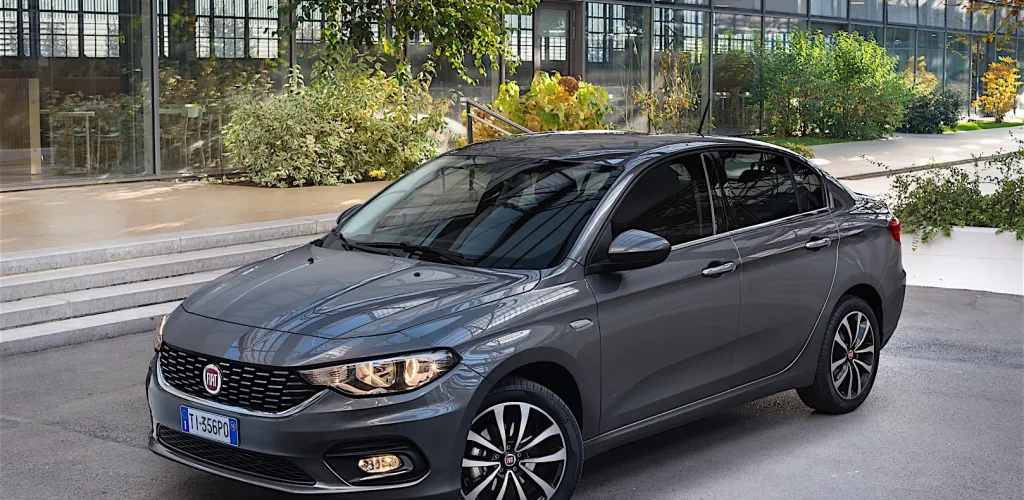
- Fiat Tipo was developed with Tofas, built in Bursa, Turkey for affordability and space.
- Over 500,000 units produced by 2019, known for interior space and equipment.
- Romanian owners praise design, space, and features; some question exterior manufacturing quality.
- Gasoline: 1.4 95hp, 1.4 T-Jet EasyPower 125hp, 1.6 110hp; Diesel: 1.3 95hp, 1.6 120hp.
Fiat Tipo represents the Italian manufacturer’s attempt to return to the C-segment with a balanced proposition between functionality and an affordable price. Developed in partnership with Tofas and assembled in Turkey, this model replaced the old Bravo and Linea, bringing a pragmatic approach to the Fiat range. With over 500,000 units produced by 2019, the Tipo earned its place in the European market thanks to its generous interior space and competitive equipment.
We collected real experiences from Romanian owners to provide a complete perspective on this model—from the strengths that attract buyers to the issues encountered in daily use.
History and development of the model
Development of the Tipo family began in 2014 when Fiat announced the Ægea (Tip 356) project developed in a partnership between Fiat (FCA Italia) and Tofas. The project aimed to create a family of C-segment cars to be sold in Europe, the Middle East and Africa (EMEA).
The production site chosen was the Bursa Turkish plant (owned by Fiat and Tofas), which already had experience producing the old Linea model. The Tipo is built on the Fiat Small Wide LWB platform, a platform optimized for interior space.
Alfredo Altavilla and Olivier Francois stated that the Ægea family was built in line with Fiat’s “Rational” range, alongside Panda, Punto, Fiorino and Doblo — vehicles characterized by functional solutions, low operating costs, and affordable prices.
Market launch
A sedan version was presented at the Istanbul Auto Show in May 2015 and began sales in Turkey in October 2015. In 2016, hatchback and estate variants followed for the European market and the United Kingdom.
The model was designed by Centro Stile Fiat in Mirafiori, Turin and co-developed by Tofas. In December 2015, the car won the 2016 Autobest Best Buy Car of Europe award from the Autobest jury comprising twenty-six European journalists.

What Romanian owners say
We asked Fiat Tipo owners why they chose this model. Here are their responses:
Chiru Sorin: “Superb design, low purchase price, interior space, multiple features, rims, color, steering wheel controls, road-holding, low fuel consumption.”
Epure Bogdan: “Looks, interior space, driving style, engine. It is a great family car, well equipped, with quality materials, very generous interior space and flawless climate control.”
Grigoras Laurentiu: “Because I thought it was an Italian model, good and reliable, but when it comes to manufacturing them for exterior markets outside the country compared to originality, I realized that isn’t the case!”

Available engines
Tipo offers a compact but balanced range of powertrains:
Gasoline engines:
- 1.4 16V FIRE: 95 HP and 127 Nm of torque
- 1.4 16V T-Jet EasyPower: 125 HP and 215 Nm of torque
- 1.6 16V E.torQ: 110 HP and 152 Nm of torque
Diesel engines:
- 1.3 16V MultiJet II: 95 HP and 200 Nm of torque
- 1.6 16V MultiJet II: 120 HP and 320 Nm of torque
Diesel engines benefit from strong low-end torque, ideal for urban driving, while gasoline variants offer livelier responses.
Driving experience
In urban driving
Owners confirm the Tipo handles city driving exceptionally well:
Chiru Sorin: “In the city it’s very easy to maneuver, it weaves through traffic. Parking is easy; I’d recommend it to novice drivers.”
George Cătălin: “In the city it’s fairly easy, especially with the city mode. In city driving, it’s extraordinary.”
Epure Bogdan: “In the city it’s excellent. It has a city mode that allows effortless maneuvers.”
On long highway journeys
On highways and national roads, the Tipo provides a comfortable experience:
Chiru Sorin: “On long trips it holds the road well, it’s at ease away from the city.”
Epure Bogdan: “On long trips very easy. The boot capacity is 520 liters, and there are storage spaces inside. The tall roof is a big plus.”
Suspension behavior
The suspension setup is fairly soft, which provides comfort on smooth roads, but most rivals handle rough surfaces or country roads better.

Common issues identified
Based on owner experiences and technical analysis, the following issues are frequently reported:
1. Particulate filter (DPF)
Diesel engines are equipped with a particulate filter (DPF), which requires special attention:
- Requires frequent highway trips for regeneration
- Regeneration starts only when exhaust gas is hot enough
- Urban driving can clog the filter
- Partial stop during regeneration can contaminate the oil/fuel system
2. Electrical system
Some models exhibit electrical system issues:
- Check all electrical components at purchase
- Well-equipped models feature many systems that can develop faults
- Owners have reported issues with the instrument cluster display
3. Suspension components
Anti-roll bar links are components that wear prematurely:
Chiru Sorin: “The only thing replaced quite early were the anti-roll bar links, but they were replaced under warranty at 40,000 km.”
Epure Bogdan: “Only one stabilizer link I replaced due to the rough roads in Bulgaria.”
4. Interior plastic materials
Interior plastics can mark easily, an aesthetic issue common on higher-mileage models.
Reliability in operation
Owner experiences vary, but most report decent reliability:
Chiru Sorin: “Otherwise there weren’t other issues to attribute to it.”
Epure Bogdan: “No real problems.”
Grigoras Laurentiu had a less favorable experience, with electrical system problems leading to engine stalling.
Recommendations for maintaining reliability:
- Keep up with timely servicing
- For diesel engines, take regular highway trips
- Monitor oil level, especially on diesel models
- Regularly verify electrical systems
Fuel consumption
Tipo offers economical fuel consumption, a trait appreciated by owners. Consumption varies by powertrain and driving style:
- Diesel engines are more economical in urban use
- Gasoline engines provide better performance on mixed routes
- Consumption can be optimized by using the “city” mode in urban traffic
Used car prices (2023)
In the used-car market, Fiat Tipo (2015-2018) prices range from around €7,000 to €10,000, depending on:
- Year of manufacture
- Mileage
- Powertrain
- Trim level
- Overall condition
Concrete examples:
- Fiat Tipo 1.4, 2017, 29,000 km: €8,690
- Fiat Tipo 1.4 turbo 120 HP, 2017, 37,000 km: €10,700
Prices are competitive in the C-segment, offering a good quality-price ratio for a relatively new car.
Buying tips
Owners offer valuable recommendations for those considering a Tipo:
From Chiru Sorin:
“Buy the 1.6 diesel engine, it’s very well thought out. Be careful with how the engine has been maintained; ensure timely service intervals.”
From Epure Bogdan:
“Read the manual and don’t assume you know cars. Pay attention to the trim level. The higher the range, the better the materials.”
Additional recommendations:
- Check service history and maintenance records
- Test all electrical functions
- Inspect interior wear on plastic trim carefully
- For diesel, ask about prior usage (urban vs. extra-urban)
- Check the condition of stabilizer links
- Opt for higher trim levels for better materials
Conclusion
The Fiat Tipo (2015-2018) represents a balanced proposition in the compact segment, with clear strengths: generous interior space, competitive equipment, and an affordable price. The identified issues are generally minor and manageable with proper maintenance.
The car suits families seeking a practical daily-use vehicle with low running costs. Owner experiences confirm that, despite some minor issues, the Tipo delivers a satisfying price-to-utility ratio in its segment.